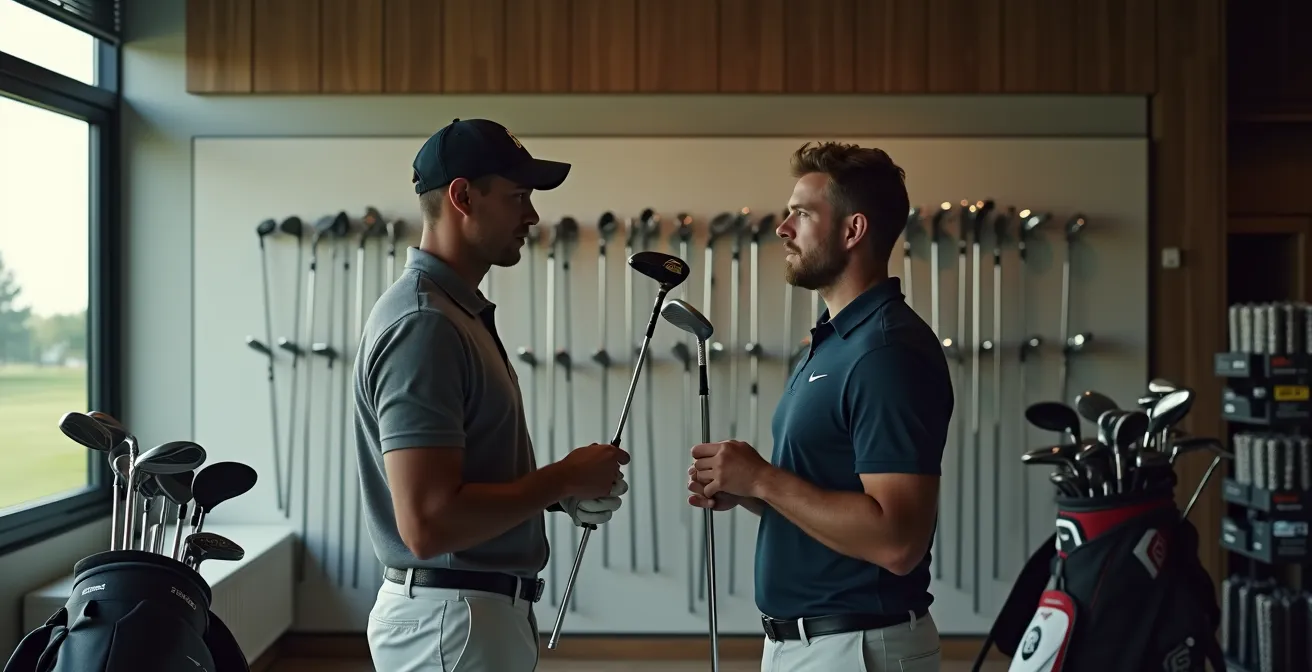
For intermediate golfers, a box set is not a performance dead-end but a strategic asset; the key is to methodically ‘cannibalize’ it to build a premium bag at a fraction of the cost.
- The driver and putter are typically the first clubs to create a “performance ceiling,” limiting your potential more than the irons.
- Upgrading piece by piece, starting with the weakest links, provides the best return on investment for score improvement.
Recommendation: Instead of replacing the whole set, start by identifying the single club in your bag that costs you the most shots per round and plan to replace only that one first.
You’ve done the hard work. You’ve graduated from a complete novice to a genuine golfer. Your swing is more consistent, you’re breaking 100 regularly, and you’re starting to wonder: is this all-in-one package set I bought now holding me back? It’s a common and critical question for any improving player. The standard advice is often black and white: “box sets are for beginners” and “you need to get custom-fitted.” While there’s truth in that, it overlooks a more nuanced, value-oriented strategy.
The reality is that your starter set still holds significant value, just not in the way you might think. The transition to a “player’s bag” doesn’t have to be an expensive, all-at-once leap. In fact, thinking of your package set not as a final product but as a transitional asset is the smartest approach. The real key to unlocking your potential isn’t just about getting better clubs; it’s about understanding which parts of your current set are failing you first and how to replace them intelligently.
This guide will move beyond the generic advice. We will deconstruct the typical package set to identify its true weak points and its hidden strengths. We’ll explore a methodical upgrade path—a concept of “strategic cannibalization”—that allows you to build a high-performance, personalized bag over time without decimating your bank account. It’s time to stop wondering if your clubs are good enough and start building a smarter bag, one piece at a time.
This article provides a comprehensive framework to help you decide. We’ll analyze the performance limitations of typical sets, the financial implications of upgrading, and how to build a superior bag on a budget.
Summary: Box Sets vs Individual Clubs: Are Package Sets Good Enough for Intermediate Play?
- Driver vs Putter: Which Club Is usually the Weak Link in a Package Set?
- Do Package Sets Hold Any Value When You Are Ready to Upgrade?
- Weekend Warrior or Aspiring Pro: Who Should Stick with a Box Set?
- The Bag Itself: Is the Carry Bag in the Set Durable Enough for Walking?
- Gapping Issues: Do Package Sets Leave Huge Distance Holes in Your Bag?
- Second-Hand Gold: How to Find Premium Clubs for a Budget Price?
- Bringing Your Bag vs Renting: When Is It Worth Hauling Clubs on a Plane?
- Iron Set Gapping: How to Eliminate Distance Overlap Between Clubs?
Driver vs Putter: Which Club Is usually the Weak Link in a Package Set?
For the rapidly improving golfer, the first component of a package set to reveal its limitations is almost universally the driver. While the irons in most modern sets are surprisingly forgiving and playable, the driver is where budget constraints in design and materials become most apparent. The goal of a box set driver is to be easy to hit for a slow-swinging beginner, which often means a lightweight shaft and a clubface designed to maximize launch and fight a slice at all costs. As your swing speed and consistency improve, these “features” become bugs.
An intermediate player generates more clubhead speed, which can overwhelm the soft, high-torque shafts common in box sets, leading to inconsistent face control and a wide shot dispersion. Furthermore, the clubheads themselves are often engineered for maximum spin to help beginners keep the ball in the air. For a better player, this translates into a “ballooning” ball flight that sacrifices significant distance, especially into the wind. Research confirms this; a Golf Digest analysis using robot testing found that compared to premium models, shots struck with box-set clubs launched higher and spun more, a combination that kills distance for players who can already generate adequate launch on their own.
The putter is the second-most-common weak link, but for a different reason: feel. Box set putters are typically basic blade or mallet designs with simple inserts. They get the job done, but they lack the refined weighting, balance, and face technology of premium putters that provide superior feedback and distance control. While a poor driver costs you one shot per hole, poor distance control on the green can easily add 2-3 putts to your score. Upgrading these two clubs alone can have a dramatic impact on your scorecard.
Do Package Sets Hold Any Value When You Are Ready to Upgrade?
Absolutely, but you must shift your mindset from “resale value” to “transitional value.” The biggest mistake improving golfers make is assuming their package set is a sunk cost that needs to be replaced entirely. Instead, view it as a foundation for a “strategic cannibalization” process. You don’t throw the set away; you systematically dismantle it, replacing the weakest links over time while retaining the components that still perform adequately. This approach allows you to build a premium bag at a fraction of the cost of buying a full new set.
The irons and wedges, for example, are often perfectly serviceable for a 15-handicap player. The bag itself might be durable enough. By keeping these components, you can allocate your budget towards high-impact upgrades like a modern driver or a high-end putter. This phased upgrade path is not only financially prudent but also strategically sound. It allows you to adapt your bag to your evolving game without the overwhelming expense and commitment of a full custom fitting before you’re ready.
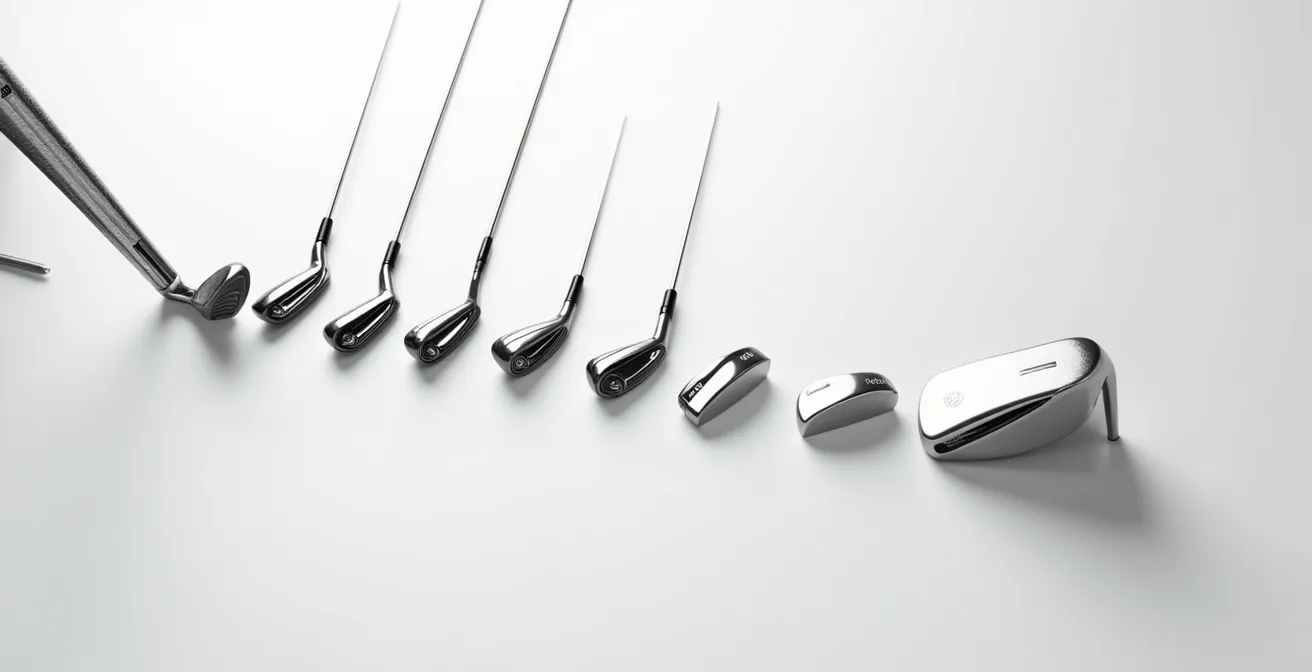
The financial logic is compelling. While a package set has low resale value in absolute terms, its value is realized by reducing the upfront cost of your next set. By keeping 5-7 of the original clubs, you are effectively “saving” the hundreds of dollars it would cost to buy their premium equivalents. This table illustrates the net cost difference over two years between starting fresh and strategically upgrading from a box set.
This table compares the long-term cost of owning a box set versus a custom set, factoring in their expected resale value after two years of use.
| Factor | Box Set | Custom Set |
|---|---|---|
| Initial Purchase Price | $400-$1,400 | $2,000-$4,000 |
| Expected Resale Value (2 years) | 25-30% of original | 50-60% of original |
| Net Cost After Resale | $280-$980 | $800-$1,600 |
| Cost Per Year of Use | $140-$490 | $400-$800 |
Weekend Warrior or Aspiring Pro: Who Should Stick with a Box Set?
The decision to stick with a package set or upgrade is less about your current score and more about your goals and commitment level. Not every intermediate golfer needs a fully custom-fitted bag. Defining your player profile is the most honest way to determine the right equipment path for you. For many, a complete package set remains the ideal solution for its simplicity and value.
According to experts at Callaway, golfers with aspirations of reaching a low handicap will eventually hit a performance ceiling with the technology in a box set. For these players, who practice diligently and are aiming to shoot in the 70s, moving to individually selected or fitted clubs is a necessary step to fine-tune their ball flight and gain precision. However, for a huge segment of the golfing population, this ceiling is irrelevant.
Consider these profiles to see where you fit:
- The Social Golfer (plays less than once a month): If golf is primarily a social outing and you’re not focused on competitive scoring, a box set is perfect. It offers great value and eliminates the stress of equipment decisions.
- The Score-Driven Improver (15+ handicap): If you’re consistently taking lessons and working on fundamentals, your box set is likely still suitable. Your biggest gains will come from technique, not technology.
- The Casual Competitor (12-18 handicap): This is the gray area. You’re competitive but may not have the time to practice constantly. For you, the “strategic cannibalization” approach is ideal. Start by upgrading your driver and putter, but keep the rest of the set.
- The Aspiring Pro (targeting sub-10 handicap): You’ve outgrown the set. The lack of gapping precision and driver performance is actively costing you strokes. Custom fitting is no longer a luxury; it’s essential for progress.
Ultimately, be honest about how much time you dedicate to the game versus how much you spend. For the weekend warrior who plays a couple of times a month and enjoys the game, a box set, perhaps with a new driver, is often more than enough club.
The Bag Itself: Is the Carry Bag in the Set Durable Enough for Walking?
One of the most overlooked components of a package set is the bag itself. Manufacturers know that beginners often use carts, so the included stand or carry bag is a primary area for cost-cutting. While it may look the part on the showroom floor, its durability often falls short for the golfer who prefers to walk the course. For an intermediate player who walks 18 holes regularly, a flimsy bag isn’t just an inconvenience; it’s an eventual and unplanned expense.
The common failure points are predictable: cheap, unbranded zippers that snag and break; weak stitching at the strap anchor points that frays under load; and flimsy stand mechanisms that bend or fail to deploy properly. The fabric itself is often a low-denier nylon that is prone to tearing and offers little water resistance. After a season or two of regular use, finding a replacement becomes a necessity, adding an unexpected replacement cost of $150-$250 to your total investment. This erodes the initial value proposition of the set.
Before you decide to keep the bag from your set for long-term use, it’s crucial to perform a quality inspection. A well-made bag can last for years, while a poorly made one will fail quickly, becoming a source of frustration on the course. Use this checklist to objectively assess the quality of your current bag or any potential replacement.
Your Action Plan: Bag Quality Inspection for Walking Golfers
- Check Zipper Quality: Look for trusted brands like YKK on the zipper pulls. Test all zippers; they should operate smoothly without catching. Generic zippers are a major red flag for poor quality.
- Test Strap Stitching: Firmly pull on the shoulder straps where they connect to the bag. Look for reinforced, X-pattern stitching at these high-stress points. Single, straight-line stitching is a sign of weakness.
- Evaluate Stand Mechanism: Deploy the stand legs 10-15 times. They should snap out and retract smoothly. Place the bag on slightly uneven ground to check for stability. A wobbly stand is a common failure point.
- Assess Fabric Durability: Check the tag or product description for the fabric denier rating. For a bag used regularly for walking, a minimum of 420D (Denier) nylon is recommended for decent durability.
- Confirm Comfort Features: If you walk 18 holes, check the padding thickness on the dual straps and look for breathable mesh on the back panel. Accessible water bottle pockets are also crucial for a comfortable round.
Gapping Issues: Do Package Sets Leave Huge Distance Holes in Your Bag?
Yes, and this is arguably the biggest performance flaw for an intermediate player. Gapping refers to having consistent, predictable distance increments between each club in your bag. Beginners don’t have the consistency to notice a 15-yard gap, but for an intermediate player, it’s a “black hole” that forces awkward half-swings. Package sets are notorious for creating two major gaps that can wreak havoc on your scoring.
The first major void often appears at the top of the bag, between the longest iron (typically a 5-iron) and the shortest fairway wood. This can leave a massive 30-40 yard gap, making shots in the 170-200 yard range incredibly difficult. You’re left choosing between an over-swung iron or a choked-down wood, neither of which is a high-percentage shot.
The second, and perhaps more critical, gap occurs in the scoring zone. Most box sets include only a Pitching Wedge (PW) and a Sand Wedge (SW). A typical PW might have 45 degrees of loft, while the SW has 56 degrees. This 11-degree difference creates a 20-25 yard gap, often right around the crucial 100-yard mark. According to a guide from Callaway on club set composition, this is a significant flaw, as having the right tool for full shots inside 120 yards is key to lowering your score. You need a club for that 100-yard shot, not a 3/4-swing PW.
Fortunately, these gaps are the easiest and most affordable problems to fix. Since most package sets only include 10-11 clubs, you have room to add 3-4 more under the 14-club rule. Here are some budget-friendly strategies to fill those holes:
- Fill the Wedge Gap: The highest priority is adding a Gap Wedge (often labeled ‘A’ or ‘G’, with 50-52 degrees of loft). A quality used gap wedge can be found for under $50 and will immediately give you a reliable 100-yard club.
- Bridge the Iron-to-Wood Gap: Look for a used 7-wood or a high-lofted hybrid (e.g., a 4 or 5 hybrid). These clubs are far easier to hit than long irons and can be acquired for $75-$100.
- Learn “Knock-Down” Shots: Practice hitting 3/4 shots with your existing clubs to create “virtual” yardages between your full swings.
Second-Hand Gold: How to Find Premium Clubs for a Budget Price?
This is the heart of the strategic upgrade. Once you’ve identified a club to replace, the used market is your best friend. You can build an entire bag of 3-to-5-year-old premium clubs for a price comparable to a new, mid-tier package set. These clubs will offer significantly better performance, feel, and technology. Brands like TaylorMade, Callaway, PING, and Titleist hold their value well but become affordable after a few product cycles.
The key is to buy smart. Reputable online retailers like Callaway Pre-Owned, 2nd Swing, or GlobalGolf offer certified used clubs with condition guarantees. Marketplaces like eBay can offer great deals, but require more diligence to avoid counterfeits and misrepresented items. Before buying online, always follow a quality check protocol:
- Verify Serial Numbers: Most major manufacturers have online tools to authenticate a club’s serial number. This is the best way to avoid fakes.
- Request High-Resolution Photos: Ask the seller for clear pictures of the clubface (to check groove wear), the sole (to see wear patterns), and the shaft graphics (to confirm the model).
- Use a Pricing Guide: Use the PGA Value Guide to check the fair market price for a specific model and condition. This prevents you from overpaying.
- Check for Consistency: On premium brands, look for sharp, consistent font spacing and alignment on all markings. Sloppy logos or lettering are a huge red flag for counterfeits.
To illustrate the value, consider this sample bag of highly-regarded, second-hand premium clubs. The total cost is often less than a top-of-the-line new package set, but the performance is in a completely different league.
This table provides a sample build of a full set using premium used clubs, demonstrating how affordable a high-quality bag can be.
| Club Type | Used Premium Option (3-5 years old) | Estimated Cost |
|---|---|---|
| Driver | TaylorMade SIM or Callaway Epic Flash | $150-200 |
| Fairway Wood | PING G410 3-wood | $80-100 |
| Hybrid | Titleist 818H | $60-80 |
| Irons (5-PW) | Mizuno JPX 919 or TaylorMade P790 | $350-400 |
| Wedges (52, 56) | Cleveland RTX4 or Vokey SM7 | $80-100 |
| Putter | Odyssey O-Works or Scotty Cameron Select | $100-150 |
| Total | Premium Brand Full Set | $820-1,030 |
Bringing Your Bag vs Renting: When Is It Worth Hauling Clubs on a Plane?
For the traveling golfer, the box set finds a new and incredibly valuable purpose: the perfect, low-stress travel set. Hauling a $3,000 custom-fitted bag through an airport is a nerve-wracking experience. The risk of damage by baggage handlers or, even worse, the entire bag getting lost, is a major source of stress that can sour a golf vacation. This is where a package set shines, even for an advanced player.
Using your original box set (or buying a cheap used one) for travel completely changes the financial and emotional equation. As noted in guides for new players, a key benefit of complete sets is the simplicity and streamlined cost. This logic applies perfectly to travel. Losing or damaging a $400 set is an annoyance; losing a custom-built set is a financial and logistical disaster. The peace of mind that comes from traveling with a replaceable set is invaluable.
The decision to bring clubs versus renting them at your destination comes down to a simple break-even analysis. Airline baggage fees for golf bags can range from $50 to $150 each way, and a decent travel bag costs at least $100. Rental sets at quality courses can run from $60 to $100 per round. If you play multiple rounds on your trip or travel for golf more than twice a year, bringing your own clubs—especially a low-risk box set—quickly becomes the more economical choice. For infrequent travelers, renting remains the best option.
This matrix breaks down the key factors to help you decide whether to bring your clubs or rent at your destination for your next golf trip.
| Factor | Bring Box Set | Bring Premium Set | Rent at Destination |
|---|---|---|---|
| Airline Baggage Fee | $50-150 each way | $50-150 each way | $0 |
| Travel Bag Investment | $100-200 (basic) | $200-400 (premium protection) | $0 |
| Damage/Loss Risk Stress | Low (replaceable) | High (expensive) | None |
| Performance Consistency | Good | Excellent | Variable |
| Break-even Point | 3-4 trips/year | 5+ trips/year | Best for 1-2 trips/year |
Key takeaways
- A box set is a transitional asset, not a dead end. Plan to “cannibalize” it by upgrading key clubs rather than replacing the whole set.
- The driver and putter are the first clubs that will limit an intermediate player’s performance. Prioritize upgrading these for the biggest impact on your score.
- Gapping is a major flaw in box sets. Adding a single gap wedge (50-52°) to fill the 100-yard void is a cheap and highly effective first step.
Iron Set Gapping: How to Eliminate Distance Overlap Between Clubs?
Even if you decide to stick with the irons from your package set, you can still make a significant, low-cost improvement by addressing their gapping. Manufacturers often produce irons with inconsistent loft increments to help beginners get the ball in the air. This can lead to two irons that fly nearly the same distance or a large, unexpected gap between two consecutive clubs. For an intermediate player who has developed a consistent swing, this is a major source of frustration.
The ideal separation between irons is a consistent 4-degree loft increment, which typically produces a 10-15 yard distance gap. A professional guide on club basics highlights that maintaining this 4-degree increment is the foundation of proper distance gapping. However, in many package sets, you might find a pitching wedge at 45° and a 9-iron at 41°, but then a large jump to a sand wedge at 56°. This creates overlap at the bottom and a huge gap at the top of your wedges.
The solution is a professional loft and lie adjustment. This is a simple and affordable service offered by any reputable golf shop or club repair professional. For about $5-$10 per club, a technician can use a specialized machine to measure the current lofts of your irons and bend them to create consistent 4-degree gaps throughout the set. A full iron set adjustment can often be done for under $100 and will transform your existing irons into a far more precise and predictable set.
The process is straightforward:
- Take your current iron set to a certified club repair shop.
- Ask them to measure the existing lofts and lies on a machine.
- Work with the technician to identify overlaps or large gaps.
- Request adjustments to create even 4-degree loft gaps between clubs (e.g., 45°, 49°, 53°, 57°).
- Re-test your distances on a range or simulator to confirm your new, predictable yardages.
This one-time adjustment is the single most cost-effective way to extract maximum performance from the irons you already own, making them perfectly suitable for intermediate play.
Ultimately, your golf bag should be a reflection of your game and your goals. By viewing your package set as a starting point for a strategic, value-first upgrade path, you can build a set of clubs that enhances your performance without requiring a massive financial outlay. The next logical step is to analyze your own game: identify the one club that causes the most trouble and begin your journey to building a better bag today.