
Forgiving irons don’t fix a bad swing, they manage its consequences—and that’s not necessarily a bad thing.
- Game improvement technology is designed to minimize the penalty of off-center strikes, preserving ball speed and reducing slice, not to correct the underlying swing flaw.
- The core decision for an improving golfer is a trade-off: choosing the raw feedback from players’ irons needed for long-term improvement versus the forgiveness from game improvement irons needed to enjoy the game today.
Recommendation: The best set for you is one that matches your current skill, your improvement goals, and ultimately, what makes the game most enjoyable for you right now.
For any golfer looking to improve, the debate between “game improvement” irons and “players'” irons is a significant crossroad. The marketing promises are alluring: clubs designed with advanced technology to help you hit straighter, longer shots, even when your swing isn’t perfect. This naturally leads to the fundamental question: are these forgiving clubs a genuine tool for improvement, or are they a crutch that simply papers over the cracks in your technique?
The common advice often falls into two camps. Purists argue that true improvement only comes from the harsh, unfiltered feedback of a blade-style iron, which immediately punishes a poor strike. On the other side, proponents of game improvement (GI) technology champion the confidence and enjoyment these clubs bring, suggesting they make a difficult game more playable. They point to features like perimeter weighting, wide soles, and offset as solutions to the average golfer’s most common problems.
But what if the key isn’t choosing between “good” or “bad” technology, but understanding its true purpose? This article adopts an honest, consumer-focused perspective. We will move beyond the marketing hype to explore the central trade-off: feedback versus forgiveness. Forgiving irons don’t magically fix a bad swing; they are sophisticated tools for consequence management. They are designed to make your misses more manageable, keeping you in play and boosting your on-course enjoyment.
Throughout this guide, we will dissect how each element of a GI iron works, from the cavity back to the wide sole. We will analyze the real-world impact on your game, the psychological effect at address, the financial implications of your purchase, and ultimately, how to make the most informed decision for your personal golf journey. It’s time to determine whether you need a tool that diagnoses your flaws or one that manages them while you play.
To help you navigate this complex decision, this guide breaks down every critical aspect of forgiving irons, from the underlying technology to the long-term value and fitting considerations.
Summary: Your Guide to Understanding Forgiving Irons
- How Cavity Back Irons Keep Your Ball Straight on Toe Hits?
- Why Does the Offset on Game Improvement Irons Help Reduce Your Slice?
- Wide Sole vs Narrow Sole: Which One prevents Digging in Soft Turf?
- Thick Topline Anxiety: Getting Used to the Look of Chunky Irons?
- Do Game Improvement Clubs Hold Their Value Better Than Blades?
- Combo Sets: When Should You Mix Cavity Backs with Muscle Backs?
- Oversized Heads: How Maximum Forgiveness Technology Helps New Players?
- Is Custom Fitting Worth the Money for a Mid-Handicap Golfer?
How Cavity Back Irons Keep Your Ball Straight on Toe Hits?
The core principle behind a cavity back iron is Moment of Inertia (MOI), a term that simply measures an object’s resistance to twisting. In a traditional blade iron, the mass is concentrated directly behind the center of the face. If you strike the ball on the toe, the clubhead twists open significantly, causing a dramatic loss of ball speed and a shot that veers weakly to the right (for a right-handed golfer). A cavity back design fundamentally alters this equation by scooping out mass from the center and redistributing it to the heel and toe—the perimeter of the club.
This perimeter weighting makes the clubhead far more stable on off-center hits. When you strike the ball on the toe, the extra weight on the toe counteracts the twisting force. The face stays squarer to the target line through impact, preserving a significant amount of ball speed. The result isn’t a perfect shot, but it’s a far more playable one. In essence, the technology raises your “performance floor” by making your bad shots better. For instance, some modern designs demonstrate how even a small redistribution of weight, such as moving 15 grams of weight to the perimeter, can dramatically reduce ball-speed loss on mishits.
Launch Monitor Data: Cavity Back vs. Blade on Toe Strikes
Independent testing provides clear evidence of this effect. During a controlled test comparing game improvement irons against blades with identical toe strikes, the results were stark. Blades consistently lost 10-15 yards of carry distance on these off-center hits. In contrast, the cavity back irons maintained their carry distance to within 5 yards of a center strike, winning 13 out of 21 head-to-head distance comparisons. This quantifies how forgiveness technology doesn’t “fix” the mishit but effectively manages its negative consequences.
This stability is the primary reason why cavity backs are recommended for golfers who don’t consistently find the center of the face. It provides a safety net that keeps the ball in play, reduces frustration, and can ultimately lead to lower scores and a more enjoyable round of golf.
Why Does the Offset on Game Improvement Irons Help Reduce Your Slice?
Offset is a design feature where the leading edge of the clubface is set back from the hosel. While it may look slightly unusual to the untrained eye, it’s one of the most effective anti-slice technologies built into game improvement irons. A slice is most often caused by the clubface being open to the swing path at impact. Offset helps combat this in three distinct ways: dynamically, mechanically, and psychologically.
Dynamically, the offset provides the golfer with a fraction of a second more time during the downswing to rotate their hands and square the clubface. For a player who struggles with a slice, this tiny bit of extra time can be the difference between an open face and a square one at impact. Mechanically, this design also shifts the club’s center of gravity further back and away from the shaft, which helps promote a draw bias and makes it easier to close the face through impact.
Game improvement irons I think they should be called ‘Hide My Bad Game Clubs’ – A golf club is not going to improve your golf game.
– GolfWRX Forum Member, GolfWRX Forgiving Irons Discussion
This quote from a forum user highlights the purist’s view: that offset doesn’t teach you to square the face, it just does it for you. This perfectly captures the “consequence management” aspect. It treats the symptom (an open face) rather than the cause (the swing flaw leading to it). Psychologically, the visual cue of an offset club at address can encourage a more hands-forward setup, another key fundamental for solid ball-striking.
The table below breaks down how these elements work together to reduce that dreaded slice and produce a straighter, more playable ball flight. It’s a clear example of technology stepping in to mitigate a common swing fault.
| Feature | Dynamic Effect | Result on Ball Flight |
|---|---|---|
| Offset Design | Gives hands extra fraction of second to square clubface | Reduces face angle at impact by 2-3 degrees |
| High Toe Weight Reduction | Makes club easier to square through impact | Decreases slice spin by up to 400 rpm |
| Visual Cue at Address | Encourages hands-forward setup position | Promotes draw bias alignment |
Wide Sole vs Narrow Sole: Which One prevents Digging in Soft Turf?
Turf interaction is a critical, yet often overlooked, aspect of iron performance. The width of the sole—the bottom part of the clubhead—plays a massive role in how the club behaves as it strikes the ground. A wide sole, characteristic of game improvement irons, acts much like the hull of a boat. It’s designed to glide or “bounce” off the turf, preventing the leading edge from digging into the ground, especially on “fat” or heavy shots.
This is particularly beneficial for players with a steep angle of attack, often called “diggers,” who tend to take deep divots. On soft turf, a narrow-soled players’ iron can dig in like a knife, leading to a huge loss of energy and a shot that comes up well short. The wide sole provides a margin for error, allowing the club to skim through the turf even if the low point of the swing is slightly behind the ball. For example, testing of specific designs shows that a V-shaped sole can reduce digging by 30% in soft conditions, ensuring more consistent contact and distance.

As the illustration shows, the wider surface area distributes the impact force over a larger patch of ground, promoting a gliding motion. Conversely, the narrow sole of a players’ iron is designed for precision. It allows skilled golfers, often “sweepers” with a shallower angle of attack, to cleanly clip the ball off the turf with minimal ground contact, enabling greater shot-shaping ability. However, this design offers zero forgiveness for a heavy strike.
Advanced Sole Technology: The Best of Both Worlds?
Modern engineering seeks to bridge this gap. Srixon’s Tour V.T. sole, for instance, uses a combination of wide and narrow sections along with strategic bounce angles. This hybrid geometry allows steep “diggers” to get the benefit of bounce to prevent digging, while shallow “sweepers” can still achieve clean contact without the sole catching the turf. It’s a testament to how technology is evolving beyond a simple wide-or-narrow choice.
Thick Topline Anxiety: Getting Used to the Look of Chunky Irons?
While the performance benefits of forgiving irons are clear, one of the biggest hurdles for an improving golfer can be purely aesthetic: the look of the club at address. Game improvement irons typically feature a thick topline—the top edge of the clubhead visible when you look down. For a player accustomed to or aspiring to use sleeker players’ irons, this “chunky” appearance can be visually jarring and even erode confidence.
This “topline anxiety” is a real phenomenon. A thick topline can make the club look clumsy or bulky, especially in the shorter scoring irons where precision and delicacy are paramount. It can feel less like a surgical instrument and more like a blunt object. Many golfers feel that a thinner topline inspires confidence and promotes a feeling of workability and control. This sentiment is often echoed by players making the transition.
I still cannot get used to the size of the heads in the short irons in more forgiving clubs which is why I went to the mizzies in the first instance.
– Forum User with Mizuno JPX 900 Tours, Golf Monthly Forum Discussion
However, manufacturers are acutely aware of this psychological barrier and employ sophisticated design tricks to mitigate it. The thick topline is a necessary consequence of creating a hollow or deep cavity design that pushes mass to the perimeter for forgiveness. To counter the bulky look, engineers use visual illusions. Polished chamfers, beveled edges, and specific paint finishes can make a topline appear significantly thinner than it actually is. For example, PING’s Hydropearl 2.0 chrome finish is designed to reduce glare and create a visual effect that can make the topline seem more compact.
Ultimately, getting used to the look is a personal journey. For some, the performance benefits quickly outweigh any initial aesthetic concerns. For others, confidence at address is non-negotiable, and a thinner profile is a must. This is a key part of the fitting process—finding a club that not only performs well on the launch monitor but also inspires confidence when you stand over the ball.
Do Game Improvement Clubs Hold Their Value Better Than Blades?
It’s a common assumption that because game improvement irons are sold in higher volumes, they must have a robust resale market. However, when it comes to long-term value retention, the opposite is often true. Classic, forged blade-style irons from iconic brands tend to hold their value significantly better than their mass-market, cast game improvement counterparts. The reason lies in the nature of their respective markets.
Game improvement irons are driven by rapid technology cycles. Each year brings a “new and improved” model, promising more distance and more forgiveness. This constant innovation quickly renders previous models obsolete in the eyes of the market, leading to steep and rapid depreciation. A set of GI irons can lose a significant portion of its value within the first 6-12 months. In contrast, the design of classic blades is more timeless. Their value is tied to craftsmanship, feel, and brand heritage rather than the latest tech gimmick. A golfer seeking a set of Mizuno MP-20s or Titleist 620 MBs is buying into a legacy, and this niche demand remains stable over time.
The data from the second-hand market confirms this trend. An analysis from Golf Avenue reveals that classic forged blades can retain 65% of their value after three years, compared to just 40% for typical game improvement irons from the same period. This makes blades a surprisingly better long-term investment from a purely financial standpoint, provided you have the skill to play them.
The following table illustrates the typical depreciation curves and market dynamics for different iron categories. While GI irons have a high turnover, their value plummets quickly, whereas blades offer a slower, more stable depreciation.
| Iron Type | 2-Year Depreciation | Market Demand | Best Resale Period |
|---|---|---|---|
| Mass-Market Game Improvement | 45-55% | High volume, quick turnover | 6-12 months |
| Classic Blades (Mizuno MP, Titleist MB) | 25-35% | Niche but stable | 2-4 years |
| Players Distance Category | 35-40% | Broad appeal | 12-18 months |
Combo Sets: When Should You Mix Cavity Backs with Muscle Backs?
The choice between forgiving cavity backs and precise muscle backs doesn’t have to be an all-or-nothing decision. A combo set, which blends different iron models within a single set, offers a pragmatic and increasingly popular solution. The logic is simple: use forgiveness where you need it most (in the long irons) and opt for precision and feel where it’s most valuable (in the scoring clubs).
Most golfers, even skilled players, struggle to generate sufficient height and speed with their 3, 4, and 5-irons. Using a more forgiving hollow-body or cavity-back model for these clubs provides a higher launch, more ball speed, and a larger sweet spot, making these difficult-to-hit clubs more playable. As you move into the mid and short irons (7-iron through pitching wedge), consistency and ball-striking generally improve. Here, a player can transition to a more compact players’ iron or even a muscle back. These clubs offer superior feel, feedback, and the workability to control trajectory and shape shots into the greens.
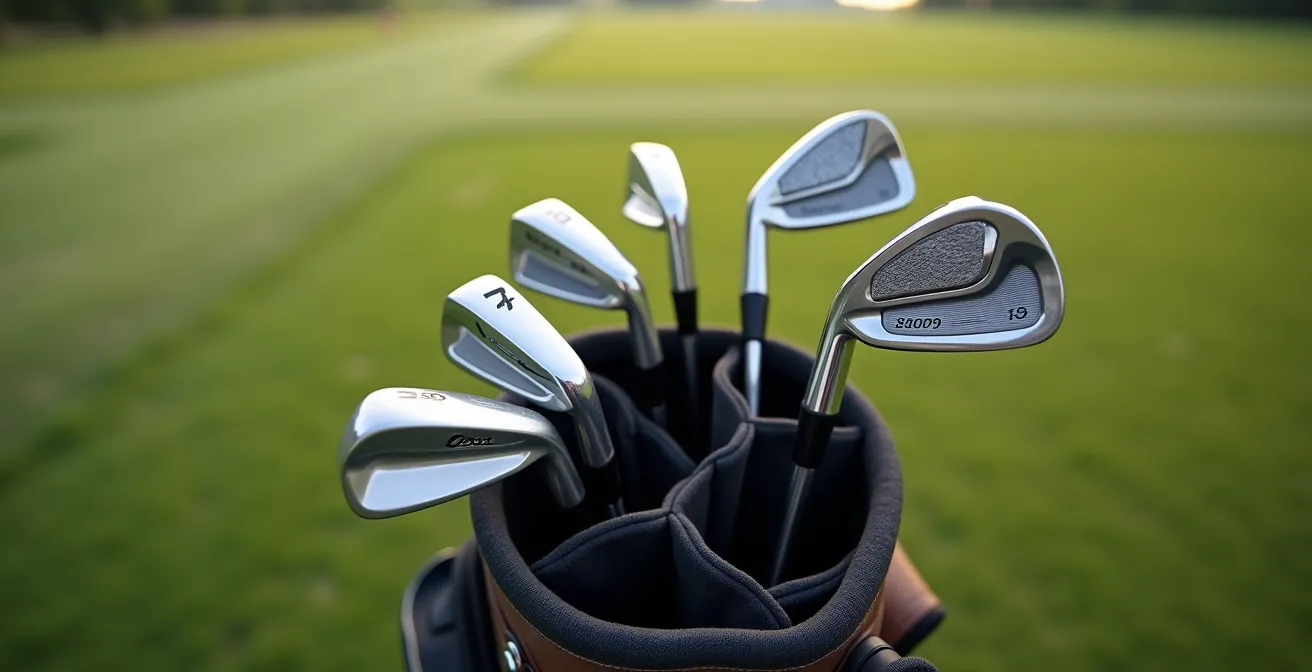
The key is a seamless transition. A good fitter will ensure that the lofts are gapped correctly (typically 4 degrees between each club) and that the shaft weights and profiles are consistent enough to prevent a jarring change in feel between the “forgiving” and “players'” sections of your bag. The “transition club,” often the 6 or 7-iron, is the most critical to get right.
Creating a combo set is the ultimate expression of tailoring equipment to your specific needs. It acknowledges that the demands of a 210-yard shot with a 4-iron are vastly different from those of a 140-yard approach with an 8-iron. The following plan outlines how to approach building your own custom-blended set.
Your Action Plan: Building a Combo Iron Set
- Identify Your Transition Point: Use impact spray or tape on your current irons. Find the club where your strike pattern becomes consistently centered (often the 7-iron or shorter for most players). This is where you can switch to a less forgiving head.
- Select Your Long Irons: Choose cavity backs or hollow-body irons for the clubs above your transition point (e.g., 4, 5, 6-irons) where launch assistance and forgiveness are paramount.
- Select Your Scoring Irons: Choose players’ cavity backs or muscle backs for the clubs at and below your transition point (e.g., 7, 8, 9-iron, PW) where precision, feel, and control are the priority.
- Ensure Proper Gapping: Work with a fitter to have the lofts adjusted across the set. This is crucial to avoid awkward distance gaps, especially between the two different models.
- Test the Transition Club: Spend extra time hitting the club right at the transition point (e.g., the 6-iron and 7-iron) to ensure the feel, turf interaction, and ball flight are seamless.
Key Takeaways
- Forgiveness technology (cavity backs, offset) is about managing the consequences of a bad swing, not fixing it. It makes your misses more playable.
- The primary decision is a trade-off between the unfiltered feedback of players’ irons (for improvement) and the confidence-boosting forgiveness of GI irons (for enjoyment).
- Aesthetics and feel (“topline anxiety,” sole interaction) are valid factors, and a custom fitting is essential to unlock the full potential of any iron, forgiving or not.
Is Custom Fitting Worth the Money for a Mid-Handicap Golfer?
There’s a persistent myth that custom fitting is a luxury reserved for low-handicappers and professionals. For a mid-handicap golfer, especially one investing in forgiving irons, this could not be further from the truth. In fact, a fitting is arguably more important for this player category because it ensures the built-in forgiveness technology can actually do its job. Buying a set of expensive game improvement irons off the rack without a fitting is like buying a performance car and putting the wrong size tires on it—you’re sabotaging the engineering from the start.
The most critical factor is lie angle—the angle between the shaft and the sole of the club at address. If the lie angle is too upright for your swing, the heel will dig, and the ball will go left. If it’s too flat, the toe will dig, and the ball will go right. All the perimeter weighting and offset in the world can’t correct a ball that starts offline because of an incorrect lie angle. The data is shocking: custom fitting analyses reveal that a 2-degree lie angle error can cause the ball to start 8 yards offline on a 150-yard shot. For a mid-handicapper, that’s the difference between hitting the green and being in a bunker.
Beyond lie angle, a fitter will optimize other crucial variables. They will match the shaft weight and flex to your swing speed to ensure you can load the shaft properly for optimal launch and feel. They will determine the correct grip size to promote proper hand action and face control. As one expert puts it, fitting is not an add-on; it’s what activates the technology.
For a mid-handicapper buying forgiving irons, a fitting is not a luxury—it’s an essential step to activate the club’s technology.
– Neil Wain, PGA Professional, Today’s Golfer Equipment Testing
A fitting session replaces guesswork with data. It ensures that the significant investment you’re making in new irons is tailored precisely to your body and your swing, giving you the best possible chance to improve and enjoy the game more. For a mid-handicapper, it’s not a cost; it’s an investment in consistency and confidence.
Oversized Heads: How Maximum Forgiveness Technology Helps New Players?
For a new golfer, the single biggest barrier to enjoyment is inconsistency. Topping the ball, hitting it fat, and watching it slice out of bounds is frustrating and can quickly discourage a beginner. This is where maximum forgiveness, or “super game improvement,” irons with oversized heads play a crucial role. Their primary purpose is to maximize the “enjoyment factor” by making the game as playable as possible, as early as possible.
These clubs employ the most extreme versions of forgiveness technology. The heads are often hollow or feature massive cavities, allowing engineers to push even more weight to the absolute perimeter. This results in the highest possible MOI, making the club incredibly stable on even the most severe mishits. For example, engineering data from manufacturers shows that a hollow design with tungsten weights can increase MOI by up to 28% over a standard cavity back. This means that even when a beginner strikes the ball far on the heel or toe, the club resists twisting and preserves a remarkable amount of ball speed.
Case Study: Beginner Progression with Cleveland Halo XL
The real-world impact of this technology is profound. In a documented test, a beginner golfer using Cleveland’s Halo XL Full-Face irons, which feature oversized heads and specialized soles, was able to progress from scoring over 95 to consistently breaking 90 within six months. The clubs helped produce a high, long, and straight ball flight across the entire set, even on off-center strikes. This demonstrates how max-forgiveness clubs can accelerate the learning curve by building confidence and making the game fun from the start.
However, this level of forgiveness comes with a significant trade-off: a dramatic reduction in feedback. The club is so effective at masking mishits that it becomes difficult for the player to feel *where* on the face they made contact. While this is great for on-course results, it can slow down the long-term process of learning to self-diagnose and correct swing flaws. The choice is clear: oversized heads are an incredible tool for helping new players fall in love with the game, but an improving golfer must eventually decide when to transition to a club that offers more feedback.
Frequently Asked Questions About Forgiving Irons
How long should beginners use oversized irons?
A great way to measure your progress is to use impact spray or tape on your clubface during practice sessions. Once you can consistently produce a tight impact pattern (with misses of less than half an inch from the center), it’s a good sign that you’re ready to “graduate” to standard game improvement irons that offer more feedback.
Do oversized heads really hide swing flaws?
Yes, in terms of results, they absolutely do. They minimize the penalty for off-center strikes by maintaining a high percentage of ball speed (often 70-80%). However, they also muffle the sensory feedback—the feeling in your hands—that is essential for identifying and correcting the root cause of those mishits in the long run.
What’s the trade-off with maximum forgiveness irons?
The fundamental trade-off is consistency now versus feedback for future improvement. With maximum forgiveness, you gain immediate consistency, higher ball flight, and more enjoyment on the course. What you lose is the precise, sometimes harsh, feedback on mishits that helps a golfer understand their swing flaws and work to correct them.