Equipment and gear
The right golf equipment can transform your experience on the course, but the sheer volume of options and technical terminology often leaves players overwhelmed. From understanding how perimeter weighting helps your mis-hits to choosing between a gap wedge and a lob wedge, every decision impacts both your performance and your wallet. The golf industry has evolved dramatically, introducing innovations like AI-designed faces, adjustable weights, and multi-material construction that promise measurable improvements.
This comprehensive resource demystifies golf equipment by explaining the technologies that matter, the fitting parameters that affect your swing, and the practical considerations that help you build a bag suited to your game. Whether you’re assembling your first set or refining your current setup, understanding these fundamental concepts empowers you to make informed decisions that enhance both enjoyment and results.
Understanding Club Technology and Design
Modern golf clubs incorporate sophisticated engineering principles designed to maximize performance across varying skill levels. The technology embedded in today’s equipment addresses specific challenges that golfers face with every swing.
Game Improvement Technologies
The most significant innovation for amateur golfers involves perimeter weighting, which redistributes mass around the clubhead’s edges. Think of it like a gymnast extending their arms during a spin—the weight distribution creates stability. When you strike the ball off-center, this design minimizes the twisting that would otherwise send your shot offline. Super game-improvement irons take this concept further with hollow body construction, creating a larger sweet spot that forgives inconsistent contact.
Offset benefits represent another crucial design element. By positioning the clubface slightly behind the shaft, manufacturers give you extra milliseconds to square the face at impact. This seemingly minor adjustment helps players who struggle with slices, making the difference between the fairway and the rough on tight holes.
Advanced Performance Features
For players seeking optimization, adjustable weights allow on-the-fly customization of ball flight. Moving a small weight from the heel to the toe can shift your typical shot shape from a draw to a fade. Similarly, loft adjustability lets you fine-tune launch conditions without purchasing multiple clubs. A driver adjustable through three degrees of loft effectively becomes several clubs in one.
Face technology has reached remarkable sophistication. COR (Coefficient of Restitution) measures how much energy transfers from club to ball, with manufacturers pushing right up against regulatory limits. Variable face thickness, created through precision milling or AI-designed patterns, maintains ball speed even on mis-hits by flexing strategically across the impact zone.
Choosing the Right Golf Ball for Your Game
Golf balls represent the most overlooked equipment decision, yet they influence every single shot you play. Understanding ball construction helps you match performance characteristics to your priorities.
Compression and Feel
Compression ratings indicate how much force the ball requires to deform at impact. Lower compression balls (around 70-80) compress easily with slower swing speeds, maximizing energy transfer and distance. Higher compression options (90-100+) need the velocity generated by faster swings to perform optimally. Playing a ball mismatched to your swing speed is like wearing the wrong shoe size—technically possible, but unnecessarily difficult.
This compression difference profoundly affects short game control. Softer balls grab the clubface longer during wedge shots, generating spin that helps you stop the ball quickly on the green. Premium multi-layer construction combines a soft outer layer for greenside grab with a firm core for distance off the tee.
Performance in Different Conditions
Environmental factors significantly impact ball performance. Cold weather stiffens the core, effectively increasing compression and reducing distance. Dimple patterns influence trajectory and wind performance—shallower dimples typically produce lower, more penetrating ball flights that fight through breezy conditions, while deeper patterns create higher launches in calm air.
Scuff resistance varies considerably between models. Urethane-covered premium balls offer exceptional spin but show visible wear more quickly than ionomer covers. For recreational play, this durability trade-off may outweigh the spin benefits, especially if you’re still working on consistent contact.
The Importance of Proper Club Fitting
Custom fitting transforms golf equipment from generic tools into precision instruments matched to your unique swing characteristics. The performance gap between off-the-rack and properly fitted clubs often surprises players.
Static vs Dynamic Fitting
Static fitting uses physical measurements—height, wrist-to-floor distance, hand size—to establish baseline specifications. While useful for narrowing options, dynamic fitting observes your actual swing, measuring ball flight, launch angle, spin rate, and impact location with launch monitors. A player might measure perfectly for standard length clubs, yet benefit from shorter shafts if their swing plane is particularly upright.
Shaft matching illustrates this complexity beautifully. Two shafts with identical flex ratings can behave completely differently based on their torque (resistance to twisting), balance point, and kick point (where the shaft bends most during the swing). Dynamic fitting reveals which shaft profile delivers optimal results for your tempo and transition.
Key Fitting Parameters
Several specifications dramatically impact performance:
- Lie angle adjustment ensures the sole rests flat at impact, preventing the toe or heel from digging and steering shots offline
- Shaft length impact affects both distance potential and consistency—longer shafts increase clubhead speed but reduce control
- Grip sizing influences hand action through the swing, with undersized grips promoting release and oversized grips quieting excessive hand rotation
- Loft adjustments optimize distance gapping between clubs, preventing overlaps that leave you between clubs on approach shots
While some dismiss fitting as placebo effect, launch monitor data clearly demonstrates measurable improvements in consistency and distance optimization when specifications match swing characteristics.
Equipment Selection Based on Skill Level
Matching equipment to ability accelerates improvement and prevents frustration. The 14-club myth—that beginners need a full set immediately—often leads to poor purchasing decisions and overcomplicated bag composition.
Beginner Equipment Strategy
New players benefit most from forgiving, confidence-inspiring clubs. A sensible starting bag might include:
- A high-lofted, oversized driver (10.5-12 degrees) that promotes getting the ball airborne
- A fairway wood or hybrid around 20-22 degrees for versatility
- Irons from 6-iron through pitching wedge with wide soles and perimeter weighting
- A single gap wedge for short approach shots
- A forgiving mallet putter with alignment aids
This simplified setup eliminates difficult long irons and specialty wedges that demand consistent ball-striking. The used vs new debate favors quality used equipment for beginners—last generation’s premium clubs often outperform current budget models at similar prices.
Junior to Adult Transition
Young players outgrowing junior sets face unique challenges. Rather than immediately jumping to full-length adult clubs, consider transitioning gradually. Many manufacturers offer intermediate lengths that bridge the gap, preventing the swing compensations that develop from using clubs that are too long or heavy.
Essential Accessories That Impact Performance
Beyond clubs and balls, several accessories directly influence comfort, consistency, and equipment longevity.
Gloves and Grips
Fit tightness in gloves prevents the bunching and twisting that disrupts your grip pressure. Cadet sizing accommodates shorter fingers relative to palm width—a common proportion that standard gloves fit poorly. Weather rotation matters significantly; all-weather synthetic gloves maintain grip in rain, while premium leather provides superior feel in dry conditions but becomes slippery when wet.
Grip longevity tips include regular cleaning with mild soap and replacing grips annually for frequent players. Worn grips harden and become glossy, forcing you to grip tighter and creating tension that restricts your swing. Hand sweat management through frequent cleaning extends grip life and maintains consistent feel.
Footwear and Apparel
Footwear traction directly affects your ability to maintain balance and generate power. Modern spikeless designs offer impressive torque resistance through strategically placed traction patterns, though traditional cleats still provide superior grip on wet or hilly terrain. Cleat replacement extends shoe life considerably—worn cleats compromise stability even if the shoe itself remains structurally sound.
Apparel for adverse conditions has advanced remarkably. Breathability importance cannot be overstated; waterproof fabrics that trap moisture create discomfort that affects concentration. Gore-Tex vs coatings represents a key decision—Gore-Tex membranes breathe better but cost more, while polyurethane coatings offer budget-friendly water resistance with reduced vapor transmission. Ensuring zero swing restriction should guide all apparel choices.
Equipment Transport and Storage
Bag quality affects both club protection and playing comfort. Proper divider systems prevent shafts from tangling and wearing against each other. Full-length dividers offer maximum protection, while shared compartments allow easier club insertion. Waterproofing varies dramatically—sealed seams and rain hoods keep gear dry, while basic bags leave clubs and accessories exposed.
For walking, leg mechanism durability and strap adjustment determine comfort over 18 holes. Dual straps that distribute weight across both shoulders reduce fatigue compared to single-strap designs. Storage logic matters too—external pockets for frequently accessed items like balls and tees eliminate constant rummaging.
Technology and Distance Measurement Tools
Distance measurement technology has revolutionized course management, providing precision that eliminates guesswork on club selection.
GPS and laser rangefinders serve different purposes. GPS devices show distances to multiple targets simultaneously and provide complete hole layouts, helping with strategy planning. Laser rangefinders excel at pin-seeking accuracy, delivering exact distances to flagsticks even on unfamiliar courses. The slope function legality remains controversial—it accounts for elevation change in distance calculations, but tournament rules prohibit its use in competitive play.
Battery life considerations vary by technology. GPS units with color screens drain power quickly, requiring charging every few rounds, while simpler laser rangefinders often last an entire season. The confidence factor these devices provide often outweighs the cost—knowing exact distances eliminates the mental uncertainty that leads to tentative swings.
Making Smart Investment Decisions
Golf equipment represents a significant financial commitment. Strategic purchasing maximizes value while building a functional bag.
New vs Used and Resale Value
Premium clubs typically lose 30-40% of retail value immediately after purchase, making the used market incredibly attractive. One-generation-old flagships often match or exceed current mid-tier models in performance. Resale value considerations should influence initial purchases—popular brands and classic models retain value far better than obscure alternatives.
Refurbished golf balls present a calculated risk. Professionally refinished balls undergo inspection and testing, but the processes can affect core integrity and compression consistency. For practice or casual rounds, quality refurbished balls offer excellent value, but critical performance situations warrant new balls.
Cost Justification and Quality Gaps
The performance gap between budget and premium equipment varies by category. In drivers, expensive models deliver measurable advantages in ball speed and forgiveness through advanced materials and manufacturing precision. In putters, however, the differences often relate more to feel and alignment features than roll quality—an expensive milled putter won’t necessarily sink more putts than a well-fitted budget option.
Blended sets represent smart value. Pairing premium short irons (where precision and feel matter most) with game-improvement long irons (where forgiveness trumps feedback) optimizes both performance and budget. This gap analysis approach ensures you invest most heavily in clubs that affect scoring while accepting less expensive solutions where maximum forgiveness is the priority.
Building an effective golf bag requires understanding how technology, fit, and personal needs intersect. Rather than chasing the latest releases, focus on equipment matched to your current swing characteristics and skill level. Invest in proper fitting for clubs you’ll use most frequently, choose balls appropriate for your swing speed and playing conditions, and recognize that yesterday’s premium equipment often represents today’s best value. As your game evolves, your equipment needs will change—making informed decisions now creates a foundation for continued improvement and enjoyment on the course.

Laser vs GPS Watch: Which Distance Tool Improves Your Course Management?
For the precise player, a laser rangefinder’s true advantage isn’t just accuracy; it’s the creation of ‘decision confidence’ by providing a single, self-acquired number. A laser eliminates the mental clutter of multiple GPS distances (front, middle, back), leading to a…
Read more
Layering for Golf: How to Stay Dry Without Restricting Your Swing?
Staying dry in bad weather is not about deflecting rain, but about managing moisture from both inside and out. True performance comes from a breathable, stretchable “system” that expels sweat as effectively as it blocks rain. Proper maintenance, not just…
Read more
Carry vs Cart: Why the Modern Stand Bag Is the Ultimate Hybrid?
The modern stand bag has evolved beyond a simple compromise; it is now the most efficient logistical system for the versatile golfer. It combines ergonomic load management for walking with a stable, cart-compatible design. Strategic organization of clubs, pockets, and…
Read more
Spiked vs Spikeless: Do You Really Need Cleats for Stability?
The choice between spiked and spikeless golf shoes is not about wet or dry conditions; it is a critical biomechanical decision about how your body manages ground reaction forces. Spiked shoes create a “locked-in” platform, maximizing shear force resistance for…
Read more
Cabretta Leather vs Synthetic: Which Glove Improves Your Feel and Grip?
In summary: Your glove is a critical “grip system” interface; a tight fit is non-negotiable for control. Cabretta leather offers superior feel, while synthetics provide better grip in wet or humid conditions. Proper care and rotation can triple a glove’s…
Read more
Why Do Tour Pros Exclusively Play Urethane Cover Balls?
The $50 price tag on a tour ball isn’t for more spin—it’s for the non-negotiable shot predictability that pros depend on to make a living. Urethane’s soft, “tacky” material science allows it to grip wedge grooves, providing consistent, controllable spin…
Read more
Distance vs Spin: Which Ball Characteristic Should You Prioritize for Your Game?
The debate isn’t about choosing distance OR spin; it’s about finding the ball that provides the most efficient ball flight for your unique swing. A “low spin” ball doesn’t fix a slice but can reduce its severity by minimizing side…
Read more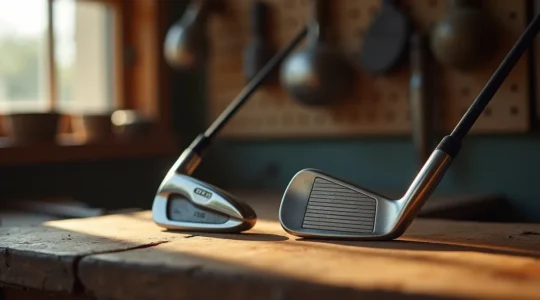
Forged vs Cast Irons: Can an Average Golfer Really Feel the Difference?
Contrary to popular belief, the ‘feel’ of a forged iron is not a myth reserved for professionals; it is a tangible physical property rooted in the metal’s grain structure that an average golfer can learn to interpret. Forging aligns and…
Read more
Beyond the Beginner: Are Box Sets Holding Back Your Intermediate Golf Game?
For intermediate golfers, a box set is not a performance dead-end but a strategic asset; the key is to methodically ‘cannibalize’ it to build a premium bag at a fraction of the cost. The driver and putter are typically the…
Read more
Marketing vs Reality: Which “Performance” Features Actually Lower Scores?
Most “performance” features in golf are not silver bullets for distance, but exercises in managing physical trade-offs; true improvement comes from understanding these compromises, not from believing the hype. Movable weights often trade slice correction for a loss in overall…
Read more