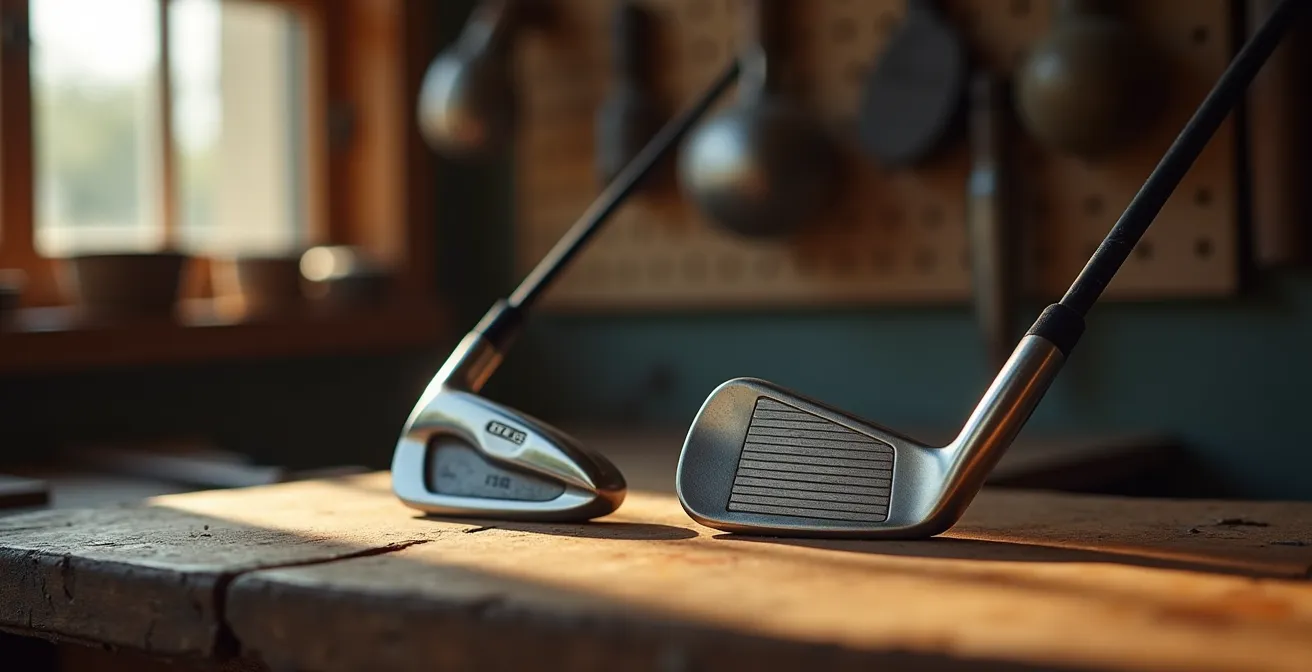
Contrary to popular belief, the ‘feel’ of a forged iron is not a myth reserved for professionals; it is a tangible physical property rooted in the metal’s grain structure that an average golfer can learn to interpret.
- Forging aligns and densifies the carbon steel’s grain, which transmits vibrations from impact more clearly to the hands, providing direct feedback on strike quality.
- Casting allows for more complex, perimeter-weighted designs that dampen these vibrations, making off-center hits feel less harsh but also providing less precise feedback.
Recommendation: The key is not to chase a mythical ‘buttery’ feel, but to undergo a blind custom fitting to determine if the clearer feedback of a forged iron or the stability of a cast iron best improves your consistency and dispersion.
For any golfer on the cusp of upgrading their equipment, the debate between forged and cast irons is a rite of passage. The purist whispers of the unmatched, ‘buttery’ feel of a perfectly struck forged blade, a sensation often described with an almost mystical reverence. On the other hand, pragmatism points towards the forgiveness and technological prowess of modern cast irons, which promise to salvage our frequent mis-hits. For the mid-handicapper, this creates a frustrating dilemma: are you paying a premium for a feeling you’re not skilled enough to perceive, or are you missing out on a crucial element of feedback that could elevate your game? The conversation often stalls on this subjective notion of ‘feel’.
But what if the difference wasn’t a matter of opinion, but of physics? The distinction between these two manufacturing methods goes far deeper than marketing jargon. It’s a story told in the microscopic structure of the steel itself—in the way its grains are aligned, in its density, and in its capacity to be shaped. This article moves beyond the myth of ‘feel’ and into the tangible science behind it. We will explore how the forging process creates a unique instrument for feedback, why that feedback can be both a blessing and a curse, and how modern innovations are blurring the lines between these two historic philosophies. The goal is to equip you not with an opinion, but with the technical understanding to decide for yourself whether the art of forging has a place in your bag.
This comprehensive analysis will deconstruct the core differences, from the impact on off-center strikes to the potential for long-term customization. By understanding the engineering behind each club type, you can make a more informed investment in your game.
Summary: A Technical Comparison of Forged and Cast Iron Performance
- The Unforgiving Nature: Why Off-Center Hits Sting More with Forged Irons?
- Soft Metal Benefits: Why Customizing Lofts Is Easier with Forged Clubs?
- Bag Chatter: Why Forged Irons Look Worn Out Faster Than Cast Irons?
- Grain Flow: How the Forging Process Affects the Density of the Metal?
- Collector’s Items: Do Certain Forged Models Appreciate in Value?
- Blade Look, Cavity Performance: How Hollow Body Irons Changed the Market?
- Combo Sets: When Should You Mix Cavity Backs with Muscle Backs?
- Is Custom Fitting Worth the Money for a Mid-Handicap Golfer?
The Unforgiving Nature: Why Off-Center Hits Sting More with Forged Irons?
The most immediate sensation a mid-handicapper will notice with a traditional forged iron, often a ‘muscle back’ or blade design, is the stark clarity of an off-center strike. This isn’t a design flaw; it’s a feature. The sharp, high-frequency vibration that travels up the shaft—the infamous “sting” in your hands on a cold day—is pure, unfiltered feedback. Because a forged blade is typically a solid piece of dense steel with its mass concentrated behind the sweet spot, it has a lower Moment of Inertia (MOI). When you strike the ball away from this center of mass, the head twists more significantly, resulting in a substantial loss of energy transfer and that harsh vibrational feedback.
In contrast, cast irons are designed specifically to mitigate this effect. The casting process allows for complex shapes, like deep cavity backs, where weight is moved to the perimeter of the clubhead. This dramatically increases the MOI, making the club more stable on off-center hits. The club resists twisting, preserving ball speed and sending a much more dampened, muted sensation to the hands. For a scratch golfer, the pure feedback of a forged iron is valuable data. For a developing player whose strike pattern is less consistent, this feedback can feel more like punishment. It’s worth noting the performance drop-off is real; data from Shot Scope reveals that even scratch golfers only hit about 31 percent of greens from the 175-200 yard range, a distance where mishits are severely penalized.
Therefore, the “unforgiving” nature of forged irons is the direct result of their design philosophy: to reward precision with the purest possible feeling and to communicate imperfection without ambiguity. For a mid-handicapper, the question becomes whether you are ready to listen to that unfiltered truth.
Soft Metal Benefits: Why Customizing Lofts Is Easier with Forged Clubs?
Beyond the esoteric concept of ‘feel’, the material science of forged irons offers a profoundly practical advantage: workability. This doesn’t refer to shaping shots on the course, but to a club fitter’s ability to physically shape the club to your specific swing. Forged irons are almost exclusively made from a very soft carbon steel, a necessary choice for the forging process itself, which involves heating and hammering a billet of steel into shape. This inherent softness is a massive benefit for customization.
As the Titleist Engineering Team explains, the forging process creates a material that is both dense and consistent. This malleability means a skilled club fitter can easily and safely bend the hosel to adjust the loft and lie angles of the iron. Need to create a consistent 12-yard gap between your 8 and 9 iron? A fitter can weaken the 9-iron’s loft by a degree or two. Is your swing DNA causing you to push shots to the right? An upright lie angle adjustment can be made in minutes. This level of personalization is crucial for optimizing a player’s ball flight and distance gapping.
In their “Learning Lab,” the experts at Titleist highlight this key distinction. As they state when explaining how their clubs are made:
A relatively soft steel is required in the forging process and irons are typically forged using a carbon steel alloy. The forging process removes impurities and squeezes the porosity out of the steel, which results in a dense, compact grain structure. Forged irons are very consistent in composition, and they provide golfers with exceptional feel and feedback.
– Titleist Engineering Team, Titleist Learning Lab
Cast irons, typically made from harder 17-4 stainless steel, are much more brittle. Attempting to bend them carries a significant risk of snapping the hosel. While minor adjustments are sometimes possible, they cannot be repeatedly adjusted over the life of the club like a forged iron can. For a mid-handicapper whose swing may evolve over time, the ability to re-fit a set of forged irons is a significant, and often overlooked, long-term value proposition.
Bag Chatter: Why Forged Irons Look Worn Out Faster Than Cast Irons?
One of the first things a new owner of a pristine set of forged irons discovers, often to their dismay, is their susceptibility to dings, scratches, and chatter. The very same soft carbon steel that allows for superior feel and custom-fitting adjustments is also much more prone to cosmetic wear. When clubs clank against each other in the golf bag, the softer forged heads will show the marks far more readily than the harder cast heads. This is the phenomenon known as “bag chatter.”
For some, this is a significant drawback. A set of expensive irons can begin to look old before their time. However, for the golf purist, this process of aging is not a flaw but a feature. It is a patina of use, a visual record of rounds played, shots practiced, and the journey of the golfer. A well-used forged iron doesn’t look damaged; it looks experienced. The most prized mark of all is the small, worn-down circle in the center of the face, a “sweet spot” burnished by thousands of pure strikes, a badge of honor for the dedicated player.
This aesthetic philosophy values authenticity over perpetual newness. The wear tells a story that a perpetually shiny, hard-cast iron never can. It is the difference between a stonewashed pair of jeans and a pair of polyester trousers; one acquires character with age, while the other simply resists it. The close-up of a vintage iron reveals this narrative in its micro-textures and wear patterns.
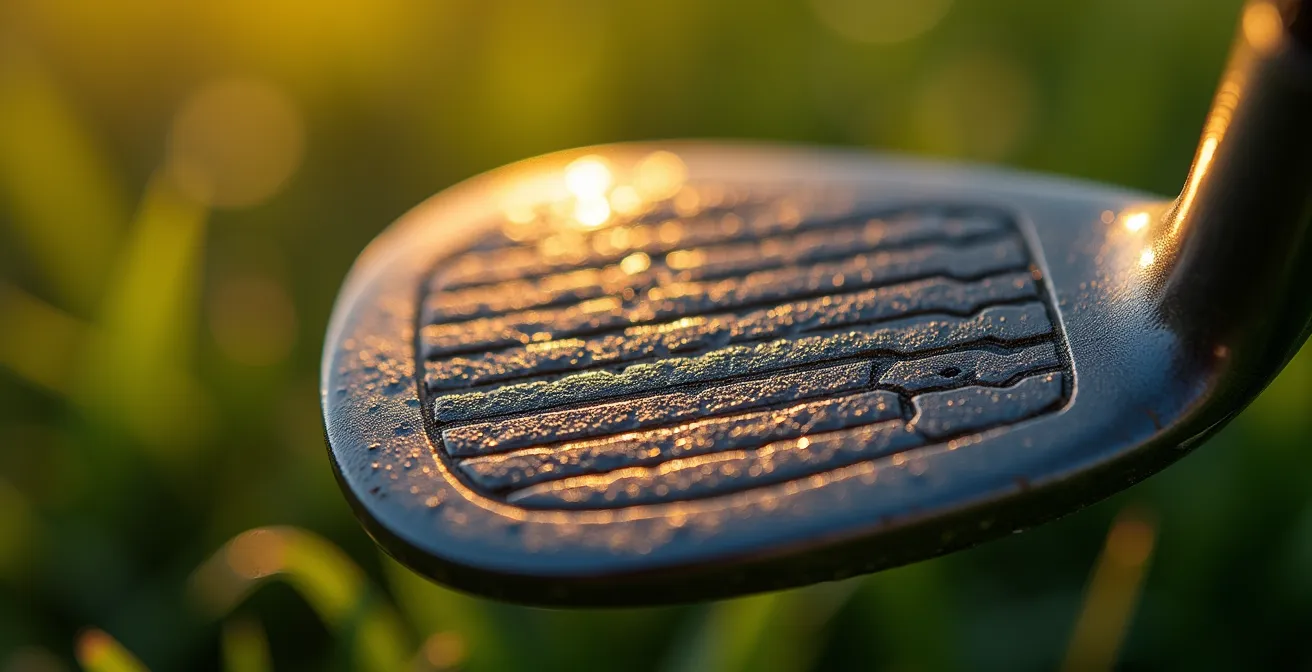
Ultimately, the perspective on bag chatter is a personal one. Do you view your clubs as pristine tools to be preserved, or as trusted companions that should bear the marks of your shared experiences on the course? For a mid-handicapper, it’s a small but important part of the ownership experience to consider. The aesthetic appeal of forged irons lies not just in their clean lines when new, but in the graceful way they age.
Grain Flow: How the Forging Process Affects the Density of the Metal?
At the heart of the forged vs. cast debate lies a principle of metallurgy: grain structure. This is the “why” behind the feel. A cast iron is made by pouring molten metal into a mold. As it cools, the metal’s grain structure is somewhat random and contains microscopic pores, like a sponge. While modern casting is incredibly advanced, this basic property remains. Forging, however, is a fundamentally different process. It starts with a solid billet of soft carbon steel that is heated and then struck multiple times under immense pressure by a forging press.
This violent process does something remarkable to the steel’s internal structure. It forces the individual grains of the metal to align and become tightly compacted, squeezing out the porosity and creating what is known as “grain flow.” Imagine the difference between a pile of loose sand and a solid piece of sandstone. The forged head is the sandstone. This exceptional density and consistent grain alignment is the primary reason for the renowned “forged feel.” When the ball impacts the face, the vibration travels through this uniform, uninterrupted structure directly to the hosel and up the shaft to your hands, providing a very pure, clear signal.
The random, porous structure of a cast iron, by contrast, tends to scatter and dampen these vibrations, resulting in a more muted or “dead” feeling on all but the most centered strikes. The following table breaks down these critical differences based on the materials and processes involved.
This comparison, drawing from insights provided by industry leaders, highlights the fundamental trade-offs as detailed in a recent comparative analysis.
| Property | Forged (1025 Carbon Steel) | Cast (17-4 Stainless) |
|---|---|---|
| Grain Structure | Dense, compact grain structure with impurities removed | Made with 431 or 17-4 grade with Chromium and Nickel for tensile strength |
| Malleability | Soft, easily adjustable | Hard, brittle if bent |
| Design Flexibility | Limited design flexibility | Allows for complex geometries with intricate channels and ribs |
| Manufacturing Cost | More time and labor-intensive | Less expensive to produce |
For the mid-handicapper, this means the “feel” is not a placebo. It’s a direct consequence of the club’s density and internal structure. You are feeling the difference in how each material transmits energy and vibration. The forged iron acts like a high-fidelity speaker, while the cast iron has built-in noise cancellation.
Collector’s Items: Do Certain Forged Models Appreciate in Value?
While the primary reason to choose a forged iron should always be performance and feel, there is a romantic, secondary aspect to them: heritage and collectibility. Unlike mass-produced cast clubs, certain forged models, particularly those from venerated Japanese houses like Miura or iconic lines from Mizuno, can attain a cult-like status. This is often tied to a combination of limited production runs, association with legendary players, and the craftsmanship of the forging house itself.
A classic example is the story of Brooks Koepka and his Mizuno JPX900 Tour irons. He was not sponsored by Mizuno at the time but chose to play the irons because he felt they were the best fit for his game. He then went on a historic run, winning multiple major championships with them. As the equipment team at Today’s Golfer noted, this created an incredible legacy for that specific model. In a review of a subsequent model, they recounted the history:
Brooks Koepka decided the JPX900 Tour irons were the perfect fit for his game. He liked them so much, he was happy to play them for nothing. Brooks then went on to win the 2017 US Open, defend that title in 2018 and bag the US PGA, all with a set of Mizuno irons.
– Today’s Golfer Equipment Review Team, Mizuno JPX921 Tour Iron Review
This kind of organic tour validation, free from the influence of a multi-million dollar endorsement deal, imbues a club with a special aura. It becomes a piece of golf history. While it’s extremely rare for a set of irons to truly appreciate in financial value—they are, after all, tools meant to be used—these iconic models hold their value far better than their cast counterparts. For a golf enthusiast, owning a set of Miura “Baby Blades” or a vintage set of Mizuno MP-29s is like a classic car enthusiast owning a vintage Porsche 911. The value isn’t just in the performance, but in the history, design, and the story they tell.
Blade Look, Cavity Performance: How Hollow Body Irons Changed the Market?
For decades, the choice for mid-handicappers was stark: accept the chunky, thick topline of a forgiving cast cavity-back, or struggle with the demanding profile of a sleek forged blade. The market offered no middle ground. The advent of the hollow-body iron completely shattered this paradigm. This innovation represents the single most important development for players who desire the clean aesthetics of a blade but require the performance benefits of a game-improvement iron.
The concept is brilliant in its execution. Engineers start with a slim, player-preferred chassis that looks like a blade at address. However, the body is hollow. This allows designers to create an extremely thin, high-strength steel face that is not structurally integral, much like the face of a driver. This thin face flexes at impact, generating significantly higher ball speeds than a solid forged iron. The hollow construction also allows weight to be positioned at the extreme perimeter and low in the head, dramatically increasing MOI and forgiveness to levels previously only seen in cast cavity-backs.
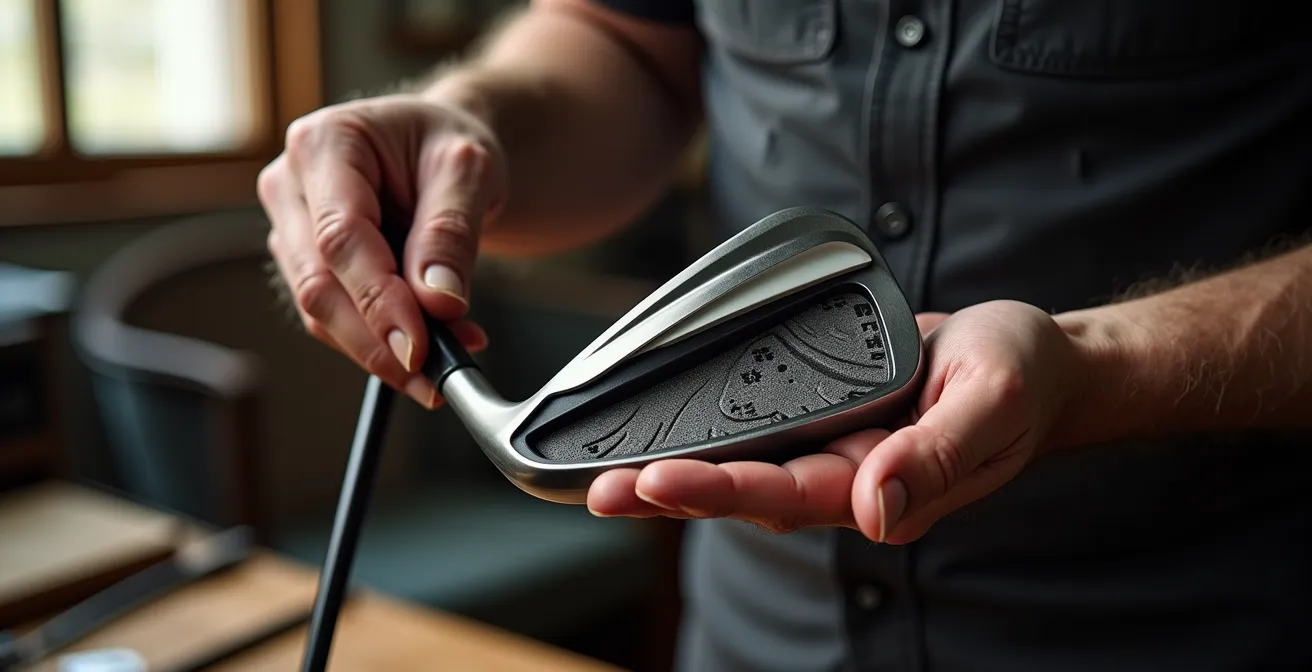
To manage the harsh sound and feel that a truly hollow metal head would produce, this cavity is injected with a lightweight, vibration-dampening polymer foam. TaylorMade’s “SpeedFoam” is a prime example. The innovation of TaylorMade’s P790 irons, as detailed in a Golf Digest analysis, showed that this combination could produce the ball speed of a game-improvement iron in a head the size of a better-player’s iron, launching shots higher despite stronger lofts. This technology gives mid-handicappers a “best of both worlds” option: an iron that looks like a tool of the pros but performs with the safety net they need.
Combo Sets: When Should You Mix Cavity Backs with Muscle Backs?
The idea of a one-size-fits-all iron set is becoming increasingly outdated. Even the best players in the world have different needs from their long irons than they do from their scoring clubs. This has led to the rise of the “combo set,” a blended set of irons where a player might use more forgiving, cavity-back or hollow-body long irons (e.g., 4-6 iron) and more precise, muscle-back or blade-style short irons (e.g., 7-PW). This is not just a trend for amateurs; industry data shows that over half of professional golfers now use some form of a combination set.
For a mid-handicapper, this strategy makes perfect sense. The long irons are the most difficult clubs in the bag to hit consistently. They require more speed to launch properly, and any mishit is magnified over the longer distance. Using a more forgiving, higher-launching model for your 4, 5, and 6 irons provides a crucial safety net and helps achieve playable trajectories. You are essentially prioritizing forgiveness where you need it most.
Conversely, the short irons are your scoring clubs. With these, precision, feel, and trajectory control are paramount. A player’s blade or compact forged cavity back in the 8, 9, and pitching wedge allows a player to feel the strike more acutely, control spin, and flight the ball into tight pin locations. You are prioritizing feel and control where accuracy is the ultimate goal. Manufacturers have embraced this, with many now offering seamless blending options, ensuring consistent looks, lofts, and gapping between the different models in a combo set.
Key Takeaways
- The ‘feel’ of a forged iron is a direct result of its dense, uniform grain structure, which transmits vibration more purely than a cast iron.
- The soft carbon steel used in forging allows for significant loft and lie adjustments, offering long-term value as your swing evolves.
- Modern hollow-body irons offer a compelling compromise, blending the sleek look of a blade with the forgiveness of a cavity-back design.
Is Custom Fitting Worth the Money for a Mid-Handicap Golfer?
After exploring the science, aesthetics, and modern innovations, we arrive at the ultimate question for the mid-handicapper: is the extra cost of forged irons—or any premium club—justified? The answer is unequivocally yes, but with a crucial caveat: only if it’s determined through a professional, brand-agnostic custom fitting. For a player in this skill range, where USGA statistics suggest the most common handicap is a 15, consistency is the holy grail. The wrong equipment can actively hinder improvement, ingraining bad habits to compensate for an ill-fitting club.
A proper fitting moves beyond the simple forged vs. cast debate. It focuses on finding the right combination of head design, shaft profile, length, lie angle, and grip that optimizes your performance. The material of the head is just one component. A fitter will use a launch monitor to analyze objective data: ball speed, launch angle, spin rate, and dispersion. They can then isolate variables to determine what truly helps you. Does the clearer feedback of a forged head help you find the center of the face more often, tightening your dispersion? Or does the higher MOI of a cast or hollow-body head preserve ball speed more effectively on your typical miss, leading to more consistent distances?
The only way to know is to test them head-to-head. A good fitter can build test clubs with identical specs (loft, lie, shaft) to isolate the performance of the head itself. For a mid-handicapper, spending money on a fitting is a far better investment than spending it on an off-the-rack set of expensive forged irons based on a perceived notion of what you *should* be playing.
Your Action Plan: Custom Fitting Evaluation for Mid-Handicappers
- Request a blind test: Ask the fitter to provide forged and cast heads with identical specs but covered branding to remove any preconceived bias.
- Collect feel data: Hit 5-10 shots with each club type and make a note each time you can confidently identify which is which based on feel alone.
- Prioritize fundamentals: Focus the fitting on finding the correct length, lie angle, and shaft profile first, as these often have a bigger impact than head material.
- Test component variables: Experiment with different shaft materials (e.g., lighter graphite vs. steel) and grip options to understand how they alter the overall feel and performance.
- Analyze performance on mishits: Compare launch monitor data for dispersion patterns and ball speed retention on your off-center strikes between the different head options.
Ultimately, a custom fitting empowers you to make an evidence-based decision. It transforms the purchase from a hopeful gamble into a calculated investment in your own improvement, ensuring that every dollar spent is directly contributing to shooting lower scores.
Frequently Asked Questions on Forged vs. Cast Irons
Which forged iron brands hold their value best?
Japanese brands like Mizuno and Miura, particularly limited editions or tour-issue models, tend to appreciate most due to their reputation for craftsmanship and quality.
What determines a forged iron’s collectible value?
Key factors include brand heritage, limited production numbers, association with famous players (like Brooks Koepka’s use of Mizuno), and unique forging processes like Japanese single-billet forging.
Should I buy forged irons as an investment?
No – 99% of forged irons depreciate. The real value is in playing experience and longevity, not potential resale price. They should be considered a performance investment, not a financial one.