
Playing the Old Course is less about your score and more about understanding its living history; it demands a different mindset, not just a different swing.
- The course’s quirks, like its seven double greens and deep pot bunkers, are historical features, not flaws. Learning their story is part of the game.
- Success relies on the ground game and creative wind management, skills often neglected in modern, aerial-focused parkland golf.
Recommendation: Embrace the challenge, listen to your caddie, and use the daily ballot system for the most authentic and accessible experience of the Home of Golf.
So, you’re making the pilgrimage. I see it in your eyes. That mix of terror and wonder. You’re standing where they all stood, from Old Tom Morris to Tiger Woods. You’ve heard the stories, you’ve seen the pictures. You think you know what’s coming. You’ve probably been told to book a year in advance, to avoid the Road Hole bunker at all costs, and to get that photo on the Swilcan Bridge. Fine advice, as far as it goes. But it misses the point entirely.
The Old Course isn’t a checklist. It’s not a museum piece to be tiptoed through. It’s a living, breathing thing, shaped by sheep, golfers, and the North Sea wind for over 600 years. Playing a round here isn’t about conquering it; that’s a fool’s errand. It’s about having a conversation with history. Every strange bounce, every shared green, every blind shot is a word in that conversation. The trouble is, most visitors don’t speak the language. They arrive with their parkland habits and their shiny new drivers, expecting the course to bend to their will. It won’t.
But that’s why you’re here, and why I’m talking to you. You’re a pilgrim, not a tourist. You want to understand. My job isn’t just to carry your bag; it’s to be your interpreter. I’ll show you how to read the ground, how to use the wind as an ally instead of an enemy, and how to understand the architectural intent behind every mound and hollow. We’ll talk strategy, we’ll talk history, and I’ll help you find your own story on these ancient fairways. Forget trying to shoot the round of your life. Instead, let’s aim for a round you’ll never forget. Listen up, the lesson begins now.
This guide is structured to walk you through the Old Course code, from its peculiar architecture to the very spirit of links golf. We’ll cover the essential knowledge you need before you even step on the first tee.
Summary: A Caddie’s guide to the Old Course
- Why Does the Old Course Have 7 Double Greens Shared by Two Holes?
- How to Secure a Tee Time at the Old Course Without Booking a Year Ahead?
- The Road Hole Bunker: Why You Must Avoid It to Save Your Score?
- Playing in 40mph Gusts: Survival Tips for a Windy Day at St Andrews
- When to Take the Swilcan Bridge Photo Without Delaying the Group Behind?
- True Links vs “Links-Style”: What Is the Difference in Soil and Grass?
- Certificate Check: Do You Need a Low Handicap to Play Championship Links?
- Why Legendary Links Courses Require a Completely Different Swing Style?
Why does the Old Course have 7 double greens shared by two holes?
First thing you need to get your head around: the Old Course isn’t ‘designed’ in the modern sense. It evolved. Those seven massive double greens you see are the clearest proof. They weren’t a clever gimmick; they were a practical solution to a problem. Back in the old days, the course was played ‘out and back’ over the same stretch of land. Players would play to a hole going out, and then play to the same green from a different direction coming back in. This created a natural, looping flow and saved precious space.
The logic is simple and beautiful. The hole numbers on each shared green add up to 18. So you’ll find the 2nd hole shares with the 16th, the 3rd with the 15th, and so on. It’s an elegant piece of natural architecture. These aren’t just big putting surfaces; they are strategic landscapes in their own right. Some, like the one shared by the 5th and 13th holes, are enormous. To put it in perspective, the average green size at St Andrews is already huge, but when you combine two, you get putting surfaces that are simply mind-boggling in scale. The largest of these greens is a testament to this unique historical layout.
These greens demand a completely different kind of approach shot and putting skill. You might be 150 feet from the hole but still on the green. Three-putting is not a failure here; it’s often a decent result. It teaches you about imagination and touch, not just technical perfection. This is the first lesson the Old Course teaches: efficiency and history created its most iconic features. It wasn’t built for you; you have to adapt to it.
How to secure a tee time at the Old Course without booking a year ahead?
Right, let’s clear up the biggest myth. Everyone thinks you need to book a tee time a year in advance or pay a king’s ransom. That’s one way, aye, the ‘Advance Application’. But for a pilgrim like you, the real soul of the St Andrews experience lies in the daily ballot. It’s a lottery, pure and simple, and it’s the most common way for visitors to get on. You enter your group of two, three, or four golfers two days before you want to play, and you wait. It’s a rite of passage, the nervous checking of the results online or on the board by the Old Pavilion.
Now, don’t get your hopes up too high for a single entry. With thousands of golfers descending on this town, recent data shows the open ballot success rate has dropped to approximately 10.54% during peak season. But that’s where a bit of local knowledge comes in. If you’re staying for a few days, enter the ballot every single day. Your odds increase dramatically with consecutive entries. Visiting in the shoulder seasons, like April, also gives you a much better chance than the height of summer.
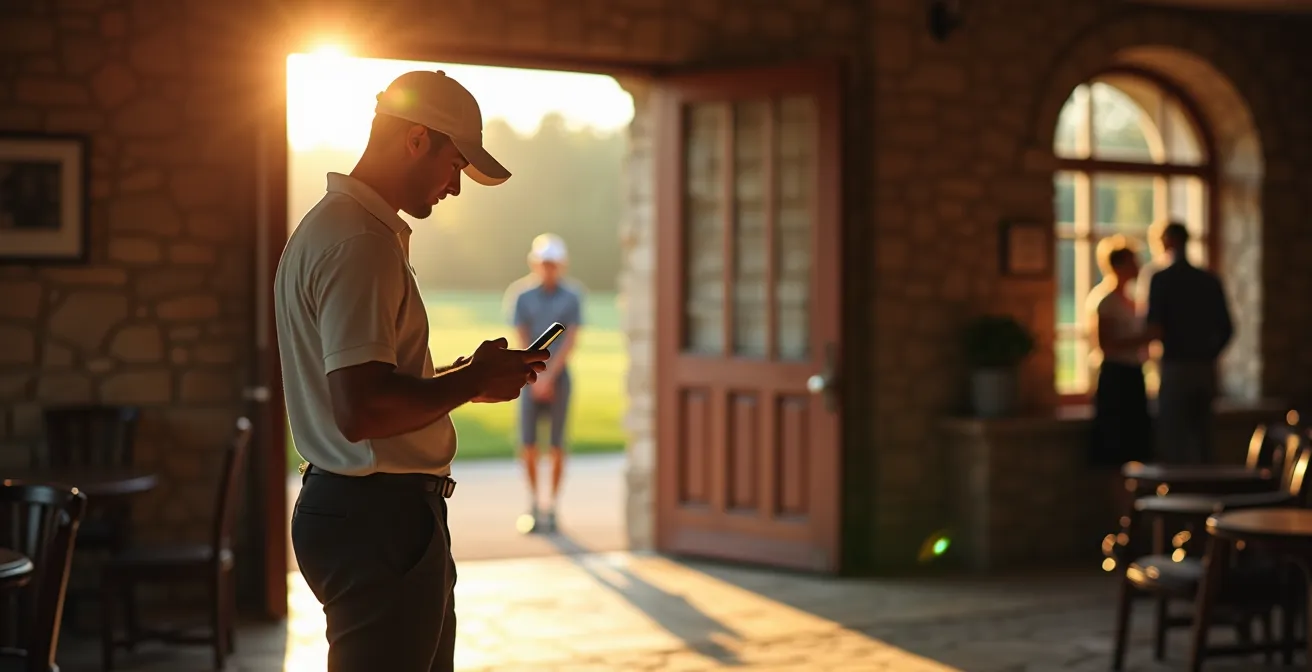
And if the ballot fails you? Don’t despair. This is where the true pilgrim’s spirit is tested. Head down to the Old Pavilion before the first light, well before 6 a.m. Get your name on the singles list. The starter will try to fit you into the day’s first available slot in a two or three-ball group. You might wait for hours, you might get on straight away. It’s a gamble, but you’ll meet fellow pilgrims from all over the world, sharing stories and coffee in the cold morning air. That camaraderie, that shared hope… sometimes, that’s more memorable than the golf itself. It’s the authentic St Andrews experience.
The Road Hole bunker: why you must avoid it to save your score?
Every course has its monster, its legend whispered in the clubhouse. Ours is a small, deep pot bunker on the 17th hole. It’s called the Road Hole Bunker, but we just call it ‘The Sands of Nakajima’ or, more simply, ‘the Devil’s own’. Your question is why you must avoid it. The better question is *what happens when you don’t*. It’s not just a hazard; it’s a black hole for golf balls and scorecards. It’s five feet deep with a revetted face that’s almost vertical. Getting in is easy. Getting out in one shot is a miracle. Getting out in the direction you intended is a victory worthy of a toast.
Don’t take my word for it. History is littered with the crumpled scorecards of champions who dared to challenge it and lost. Just look at the great Bobby Jones. During the 1921 Open, this master of the game, a man of unparalleled grace, found himself in a bunker on the 11th. After four swings, he was still in the sand. He lost his composure, picked up his ball, and walked off the course, disqualifying himself. While it wasn’t the Road Hole, that moment defined the unforgiving nature of St Andrews bunkers for him. It taught him a lesson about pride and patience that he never forgot. The Road Hole bunker is that lesson distilled into its most potent form.
The correct way to play the 17th is to treat the bunker as if it has a forcefield. Your target is anywhere but there. Aim for the left side of the green, use the slope, and be happy with a par. If you walk off with a bogey, you’ve beaten the hole. Trying to be a hero and firing at the pin with that bunker guarding it is the definition of madness. It doesn’t care how good you are. It has swallowed the ambitions of better golfers than you or I. Respect it, fear it, and stay away.
Playing in 40mph gusts: survival tips for a windy day at St Andrews
You see blue skies and think you’ve gotten lucky. Don’t be fooled. Here, the wind is the real architect of the course, and it’s always there. A calm day at St Andrews is a 15-mph breeze. A normal day is 25. And on a proper Scottish day, you’ll face 40-mph gusts that can turn an umbrella inside out and a confident golfer into a weeping child. Forgetting your high, floating parkland shots is the first step to survival. Here, you play under the wind, not through it.
First, use the course. It’s firm for a reason. The bump-and-run isn’t a quaint, old-fashioned shot; it’s your primary weapon. Use the ground as your ally. Let the ball land short and chase onto the green. Second, club up, and swing easy. If it’s a 150-yard shot, take a 5-iron instead of a 7-iron and swing at 70%. A smooth, controlled swing keeps the spin down and the ball flight low. A wide stance is your friend; it gives you a solid base. And trust your caddie. We know how the wind funnels between the dunes and buildings. We know a crosswind on the 5th becomes a headwind on the 13th. The course’s ‘out and back’ routing means the same wind will hit you from opposite directions.
Many first-timers are intimidated by the sheer size of the fairways. Indeed, the massive shared fairway between the 1st and 18th holes stretches 129 yards at its widest. But that space is a lie. The wind shrinks it. The real fairway is a 20-yard strip that your caddie points you to. Miss it, and you’re in gorse or a pot bunker you never saw. Wind management is course management on links land.
Your windy round checklist: before you play
- Club selection: Add a low-loft driving iron or hybrid for penetrating shots.
- Ball choice: Consider a lower-spin ball to reduce wind effect.
- Practice swing: Rehearse a shorter, more compact “punch” shot on the range.
- Mental game: Accept that par is a great score and bogeys will happen.
- Wardrobe: Pack waterproofs and a warm beanie, even if it looks sunny.
When to take the Swilcan Bridge photo without delaying the group behind?
Alright, let’s have a word about the bridge. The Swilcan Bridge on the 18th. It’s a 700-year-old Roman arch that’s more photographed than most movie stars. And yes, you should get your photo. It’s part of the pilgrimage. But there’s a right way and a very, very wrong way to do it. The wrong way is to treat it like your personal photoshoot, holding up the group behind you who have also waited a lifetime for this moment. Nothing will earn you the silent scorn of St Andrews faster.
Here is the unwritten rule, the St Andrews code: honour the flow. The game doesn’t stop for your selfie. The key is preparation. As you walk off the 18th tee, decide who is taking the pictures. Get the cameras or phones ready. Once the group in front is clear of the green, you hit your tee shots. Then, as you walk towards the bridge, have your ‘photographer’ go first. The rest of you walk onto the bridge, pause, pose, click-click-click, and you’re off. It should take no more than 30 seconds per person. Quick, meaningful, respectful.
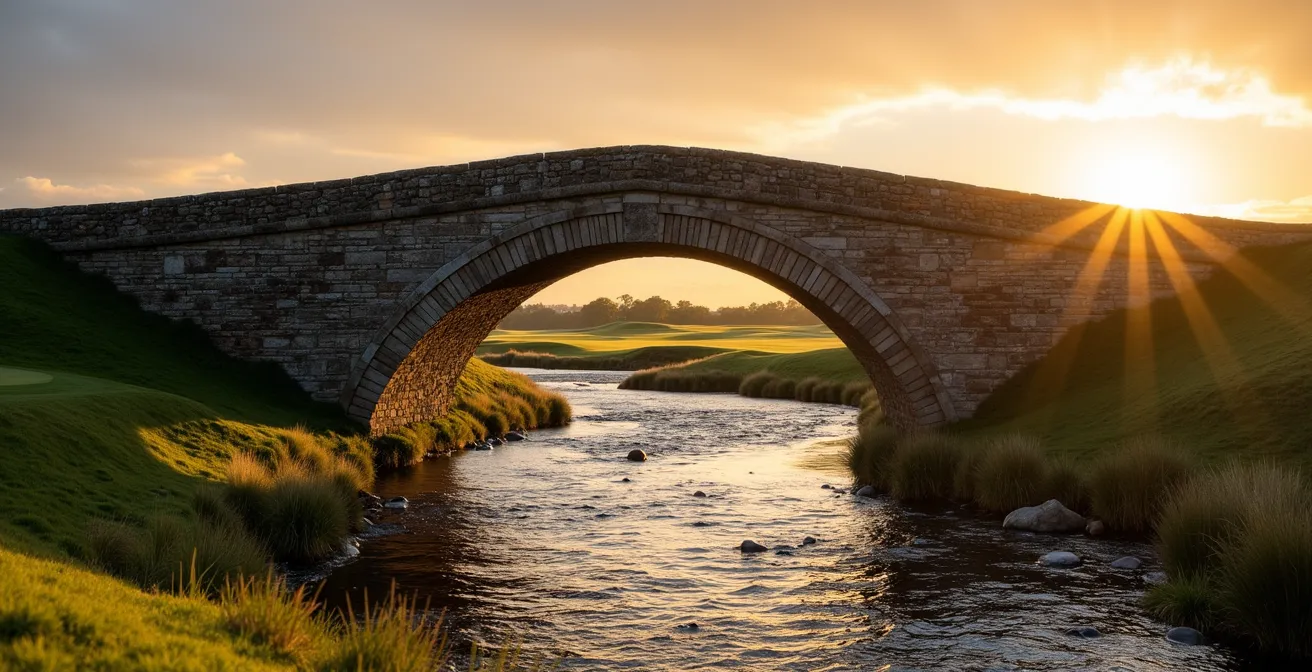
A fellow golfer who understands this summed it up perfectly. He said that walking over that bridge is a privilege, not a right. He’s right.
To find myself announced on the first tee, hit a tee shot at 17 and walk over the Swilken Bridge on 18 are all pretty amazing experiences which anyone can get. These moments are privileges, not rights – have your camera ready, make it quick and meaningful, honoring the continuous flow of play.
– A Golfer’s Experience, UK Golf Guy
That’s the spirit. You are part of a continuous stream of golfers that has flowed over that bridge for centuries. Your photo is a snapshot of your moment in that stream, not a reason to dam it up. Be ready, be quick, and then get out of the way for the next pilgrim.
True links vs “links-style”: what is the difference in soil and grass?
You’ll hear a lot of marketing talk about ‘links-style’ courses back home. Forget it. Most are just golf courses with a few dunes and no trees. The difference isn’t the look; it’s the ground beneath your feet. True links land, like St Andrews, is built on a sandy soil base. This is the crucial element. Sand drains instantly. While your course at home is soft and muddy after a drizzle, the Old Course is firm an hour after a downpour. This firmness is everything.
This sandy soil also dictates the type of grass that thrives here. We don’t have the lush, green, upright bentgrass you’re used to. We have fescue. Fescue grass is a wiry, tough, wispy thing that lies down when it’s cut. It requires less water and less fertilizer. The maintenance philosophy, dating back to Old Tom Morris himself, is to encourage these finer grasses. The course manager, Gordon McKie, follows this principle religiously, cutting the greens to just 4mm. The goal is not to create a perfect green carpet but a firm, fast surface that rewards a well-struck golf shot with a predictable impact, release, and roll.
This combination of sandy soil and fescue grass is what creates ‘the bounce’. On your parkland course, the ball hits the green and stops. Here, the game is played as much on the ground as in the air. You can putt from 30 yards off the green. You can use slopes a hundred feet away to feed your ball to the hole. The greens are enormous to compensate, with St Andrews greens average over twice the size of Augusta National at 13,608 square feet. This is the essence of links golf: the interaction between the ball and the firm, fast turf. A ‘links-style’ course can mimic the look, but it can’t replicate the soul that comes from centuries of nature shaping the land.
Key takeaways
- Respect the History: The Old Course’s quirks are its lessons. The double greens and pot bunkers tell a story of evolution, not random design.
- Embrace the Ground Game: Forget high, floaty shots. The firm fescue turf and constant wind demand that you learn to use the ground with bump-and-run shots.
- Play with the Wind, Not Against It: A low, controlled ball flight and a caddie’s knowledge are your best assets when the inevitable gusts pick up.
Certificate check: do you need a low handicap to play championship links?
Let’s put another fear to rest. Many pilgrims I meet are worried they’re not ‘good enough’ to play the Old Course. They imagine a stern-faced official demanding a portfolio of sub-80 scores. It’s nonsense. The Old Course is the ‘Home of Golf,’ and that home is open to everyone, not just the elite. This is a public golf course, after all. The primary concern here isn’t your scoring ability; it’s the pace of play. No one wants a six-hour round.
To ensure the day flows smoothly for the hundreds of golfers, there is a handicap requirement, but it’s far more inclusive than most people think. To play the Old Course, the Old Course accepts golfers with handicaps up to 36. This applies to both men and women. You’ll need to present a valid, official handicap certificate from your home club or a national golf association when you check-in for your round. It’s a simple check to make sure everyone on the course has a basic level of experience and can keep up.
So, can a high-handicapper enjoy the Old Course? Absolutely. In fact, sometimes they enjoy it more because they come without the ego of trying to shoot a low number. They’re here for the experience. They use hybrids from off the green, they putt from 50 yards out (we call that the ‘Texas wedge’), and they focus on the walk. On a links course, creativity and adaptability are far more valuable than a low handicap. It’s not about how well you score, but how you handle the challenges the course presents. If you can keep your ball moving and a smile on your face, you are more than welcome here.
Why legendary links courses require a completely different swing style?
By now you should be getting the picture. Everything we’ve talked about—the firm ground, the fescue grass, the wind, the pot bunkers—it all points to one unavoidable conclusion: you cannot play your normal game here. Trying to apply a parkland swing to a links course is like trying to speak French using only English words. The grammar is completely different. Your swing, built for soft turf and calm days, needs a total rethink.
The parkland swing is all about hitting down on the ball, creating a divot, and generating high spin for aerial approaches that stop quickly. Try that here, and you’re in for a world of pain. Hitting down on this firm turf can send a shockwave up your arms, and the ball will likely skull across the green into trouble. The links swing is shallower, more of a sweep. You’re trying to ‘pick’ the ball cleanly off the tight lies. It’s less about power and more about precision and solid contact.
This table breaks down the core differences. It’s not just advice; it’s a new set of rules for the game you thought you knew.
| Aspect | Parkland Style | Links Style |
|---|---|---|
| Ball Strike | Hit down to compress | Sweep with shallow angle |
| Typical Conditions | Soft, lush turf | Firm, fast, sandy soil |
| Grass Type | Bentgrass (upright) | Fescue (wispy, lies down) |
| Approach Strategy | Aerial, high trajectory | Bump and run, low trajectory |
| Stance | Standard width | Wider for stability in wind |
This is why legends are made and broken here. It’s a complete examination of a golfer’s skill, imagination, and adaptability. As the writer Peter Dobereiner once noted, the Old Course is the template for everything. It’s the original test.
Every golf course in the world owes something to the Old Course, for, either by accident or design, it embodies every feature and architectural trick.
– Peter Dobereiner, The Old Course at St. Andrews: hole by hole
So when you stand on that first tee, take a deep breath. You’re not just playing a round of golf; you’re adding your own whisper to a 600-year conversation. Now, go and play.
Frequently Asked Questions About the St Andrews Old Course
Do I need to be a low handicap golfer to play the Old Course?
No, the Old Course accepts handicaps up to 36 for both men and women. The requirement ensures pace of play rather than skill level.
Can high handicappers enjoy the Old Course?
Yes, using strategic club choices like hybrids and putters from off the green (the Texas wedge) can help manage the firm conditions and tight lies.
What matters more than handicap on links courses?
Adaptability, creativity, and ground game skills are more important than raw scoring ability from parkland courses.