
For senior golfers, switching to graphite shafts isn’t just about comfort; it’s a strategic intervention that reclaims lost distance and extends your playing years by aligning equipment with your body’s changing mechanics.
- Graphite’s vibration-dampening properties significantly reduce joint strain, making it a medical-grade solution for golfers with arthritis or chronic pain.
- The lighter weight allows golfers with slower swing speeds (sub-85mph) to properly load the shaft, translating to increased clubhead speed and better energy transfer.
Recommendation: A professional fitting to match graphite shaft weight, flex, and torque to your specific swing profile is the single most effective step to unlock these benefits and ensure a successful transition.
There’s a frustration every senior golfer knows intimately. It’s the feeling of a perfectly struck drive landing ten, then twenty yards shorter than it used to. It’s the creeping fatigue in your hands and lower back that turns the final six holes into an exercise in endurance rather than enjoyment. The common advice is to work on your swing or accept the inevitable decline. But this perspective misses the most critical element: the engine you’re using is no longer matched to the vehicle. Your steel shafts, the trusty companions of your faster-swinging youth, are now actively working against you.
The conversation around graphite often starts and ends with “it’s lighter” or “it’s better for old guys.” This oversimplification does a massive disservice to the technology. This isn’t just about making the clubs easier to swing. It’s about a fundamental shift in how your body’s energy is transferred to the golf ball. We’re not talking about a band-aid for your game; we’re talking about a biomechanical realignment. What if the key to unlocking another decade of competitive, enjoyable golf wasn’t in fighting your body with punishing physical training, but in equipping it with a tool that works in harmony with it?
This article will deconstruct the science and practical reality of making the switch. We will move beyond the surface-level benefits and explore the physics of carry distance for slower swings, the medical-grade advantages for joint health, and the technical details of torque and swing weight. By understanding how graphite shafts interact with an aging golfer’s body, you can make an informed, strategic decision that preserves not just your scores, but your love for the game itself.
In the following sections, we’ll break down exactly how this technology can transform your game, from the physics of speed to the economics of the upgrade. This is your roadmap to a longer, healthier, and more satisfying life on the golf course.
Summary: Reclaiming Your Game with Graphite Shaft Technology
- Below 85mph: Why Steel Shafts Are Robbing You of Carry Distance?
- Graphite vs Steel: Which Material Is Better for Golfers with Arthritis?
- Does High Torque in Graphite Shafts Really Make Your Dispersion Worse?
- Swing Weight Issues: Adjusting to the Lighter Feel of Graphite Irons?
- Why Are Graphite Shaft Upgrades So Much More Expensive Than Steel?
- Speed after 60: What Are Realistic Expectations for Senior Swing Speed?
- Lower Back Pain: How Weak Glutes Force Your Back to Do All the Work?
- Chasing Speed: How to Increase Swing Speed Without Ruining Your Mechanics?
Below 85mph: Why Steel Shafts Are Robbing You of Carry Distance?
For a golfer, the concept of “loading the shaft” is the cornerstone of power. It’s the feeling of the clubhead lagging behind your hands in the downswing, creating tension that will be unleashed at impact. With a swing speed above 90mph, a standard 120-gram steel shaft is an efficient tool; the golfer has enough force to bend the shaft properly and generate explosive speed. However, once your swing speed dips below the 85mph threshold, that same steel shaft becomes a liability. It’s too heavy and stiff for your swing to load effectively. The result? You’re essentially swinging a rigid pole, losing the “whip” effect that multiplies speed and translates to carry distance.
Lightweight graphite shafts, often weighing between 50 and 75 grams, fundamentally change this equation. Their reduced mass requires far less force to load properly. For a senior golfer with a smoother tempo and reduced speed, this means you can once again feel the shaft load and unload through impact. This isn’t about swinging harder; it’s about making your existing swing dramatically more efficient. The energy you generate is no longer wasted trying to move a heavy, uncooperative lever. Instead, it’s efficiently transferred to the ball, resulting in higher launch and restored carry distance. This principle is so effective that even competitive high school teams have seen success transitioning players with moderate swing speeds to graphite to optimize their mechanics and distance.
Graphite vs Steel: Which Material Is Better for Golfers with Arthritis?
For any golfer suffering from arthritis, tendonitis, or general joint pain, an iron shot can be a high-risk event. The shock of a heavy clubhead striking turf and ball sends a jarring vibration up the shaft and directly into the sensitive joints of the hands, wrists, and elbows. With steel shafts, this vibration is transmitted with brutal efficiency, leading to pain, inflammation, and fatigue over 18 holes. This is where graphite offers not just a performance benefit, but a profound therapeutic one. The very composition of graphite shafts is designed to absorb energy. The multi-layered, cross-woven carbon fiber composite acts as a natural shock absorber.
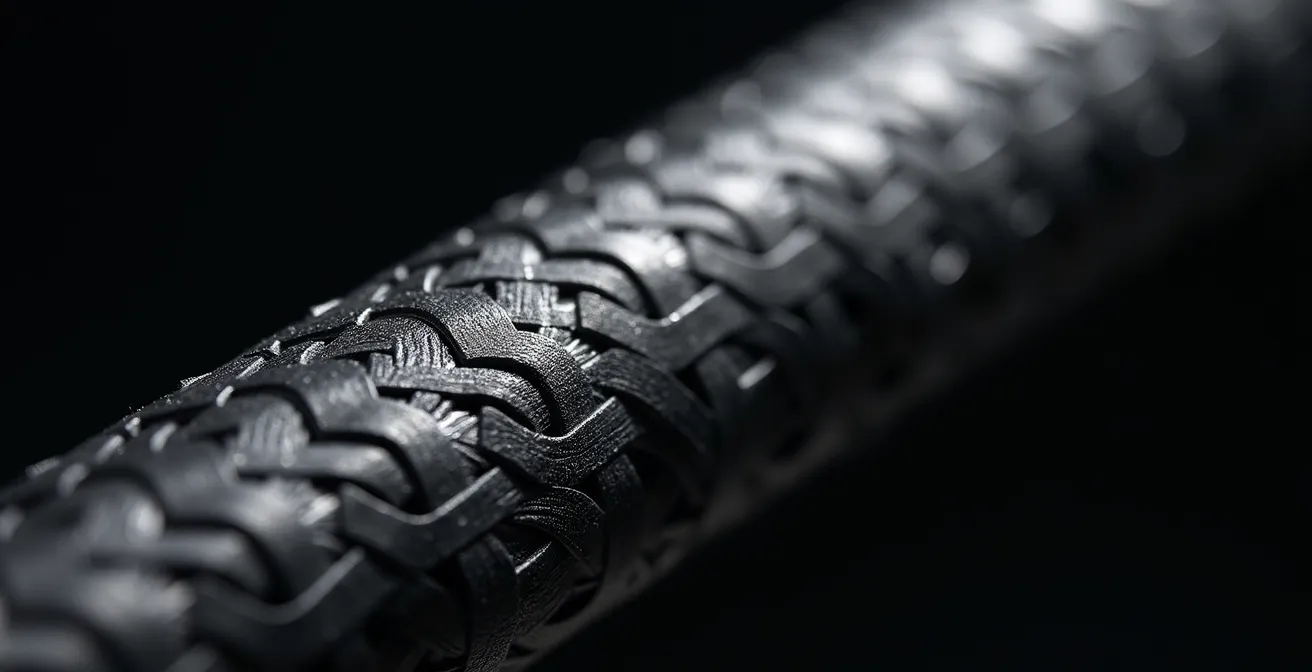
This isn’t just a marketing claim; it’s a measurable physical property. Studies show that modern graphite shafts absorb 30-50% more impact vibration than their steel counterparts. This significant reduction in shock means less stress on your joints with every single swing, especially on mishits off the toe or heel. The difference is so pronounced that it has moved graphite shafts from a “comfort” option into the realm of medical recommendation.
Orthopedic specialists frequently recommend graphite shafts for patients with arthritis, tennis elbow, or other joint conditions. Physical therapists working with golfers often suggest transitioning to graphite golf shafts for irons as part of injury prevention programs.
– GolfGear360 Editorial Team, GolfGear360 Ultimate Guide to Graphite Shafts
By switching to graphite, you are effectively installing a suspension system in your irons, allowing you to play more often, with less pain, and a dramatically reduced risk of aggravating chronic conditions. It allows you to focus on your shot, not the potential pain that will follow.
Does High Torque in Graphite Shafts Really Make Your Dispersion Worse?
One of the oldest and most persistent myths about graphite shafts is that they are “whippy” and lead to a wide dispersion of shots. This fear is rooted in a misunderstanding of a key specification: torque. Torque is a measurement, in degrees, of how much a shaft will twist during the swing. A high-torque shaft (e.g., 5.0° or higher) twists more easily, while a low-torque shaft (e.g., 2.5°) is more resistant to twisting. The old belief was that more twisting equals less control. The modern reality is that torque is a fitting tool, not an inherent flaw. The goal is to match the torque rating to the golfer’s swing speed and characteristics.
For a senior golfer with a slower swing speed, a higher torque rating is often beneficial. It can help square the clubface at impact, promoting a draw and combating the dreaded slice. Conversely, a powerful, fast-swinging player using a high-torque shaft would likely hit uncontrollable hooks, as the shaft would twist too much for their aggressive move. The key is not to seek the lowest torque number possible, but the correct one for your swing. Modern graphite shaft manufacturing allows for incredible precision in controlling this variable, enabling a fitter to dial in the perfect feel and performance.
A proper fitting solves this puzzle. As shown in the following table from a detailed guide on graphite shaft technology, ideal torque is directly related to swing speed.
| Swing Speed | Ideal Torque Range | Effect on Ball Flight | Best For |
|---|---|---|---|
| Below 75 mph | 4.5-6.0° | Higher launch, draw bias | Seniors, slice correction |
| 75-90 mph | 3.5-4.5° | Moderate launch, neutral | Average golfers |
| Above 90 mph | 2.5-3.5° | Lower launch, fade bias | Strong players, hook correction |
Case Study: A Golfer’s Successful Torque-Managed Transition
A 58-year-old amateur with a 12 handicap successfully transitioned from steel to AeroTech SteelFiber i70 graphite shafts due to arthritis. A professional fitting identified the optimal torque specification for his swing profile, delivering a perfect balance between performance and comfort. The result was consistent distance gaps and improved accuracy throughout his iron set, disproving the myth that graphite leads to poor dispersion when properly fitted.
Swing Weight Issues: Adjusting to the Lighter Feel of Graphite Irons?
The most common initial reaction for a golfer trying graphite irons for the first time is, “They feel too light. I can’t feel the clubhead.” This sensation is real, and it’s directly related to a concept called swing weight. Swing weight is a measurement of how heavy a club feels during the swing, not its total static weight. It’s determined by the balance point of the club. Because graphite shafts are significantly lighter than steel, installing them in a standard iron head dramatically lowers the swing weight, often creating a head-light feel that can disrupt a golfer’s tempo and timing.
In fact, a typical swing weight loss when switching from 120g steel to 70g graphite shaft can be as much as nine points (e.g., from D2 to C3). For a golfer accustomed to the feel of a heavier club, this can be deeply unsettling. However, this is one of the most easily solvable problems in club fitting. Restoring the club’s swing weight to a familiar level (typically D2 or D3 for men’s irons) is a standard procedure that ensures the transition to graphite is seamless. The goal is to get the speed and vibration benefits of graphite without sacrificing the familiar feel you rely on for tempo.
It is crucial to work with a qualified club fitter to manage this change. Simply installing graphite shafts without adjusting the swing weight is a recipe for failure. A fitter will use several professional methods to restore that essential clubhead feel, ensuring your rhythm and confidence remain intact.
Your Action Plan: Restoring Swing Weight After a Graphite Switch
- Assess current feel: First, hit the new setup to determine if the lighter feel is actually a problem for your tempo. Some players adapt quickly.
- Add lead tape: Work with a fitter to apply lead tape in 2-gram increments to the clubhead to find the ideal feel. This is a simple, reversible first step.
- Install tip weights: For a more permanent solution, have a club builder insert specific weights into the shaft tip before installing the head.
- Consider heavier heads: When buying new, some manufacturers offer slightly heavier head models designed specifically for use with graphite shafts to pre-solve this issue.
- Allow for an adjustment period: Even with a perfect swing weight match, give yourself 2-3 weeks of practice to fully adjust your tempo to the new weight distribution.
Why Are Graphite Shaft Upgrades So Much More Expensive Than Steel?
When considering an upgrade, the price difference between steel and graphite shafts is often a significant hurdle. A standard steel shaft might cost $30-$40, while a premium graphite iron shaft can easily exceed $100. This isn’t arbitrary price gouging; it’s a direct reflection of the vastly different materials and manufacturing processes involved. A steel shaft is, relatively speaking, a simple product. It’s an extruded, seamless piece of metal tubing. The process is highly automated, efficient, and has been refined for decades.
Graphite shaft manufacturing, on the other hand, is a far more complex and labor-intensive craft. It begins with “pre-preg,” which are sheets of carbon fiber material pre-impregnated with a specialized resin. These sheets are cut into intricate patterns, or “flags,” and are then hand-rolled by skilled technicians onto a steel mandrel. The number of layers, the angle of the wrap, and the specific pattern of the flags all contribute to the final weight, flex, and torque of the shaft. This process allows for an almost infinite level of customization, but it is slow and requires immense precision. After rolling, the shafts are cured in high-temperature ovens, sanded, painted, and tested. The entire journey from carbon fiber sheet to finished shaft is a multi-step, high-tech process that simply costs more to execute.
When you see the current market price for premium Fujikura Axiom 125 graphite iron shafts at around $105-115 per shaft, you are paying for this intricate engineering. You’re not just buying a lighter material; you’re investing in a piece of equipment where every performance characteristic has been precisely controlled through a sophisticated and costly manufacturing process.
Speed after 60: What Are Realistic Expectations for Senior Swing Speed?
For the senior golfer, the pursuit of speed is not about chasing the numbers you had at 30. It’s about smart, sustainable performance. The primary goal should be to first stop the decline, and then to claw back a few crucial miles per hour. Switching to lightweight graphite shafts is a cornerstone of this strategy. For many golfers, the simple act of reducing the club’s overall weight can instantly add 2-3 mph to their clubhead speed without any changes to their swing mechanics. As the CaddieHQ team notes, this seemingly small gain has a significant on-course impact, potentially adding “an extra 10, 15, or even 20 yards of distance.”
However, it’s vital to frame this with realistic expectations. The true victory for a golfer over 60 isn’t necessarily a net gain in speed year-over-year, but rather maintaining your current speed. Fighting off age-related decline is a win in itself. The focus should shift from raw speed to efficiency. Are you getting the most out of the speed you have? This is where tracking your “smash factor” (ball speed divided by clubhead speed) becomes a more important metric than clubhead speed alone. A good goal is a smash factor of 1.40 or higher with your irons. This indicates you’re making centered contact and efficiently transferring energy.
Setting realistic goals is key to staying motivated and measuring success correctly. Consider these benchmarks for your journey:
- Establish a Baseline: Use a launch monitor to find your current average driver and 7-iron swing speeds.
- Set Incremental Goals: Aim for a 2-3 mph increase over a 3-6 month period through equipment changes and targeted exercises.
- Focus on Maintenance: After an initial gain, view maintaining that speed year-over-year as a primary success.
- Track Efficiency: Monitor your smash factor. Improving from 1.35 to 1.42 with the same swing speed is a huge win for distance.
- Measure in Yards: Ultimately, the goal is distance. A consistent 5-10 yard gain in carry distance is a significant and realistic achievement.
Lower Back Pain: How Weak Glutes Force Your Back to Do All the Work?
Lower back pain is the number one ailment that drives golfers from the game. While many attribute it to a “bad back,” the issue often originates elsewhere: the glutes. In a correct golf swing, the powerful gluteal muscles should initiate the downswing, creating rotation and power from the ground up. However, as we age and lead more sedentary lives, these muscles can become weak or “inactive.” When the glutes don’t fire properly, the body is forced to find power from another source. All too often, that source is the lower back, which is violently torqued in a way it was never designed for. This compensation pattern is a direct path to chronic pain and injury.
This is another area where lightweight graphite shafts provide a crucial, though indirect, benefit. Swinging a heavier steel club requires more muscular effort. When fatigue sets in during the back nine, your body will take any shortcut it can to generate power. This often means abandoning proper sequencing and recruiting the lower back to heave the heavy club through impact. Lighter graphite shafts reduce the overall physical load of the swing. This makes it easier for the body to maintain proper posture and sequencing, especially under fatigue. It allows your glutes, the correct engine for the swing, to remain the primary power source instead of forcing your lower back into a dangerous compensatory role.
Case Study: The Biomechanical Benefit of Lighter Equipment
Biomechanical analysis shows that golfers using lighter graphite shafts can maintain better posture throughout their swing by reducing the strain on supporting muscles. This reduced weight allows the glutes to properly engage as the primary power source, rather than having the player compensate with excessive and harmful lower back rotation. This benefit is most pronounced during the later holes of a round when fatigue makes poor mechanics more likely.
Of course, equipment is only part of the solution. Activating your glutes before a round is a simple, powerful way to ensure they’re ready to work. A few simple pre-round exercises can wake up these muscles and remind your body of the correct movement pattern:
- Glute Squeezes: While standing, simply squeeze your glutes and hold for 5 seconds. Repeat 10 times.
- Monster Walks: With a resistance band around your thighs, take 10 wide steps sideways in each direction.
- Hip Bridges: Lie on your back and drive your hips upward, focusing on a strong glute contraction at the top. Perform 15 slow reps.
Key Takeaways
- Graphite shafts are not just for comfort; they are a performance tool that allows slower-swinging players to load the shaft properly, increasing speed and carry distance.
- The material’s natural vibration-dampening properties can reduce impact shock by 30-50%, making it a near-medical necessity for golfers with arthritis or joint pain.
- A successful transition to graphite is a system: it requires matching shaft weight to your speed, torque to your ball flight needs, and adjusting swing weight to preserve your tempo.
Chasing Speed: How to Increase Swing Speed Without Ruining Your Mechanics?
Once you’ve made the switch to graphite and stabilized your game, the question often becomes, “Can I get even faster?” The answer is yes, but the method matters. The modern golf fitness world is full of “overspeed” training protocols using weighted sticks. While effective, these can pose a risk to senior golfers if they encourage a “brute force” approach that can damage mechanics or lead to injury. For the senior player, the most effective and safest path to more speed is one that prioritizes efficiency and sequencing over raw power. The goal is to swing faster, not just harder.
Lightweight graphite shafts are the perfect platform for this type of training. They allow you to practice making a faster, more fluid motion without the strain of a heavy club. This helps engrain the feeling of speed in your nervous system. By focusing on a smooth sequence—letting the hips lead, the torso follow, and the arms and club act as the final whip—you can add miles per hour without sacrificing balance or control. As noted by one report on the advantages of graphite shafts, this can translate into an extra 10 to 20 yards of distance. This is sustainable speed, born from better mechanics, not just more effort.
There are multiple paths to gaining speed, each with different risks and rewards. Choosing the right one depends on your physical condition and goals. A smart approach often combines several methods, with a focus on low-risk, high-efficiency techniques.
| Method | Equipment Used | Speed Gain Potential | Mechanics Risk |
|---|---|---|---|
| Lightweight Training | Graphite shafts, alignment sticks | 3-5 mph sustainable | Low – maintains sequence |
| Overspeed Training | Speed sticks, weighted clubs | 5-8 mph aggressive | Medium – requires monitoring |
| Sequencing Focus | Standard graphite setup | 2-4 mph efficient | Very Low – improves mechanics |
| Strength Training | Gym equipment | 4-6 mph long-term | Low with proper coaching |
Ultimately, the chase for speed should never compromise the health and longevity of your swing. By using graphite shafts as your foundation and focusing on efficient sequencing, you can build a faster, more powerful swing that will last for years to come.
The evidence is clear: switching to graphite shafts is the single most impactful equipment change a senior golfer can make to reclaim distance, eliminate pain, and extend their time on the course. To truly unlock these benefits, the next logical step is to move from theory to practice with a professional analysis of your swing. A qualified club fitter can translate your unique numbers into the perfect shaft, transforming your game for the next decade.