
The secret to conquering a tough course isn’t hitting more heroic shots; it’s completely eliminating the catastrophic holes that kill your scorecard.
- Course architects use specific visual tricks and hazard placements to bait you into making poor, ego-driven decisions.
- A data-driven game plan, built before you even step on the first tee, is more valuable than a perfect swing on the day.
Recommendation: Stop playing golf and start playing chess against the course. Learn to identify and sidestep the architect’s traps, take your medicine when you’re in trouble, and prioritize a boring par over a heroic double-bogey.
Listen up. You stripe it on the range, your swing feels dialed in, and you step onto the first tee feeling like a world-beater. Three hours later, you’re signing for a 92, wondering where it all went wrong, and you’ve lost half a dozen of your favorite balls. Sound familiar? The problem isn’t your swing, kid. The problem is you’re playing the wrong game. You’re trying to overpower the course, but the course is playing chess, and you’re playing checkers.
Most advice tells you to “hit it straighter” or “know your yardages.” That’s table stakes. It’s what you do with that information that matters. The architect laid out this course with one goal in mind: to trick you. They use doglegs, water hazards, and strategically placed bunkers as bait. They know your tendencies. They know the shot you *want* to hit, the hero shot you see on TV, and they’ve built a trap right around it. They are daring you to take the bait.
But what if you could see the course through my eyes? After 20 years of looping on tour, I can tell you the best players in the world win not because they hit the most amazing shots, but because they hit the *fewest* stupid ones. They have a game plan. This isn’t about finding a magic swing thought. This is about developing a new way of thinking. It’s about learning to read the architect’s playbook, avoiding the sucker punches, and managing your game to score lower even on your “off” days. We’re going to deconstruct the course’s biggest challenges and build a strategy to navigate them like a pro.
In this guide, we’ll break down the strategic puzzles presented by the course. We will move from understanding the ‘why’ behind hazard placement to the ‘how’ of executing smart plays, giving you a complete framework for better course management.
Summary: A Caddie’s Guide to Outsmarting the Golf Course
- Why Architects Place Bunkers exactly Where You Hit Your Best Drive?
- Lay Up or Go for It: Making the Right Decision on a Par 5 Over Water?
- The 4 Subtle Signs on the Scorecard That Reveal a Hidden Water Hazard
- How to Strike the Ball Cleanly When the Ball Is Below Your Feet?
- Losing the Tournament on the 1st Hole: The Danger of Driver on Tight Par 4s
- Taking Your Medicine: When to Chip Out Sideways Instead of Hero Shot?
- Sideways or Backwards: How to Escape a Deep Pot Bunker on the First Try?
- How to Break 80 Without Making a Single Birdie Through Course Management?
Why Architects Place Bunkers exactly Where You Hit Your Best Drive?
Here’s the first thing you need to get in your head: architects aren’t your friends. That bunker sitting 250 yards out, right in the middle of the fairway? That’s not bad luck. That’s a trap, and you’re the target. They know the average golfer loves to hit driver. They also know where that drive is most likely to land. So they put a magnet for golf balls right there. It’s designed to punish the “good” shot that isn’t a “smart” shot. It dares you to take it on, and it collects balls all day from players who let their ego write checks their swing can’t cash.
Your job is to stop seeing the fairway as the target and start seeing a ‘safe corridor.’ This is a 30-to-40-yard-wide runway between the trouble spots. The DECADE Course Management System is built on this philosophy of data-driven decisions, eliminating guesswork. It’s not about aiming for the center; it’s about defining where you absolutely cannot go and playing away from it. This means sometimes your ideal landing spot is the left or right side of the fairway, setting up a better angle for your approach and taking that “perfectly placed” bunker completely out of play. It might mean leaving the driver in the bag and hitting a club that can’t even reach the trouble.
Lay Up or Go for It: Making the Right Decision on a Par 5 Over Water?
You’ve crushed your drive on a Par 5. You’ve got 220 yards to the green, but there’s a lake guarding the front. The hero in you is screaming “GO FOR IT!” Now, let me be the voice of reason in your ear. According to comprehensive data analysis, high-handicap golfers (20+) successfully execute long water carries only 12% of the time. Let me repeat that: you have about a 1-in-10 chance of pulling off that shot. Are you feeling lucky? Because the casino, I mean the golf course, loves those odds.
This isn’t a feeling; it’s math. Your decision to go for it or lay up should be a cold, hard calculation of risk versus reward, not a moment of hopeful ambition. Smart players don’t guess; they calculate their expected score based on the shot. This is exactly how the pros think.
| Scenario | Success Rate | Expected Score | Recommended Action |
|---|---|---|---|
| 220-yard carry (20+ handicap) | 20% | 6.8 | Lay up |
| 220-yard carry (10 handicap) | 50% | 5.5 | Consider conditions |
| 220-yard carry (scratch) | 75% | 4.8 | Go for it |
| Simple layup to 100 yards | 90% | 5.2 | Safe play |
Look at that table. A simple layup gives a 20-handicapper a better expected score than trying to be a hero. Even the best players don’t force it. In his prime, Tiger Woods’ strategy was clear. As reported by Golf State of Mind, Tiger said he would make sure he birdied most of the par 5s, throw in a couple more birdies, and then avoid mistakes with conservative strategy. He picked his spots. Laying up isn’t a failure; it’s a strategic move to guarantee you a simple wedge shot for your third, giving you a great look at birdie and almost guaranteeing a par.
The 4 Subtle Signs on the Scorecard That Reveal a Hidden Water Hazard
The scorecard is more than just a place to write down your bogeys. It’s a treasure map, if you know how to read it. The architect leaves clues all over it, little breadcrumbs that tell you where the real danger is. Before you even see the course, you can spot the holes designed to ruin your day. You just have to learn the language. It’s about seeing the patterns, not just the numbers.
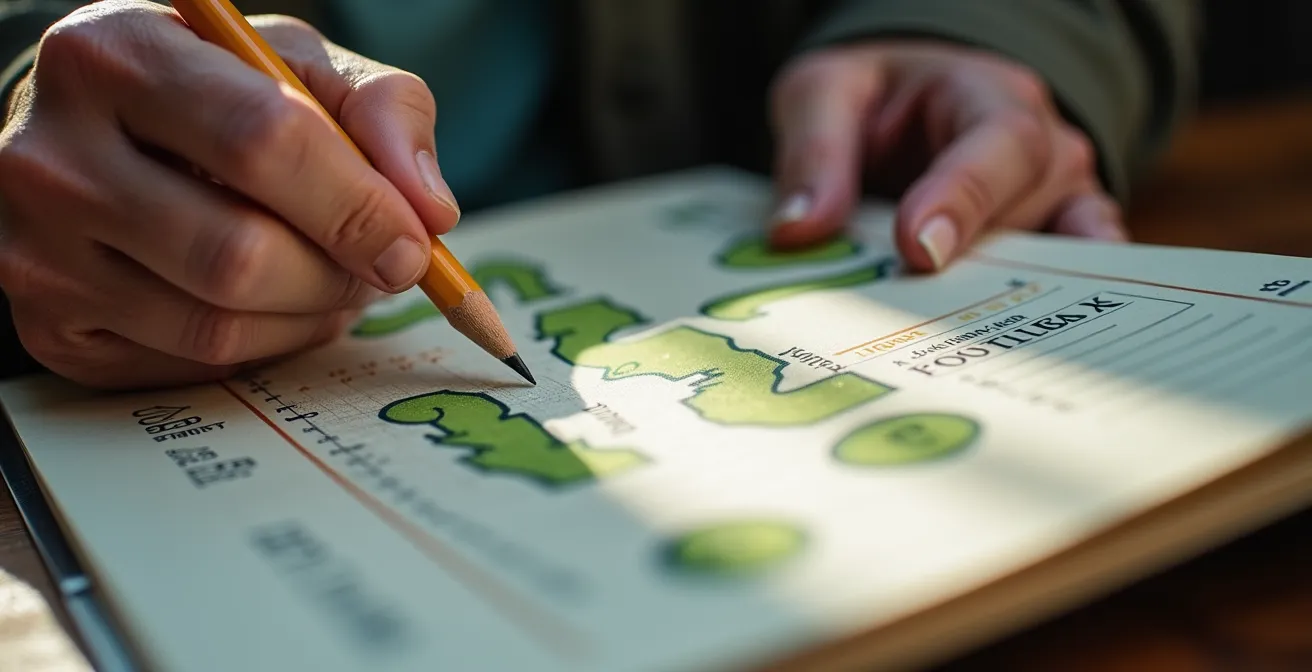
Looking at the scorecard and yardage book is your pre-round homework. You’re looking for anomalies, for things that don’t quite add up. A very short Par 4 with the #1 handicap? That’s a red flag. The architect is telling you there’s a hidden challenge that has nothing to do with length. It could be a forced carry over a creek you can’t see from the tee, or a green so well-guarded it demands a perfect shot. Your job is to identify these potential disasters before you’re standing over the ball.
Your Pre-Round Hazard Detection Plan:
- Check for Handicap Index Anomaly: Very short Par 4 with low handicap (1-5) indicates hidden strategic challenge.
- Analyze Dogleg Yardages: Different measurements to the corner vs. the total distance suggest a forced carry or that cutting the corner is a trap.
- Study Topographical Clues: Holes at the property’s lowest point are natural collection areas for water or marshland, even if not marked.
- Note Green and Tee Proximity: A long walk from a green to the next tee often means you had to cross a ravine or creek you might not have noticed.
- Look for Unnatural Gaps: Large empty spaces on the course map that aren’t another fairway often hide water features or environmentally sensitive areas.
How to Strike the Ball Cleanly When the Ball Is Below Your Feet?
Alright, so you’ve found yourself on the side of a hill, ball below your feet. This is where a good score can start to unravel. Your body wants to do all sorts of weird things, and the most common result for an amateur is a thinned or shanked shot that dives further into trouble. The key here isn’t to try a “normal” swing. You have to make adjustments to your setup to match the slope. The hill is going to naturally make the ball fly from left-to-right (for a righty), so the first step is to accept that and play for it.
Forget trying to force the ball straight. The slope will win. Your only job is to make solid contact. To do that, you need to get lower and stay lower. This is about stability and balance, not power. Here’s the no-BS checklist I give my players:
- Aim left of your target (for a right-handed golfer). The ball will want to fade, so start it left and let the slope bring it back.
- Widen your stance significantly. This creates a more stable base and keeps your lower body from getting too active.
- Bend more from your knees, not your waist. Think of sitting down into the shot. This helps you maintain your spine angle through the swing, which is crucial for clean contact.
- Take one extra club and make a smooth, 80% swing. Trying to kill it from an awkward lie is a recipe for disaster. The extra club ensures you have enough stick, and the smoother swing ensures solid contact.
- Take a few practice swings to brush the grass. See where the club naturally hits the ground. Adjust your ball position to match that spot.
Losing the Tournament on the 1st Hole: The Danger of Driver on Tight Par 4s
The first tee. All eyes are on you. You’ve got the brand new driver in your hand, ready to unleash a bomb and set the tone for the day. But you look down the fairway and it’s no wider than a hallway, with trees left and right. This is the ultimate test of ego vs. intellect. Hitting driver here is a gamble. A perfect shot is rewarding, but a miss is a reload, a punch-out, or worse. You can’t win the tournament on the first hole, but you can absolutely lose it.

The smart play, the caddie play, is to take the big trouble out of the equation. Your goal on a tight hole isn’t to get as close to the green as possible. It’s to get your ball *in play* for your second shot. That’s it. A 3-wood, a hybrid, or even a long iron that leaves you 150 yards out is infinitely better than a driver that’s lost in the woods. This is a point echoed by the pros themselves. One PGA Tour Professional, quoted by the Keiser University College of Golf, puts it bluntly: “The driver is not always the smart play, so go ahead and hit a 3-metal or hybrid to find more fairways.”
Think of it this way: what club gives you the highest probability of hitting the fairway? Even if it’s a 5-iron, that’s your play. Starting the day with a simple par, even if it feels “boring,” builds momentum and confidence. Starting with a triple-bogey because your driver went sideways creates pressure that will haunt you for the next 17 holes. Put the ego away. Choose the club that keeps you in the game.
Taking Your Medicine: When to Chip Out Sideways Instead of a Hero Shot?
You’re in the trees. You’ve got a tiny window to the green, a branch hanging over your backswing, and your feet are on a pile of pine needles. The hero shot is there… if you hit it perfectly, bounce it off the right branch, and get a lucky kick. This moment, right here, is what separates the 70s shooters from the 90s shooters. It’s the decision to “take your medicine.” Chipping out sideways feels like a failure, like giving up. But in reality, it’s one of the smartest, most score-saving plays in golf.
Tour players have a system for this. It’s not emotional. They assess the risk level of a shot as Green (go for it), Orange (caution), or Red (stop, do not attempt). A shot that requires a perfect swing AND a lucky bounce is a deep, dark Red. Part of a good course strategy is being able to honestly assess your chances. The goal is to eliminate the “big number.” A failed hero shot often leads to a double or triple bogey. A simple chip out to the fairway turns a potential 7 or 8 into a bogey at worst. You’re trading a 10% chance of a miracle par for a 90% chance of avoiding a disaster.
Here’s how to make that call:
- Are you in ‘Double-Sided Jail’? If you need a perfect shot AND a lucky bounce, it’s an automatic chip out. No debate.
- Apply the ‘Next Shot Rule’: Can you clearly visualize the next shot if your hero attempt fails? If it leaves you in even worse trouble, chip out.
- Reframe your thinking: It’s not a “chip out,” it’s a “repositioning shot.” You’re not giving up on the hole; you’re placing your ball in the ideal spot to attack for your next shot.
When in doubt, remember that one of the biggest mistakes average golfers make is trying to pull off a shot they haven’t practiced, under pressure. Take your medicine. It might taste bad for a second, but it will heal your scorecard.
Sideways or Backwards: How to Escape a Deep Pot Bunker on the First Try?
If you’ve never been in a true Scottish-style pot bunker, let me paint a picture: it’s a small, deep pit with a face as tall as you are, and it’s designed to swallow your ball and your soul. As Tiger Woods once said about the bunkers at The Open Championship, “These pots are unlike any bunkers we see at home.” Forget everything you know about normal bunker shots. The pin is irrelevant. The direction “forward” is irrelevant. Your one and only goal is to get out, on the first try, in any direction necessary.
The numbers don’t lie. Data from Shot Scope, a golf performance tracking company, reveals that the average amateur golfer has a sand save percentage of just 20% from a regular bunker. From a pot bunker, that number plummets. Getting out in one is a victory. To do it, you need a different technique and a different mindset.
- Apply the ‘Lip is Lava’ Rule: Your absolute priority is clearing the lip. Even if it means hitting the ball backwards into the fairway. Failure to get out is the cardinal sin.
- Use a ‘Clock Face’ visualization: Imagine the bunker is a clock face. Identify the lowest point of the lip—your safest exit. That is your only target, regardless of where the pin is.
- Take your most-lofted wedge (at least 58 degrees), and open the face wide open *before* you take your grip.
- Dig your feet in deep for a stable base, and keep your hands exceptionally high at address to encourage a steep swing.
- Focus on speed. You need to swing fast through the sand. The faster the clubhead, the higher and quicker the ball will pop up.
Accepting that a sideways or backwards shot is the correct play is tough for the ego, but it’s essential for survival. One shot out is infinitely better than two, three, or four shots ping-ponging against the face of the bunker.
Key takeaways
- Stop trying to hit perfect shots and focus on avoiding score-killing mistakes.
- Develop a pre-round game plan based on identifying and avoiding the architect’s traps.
- Embrace “boring” golf: a layup, a chip-out, and an iron off the tee are strategic weapons, not signs of weakness.
How to Break 80 Without Making a Single Birdie Through Course Management?
This is where it all comes together. The idea of breaking 80 seems like it should be full of heroic shots and fist-pumping birdies. The reality is far less glamorous and far more achievable. You can break 80, even 85, without making a single birdie. The entire secret lies in ruthless avoidance of the double-bogey. It’s a game of subtraction, not addition. A round of 79 on a par 72 course is just seven bogeys and eleven pars. Think about that. You don’t need perfection. You need consistency and damage control.

This is achieved by implementing a ‘Personal Par’ system. On the hardest holes on the course, your par is a bogey. You play them for a safe 5 on a Par 4. You aim for the widest part of the fairway, the fattest part of the green, and you never, ever flirt with the trouble. This takes all the pressure off. On the easier holes, you play more aggressively for your real par. This kind of strategic planning, thinking ahead about shot placement and desired outcomes, is the key. You’re not just hitting shots; you’re managing your way around the course like a pro navigating a minefield. The small gains add up. Shot Scope analysis of 200,000 rounds shows the average score per round has improved slightly in recent years. This isn’t from everyone suddenly hitting it 300 yards; it’s from smarter play.
A round of bogey golf is not a failure; for most amateurs, it’s a massive success. It’s built on a foundation of smart decisions: leaving the driver in the bag, laying up on Par 5s, chipping out of trouble, and aiming away from sucker pins. It’s “boring” golf, and it’s the most effective way to shatter your scoring barriers.
The advice is on this page. The hard part is putting it into practice. Your next step isn’t to go to the driving range and beat balls. It’s to sit down with the scorecard of your home course, identify the danger zones, and build a game plan to avoid them. Stop letting the course dictate the terms and start playing the game on your own. Now go do the homework.