
The distance overlap between your irons is a symptom of a systemic failure in your equipment’s performance matrix, not just an isolated loft problem.
- It’s often caused by a combination of aggressive modern lofts reducing critical spin, incorrect lie angles altering impact dynamics, and mismatched shaft performance.
- Simply bending lofts is a temporary fix that can create other performance issues, like poor stopping power on the greens.
Recommendation: A full diagnostic analysis, using a launch monitor to measure carry, launch, spin, and descent angle, is the only way to accurately identify the root cause and restore predictable gaps.
You execute two solid swings, one with your 7-iron, one with your 8-iron. You look up to see both golf balls landing in the same vicinity, a frustratingly familiar outcome. This phenomenon, known as distance overlap or gapping compression, is a common problem for many golfers. The immediate assumption is often that the clubs are “bad” or the lofts are wrong. While club specifications are part of the equation, the issue is rarely that simple.
The conventional wisdom often points to “strong lofts” on modern irons as the sole culprit. While it’s true that a modern 7-iron often has the loft of a traditional 5-iron, this is only one variable in a complex performance equation. The problem of your 7-iron and 8-iron traveling the same distance is not a single point of failure; it is a breakdown of the entire system. It signals a collapse in the delicate relationship between static loft, dynamic loft at impact, shaft energy transfer, and swing delivery.
This guide abandons simplistic fixes and adopts the perspective of a club fitting analyst. We will treat your iron set as an integrated system. The true solution lies not in simply bending a club, but in a systematic diagnosis of why the predictable, incremental distance gaps between your clubs have disappeared. We will dissect each component—from loft and lie to shaft material and head design—to understand how they contribute to, or detract from, functional gapping.
By analyzing the system holistically, we can identify the precise point of failure and implement a data-driven solution. This article will walk you through that diagnostic process, providing the analytical framework needed to restore order and predictability to your iron game, ensuring every club in your bag has a distinct and reliable purpose.
Summary: Iron Set Gapping: A Diagnostic System Analysis
- Strong Lofts: Are Your New Irons Really Longer or Just Deceived by Loft?
- Combo Sets: When Should You Mix Cavity Backs with Muscle Backs?
- Steel vs Graphite in Irons: Which Material Preserves Your Elbows?
- Upright or Flat: How Lie Angle Affects Your Shot Direction?
- Groove Wear: When Does an Iron Set Lose Its Stopping Power on Greens?
- How Cavity Back Irons Keep Your Ball Straight on Toe Hits?
- Hybrids over Long Irons: Why Beginners Should Avoid the 3 and 4 Iron?
- Is Custom Fitting Worth the Money for a Mid-Handicap Golfer?
Strong Lofts: Are Your New Irons Really Longer or Just Deceived by Loft?
The primary suspect in any gapping compression investigation is the trend of “strong” or “jacked” lofts. Manufacturers have progressively strengthened iron lofts over the years, stamping a “7” on a club that has the loft of a traditional 5-iron. While this produces impressive total distance numbers on a launch monitor, it often comes at a significant cost to performance. The core issue is the relationship between launch, spin, and descent angle. A lower-lofted club naturally produces less spin and a lower peak height.
When the loft difference between two consecutive irons (e.g., 7i and 8i) is a standard 4 degrees, it typically generates a predictable gap in spin and carry. However, if a player’s swing dynamics don’t generate enough speed, two strong-lofted irons can produce nearly identical ball flight characteristics. The 7-iron, despite its lower static loft, may not be launched with enough speed to differentiate its carry distance from the 8-iron. The result is dynamic loft compression, where the delivered loft at impact fails to create a functional distance gap.
Furthermore, this chase for distance often sacrifices stopping power. A tour-level 7-iron shot has an average descent angle of 50 degrees, allowing it to hold greens effectively. Many amateur players with strong-lofted irons see descent angles well below 45 degrees, causing their shots to release and run over the back of the green. Therefore, the first diagnostic step is to analyze not just the carry distance, but the entire launch-spin-descent matrix. Sacrificing control for nominal distance is a failing strategy.
Combo Sets: When Should You Mix Cavity Backs with Muscle Backs?
Viewing an iron set as a single, homogenous entity is a flawed premise. Advanced players and discerning fitters treat the set as a system of components that can be optimized individually. This is the principle behind a “combo set,” which strategically blends different iron designs to maximize performance where it’s needed most. The most common combination involves pairing forgiving, perimeter-weighted cavity back (CB) irons in the long and mid-irons with more precise, feel-oriented muscle back (MB) or player’s cavity irons in the short irons.
The logic is based on the different demands of each club. With a 4- or 5-iron, the primary goal is achieving a target carry distance with maximum forgiveness on off-center strikes. A CB design, with mass distributed to the heel and toe, increases the Moment of Inertia (MOI), stabilizing the clubface on mis-hits and preserving ball speed. This is crucial for maintaining consistent gapping at the longer end of your bag.
Conversely, with a 9-iron or pitching wedge, the focus shifts from raw distance to precision, trajectory control, and feel. A muscle back iron, with its mass concentrated behind the sweet spot, provides superior feedback and allows skilled players to manipulate ball flight more effectively. The transition point—often between the 7-iron and 8-iron—is critical. A well-designed combo set ensures a seamless transition in feel, look, and, most importantly, performance metrics like launch and spin, preventing the creation of an unexpected distance gap or overlap.
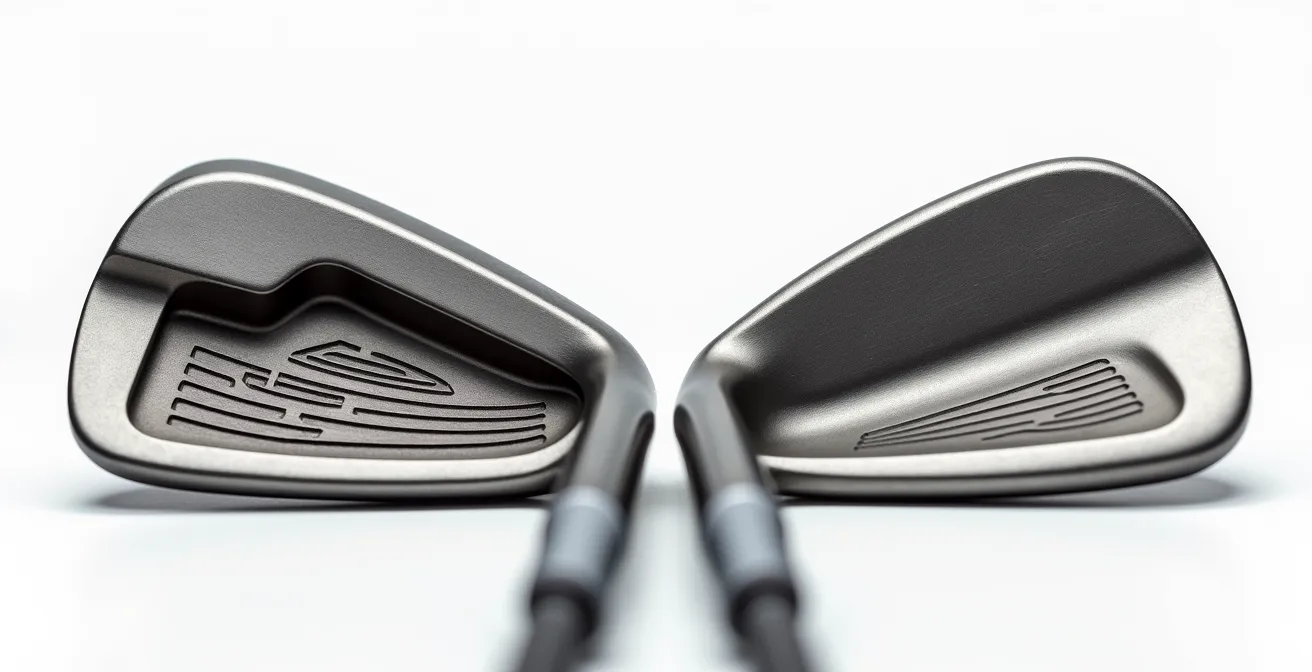
As this image illustrates, the fundamental difference in mass distribution between a muscle back and a cavity back directly impacts feel and forgiveness. A successful combo set manages this transition to create a cohesive performance system, not just a collection of individual clubs. It is a deliberate engineering choice to optimize the system’s integrity from the 4-iron through the wedge.
Steel vs Graphite in Irons: Which Material Preserves Your Elbows?
While the conversation around gapping often centers on the clubhead, the shaft is the engine of the entire system. Its material, weight, and flex profile dictate how energy is transferred from the golfer to the ball. The choice between steel and graphite shafts in irons has profound implications for gapping, swing speed, and player health. Historically, steel has been the standard for its consistency, stability, and lower torque. It provides a firm, controlled feel that higher-swing-speed players prefer.
However, steel’s primary drawback is its weight and stiffness, which transmits significant vibration to the player’s hands, elbows, and shoulders at impact. For players with slower swing speeds or those managing conditions like arthritis or tennis elbow, this can be detrimental to both performance and longevity in the game. Graphite shafts, being significantly lighter, offer a clear advantage here. A lighter shaft allows a player to generate more clubhead speed with the same effort, which can help create larger, more distinct distance gaps between irons. Players with slower swings often see minimal distance difference between clubs because they cannot generate enough speed to make the loft difference matter; a lighter graphite shaft can be the solution.
Modern premium graphite iron shafts have also largely overcome the issues of high torque and inconsistency that plagued early models. They now offer a range of weights and bend profiles to rival steel, while maintaining their signature vibration-dampening properties. Therefore, from a gapping analysis perspective, if a player’s clubhead speed is a limiting factor in creating distance separation, a switch to a properly fitted graphite shaft could be the single most effective change to the system.
Upright or Flat: How Lie Angle Affects Your Shot Direction?
Of all the specifications in a golf club, lie angle is one of the most critical and least understood. It is the angle between the center of the shaft and the sole of the clubhead. An incorrect lie angle directly impacts where the club strikes the ground and, consequently, the direction and quality of the shot. For a right-handed golfer, a club that is too upright will cause the heel to dig into the ground first, forcing the face to close and sending the ball left of the target. Conversely, a club that is too flat will cause the toe to dig in, opening the face and sending the ball to the right.
This directional miss is only part of the problem. From a gapping perspective, the real issue is the impact on strike quality and energy transfer. When the lie angle is incorrect, the point of impact on the clubface shifts away from the sweet spot. A heel-heavy or toe-heavy strike results in a significant loss of ball speed and inconsistent launch and spin characteristics. This creates a “geometric cascade” of failures. A player might hit a perfect center strike with their 8-iron but a heel strike with their 7-iron due to an incorrect lie angle, completely erasing the distance gain that the lower loft should have provided. This is a common cause of gapping compression.
It’s also crucial to distinguish between static lie angle (measured in a shop) and dynamic lie angle (the lie of the club at the moment of impact). A player’s swing dynamics—how much they drop or raise the hands through impact—determines their dynamic lie. This is why a professional fitting using impact tape or a lie board is non-negotiable for serious performance. Even clubs from top manufacturers can have slight inconsistencies, so verifying the lie angle of each iron in a set is a fundamental step in building a coherent system.
The consequences of an improperly fitted lie angle are not just directional; they directly corrupt the distance gapping of the entire iron set, as this analysis shows.
| Lie Angle Issue | Strike Pattern | Distance Impact |
|---|---|---|
| Too Upright | Heel-heavy strike | Loss of ball speed, compressed gaps |
| Too Flat | Toe-heavy strike | Reduced speed, inconsistent yardages |
| Properly Fitted | Center strike | Consistent 10-15 yard gaps |
Groove Wear: When Does an Iron Set Lose Its Stopping Power on Greens?
An iron set is a depreciating asset. With every shot, particularly from sandy or abrasive conditions, the sharp edges of the grooves on the clubface begin to wear down. While this degradation is gradual, it has a significant and measurable impact on performance, especially in the scoring clubs. Grooves serve one primary function: to channel away water, grass, and debris from the clubface at impact, allowing for a cleaner strike and maximizing friction between the face and the ball. This friction is what generates spin.
As grooves wear and become rounded, their ability to generate spin diminishes, particularly in wet or rough conditions. This leads to “flyers,” where the ball launches higher, with significantly less spin, and travels much farther than intended. This unpredictability destroys distance control and makes gapping a guessing game. Furthermore, the loss of spin results in a much shallower angle of descent, meaning the ball will not stop as quickly on the green. If you notice your short iron shots are no longer “checking up,” worn grooves are a likely culprit.
Beyond wear, another insidious issue is loft and lie drift, especially with soft forged irons. Over time, repeated impacts—even just from normal play—can cause the hosel to bend slightly, altering the club’s specifications. It is not uncommon for a fitter to find that a player’s 7-iron has drifted 2 degrees stronger and their 8-iron 1 degree weaker, creating a massive 7-degree gap instead of the intended 4 degrees. This is compounded by the fact that even new clubs have manufacturing tolerances; an analysis of these tolerances reveals that ±1° loft tolerance means some irons could have as little as 1° difference between them while others have 5-6°. Regular inspection of loft and lie angles is essential maintenance for preserving the integrity of your iron set’s gapping.
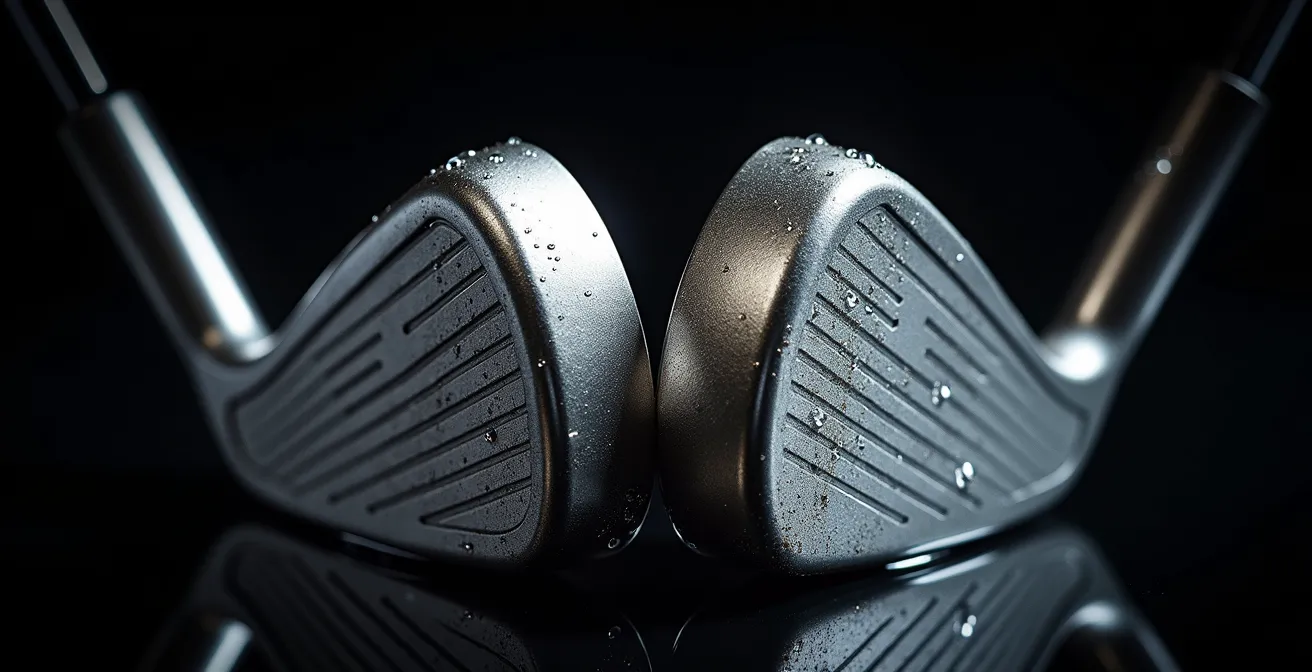
The visual difference between new and worn grooves is stark, and the performance difference is even more dramatic. A periodic audit of your equipment’s physical condition is a necessary part of any performance-oriented player’s routine.
How Cavity Back Irons Keep Your Ball Straight on Toe Hits?
The concept of “forgiveness” in a golf club is not a marketing gimmick; it is a measurable application of physics. A cavity back iron is specifically engineered to minimize the loss of ball speed and reduce side-to-side dispersion on shots that are not struck perfectly in the center of the face. This is achieved by removing mass from the center of the clubhead (creating the “cavity”) and redistributing it to the perimeter—the heel and toe. This redistribution increases the club’s Moment of Inertia (MOI).
A higher MOI means the clubhead is more resistant to twisting on off-center hits. When you strike the ball on the toe, for example, a low-MOI club (like a traditional blade) will twist open significantly, resulting in a large loss of ball speed and a shot that goes well right of the target. A high-MOI cavity back, however, resists this twisting motion. The face remains squarer to the target line, and more of the impact’s energy is transferred to the ball. This is why a toe-hit with a CB iron often feels more solid and flies straighter and longer than the same miss with a blade.
From a gapping perspective, this is paramount. Consistent distance gapping requires consistent ball speed. If your ball speed fluctuates wildly based on strike location, your carry distances will be unpredictable. Cavity back irons create a wider “effective hitting area,” producing more consistent ball speeds across the face. For the average golfer, whose strike pattern is rarely confined to a dime-sized spot on the clubface, this design is essential for building a predictable, functional set of irons. The ultimate goal is consistent gaps, and research from Ping’s VP of fitting shows that you can calculate your ideal spacing by taking your 7-iron ball speed in mph and dividing by 10. A 110 mph ball speed equates to ideal 11-yard gaps, a target that is only achievable with consistent ball speed output.
Hybrids over Long Irons: Why Beginners Should Avoid the 3 and 4 Iron?
The transition from the shortest fairway wood to the longest iron is the most common failure point in a golfer’s bag. Traditional long irons, such as the 3 and 4-iron, are notoriously difficult for most amateurs to hit consistently. They require a significant amount of clubhead speed and a precise, downward angle of attack to launch the ball effectively. For players without elite speed, the result is often low, weak shots that fail to carry much farther than their 5- or 6-iron, creating a massive point of gapping compression.
This is where hybrids have revolutionized bag composition. A hybrid club combines the larger, more forgiving head shape of a fairway wood with the length and swing-feel of an iron. This design places the center of gravity (CG) lower and deeper than in a traditional iron, making it far easier to launch the ball high into the air with adequate spin. For a beginner or slower-swing-speed player, a 4-hybrid is almost always a better choice than a 4-iron, as it will produce a higher, longer, and more consistent ball flight.
However, simply replacing a 4-iron with a 4-hybrid (a 1-for-1 swap) is a common mistake that often creates a new gapping problem: overlap. Hybrids are typically “hotter” than their iron equivalents and can travel much farther. It’s not uncommon for a player to find their new 4-hybrid goes nearly the same distance as their 5-wood, leaving a large, unusable gap between the hybrid and their longest iron (e.g., the 5-iron). Proper hybrid integration requires a data-driven approach, using a launch monitor to map the carry distances and potentially adjusting the lofts of the hybrid or fairway wood to create evenly spaced gaps. A good rule of thumb for initial selection is to choose a hybrid with a loft that is approximately 4 degrees stronger than your longest, most comfortable iron.
Key takeaways
- Distance overlap is a systemic issue, not just a problem with one club. A full diagnostic is required.
- Strong lofts trade distance for control; analyze spin and descent angle, not just carry, to determine true performance.
- Incorrect lie angles are a primary cause of inconsistent strikes and compressed gapping, requiring a dynamic fitting.
Is Custom Fitting Worth the Money for a Mid-Handicap Golfer?
After diagnosing the potential failures in the system—from lofts and lies to shafts and set composition—the question becomes one of resolution. The single most effective way to solve complex gapping issues and optimize every club in the bag is through a professional, data-driven custom fitting. Yet, many mid-handicap golfers hesitate, with over 40 percent believing it costs too much and 30 percent feeling they “aren’t good enough” for a fitting. This is a fundamental misunderstanding of what a fitting accomplishes.
A fitting is not a judgment of your swing; it is a scientific process to match the equipment to your unique swing dynamics. For a mid-handicapper, whose swing may be less consistent than a professional’s, a fitting is arguably *more* valuable. It ensures the equipment is maximizing forgiveness and producing the most consistent possible results for their typical swing, rather than punishing their misses. By optimizing variables like shaft weight, lie angle, and head design, a fitter can build a set that actively helps the player score better. The financial investment is put into perspective when you consider that major OEM research confirms that 87 percent of all golfers who are fit are able to reduce their handicap by at least 10 percent.
Your Gapping Self-Audit Checklist
- Club Analysis: List all irons, noting the problem pair (e.g., 7i, 8i) and their static lofts if known.
- Data Collection: Using a range or launch monitor, hit 5-10 shots with each iron and record the average carry distance for each.
- Gap Consistency Check: Chart the average carry distances and calculate the gap between each consecutive club. Identify any overlaps or unusually large gaps.
- Performance Metrics Review: If using a launch monitor, review not just distance but also spin rate, peak height (apex), and descent angle for each club.
- Action Plan Formulation: Based on the data, identify the most likely issue (e.g., compression between 7i/8i, large gap to hybrid) to discuss with a professional fitter.
For a player experiencing frustrating gapping issues, a fitting isn’t a luxury; it is the most direct path to a solution. Instead of spending money on a new off-the-rack set that may have the same underlying problems, investing in a professional analysis of your current equipment provides a clear, data-backed roadmap for improvement.
Deciding between a DIY approach and a professional fitting depends on the specific issue you’re trying to solve. This matrix provides a clear decision-making framework.
| Your Issue | Recommended Approach | Expected Investment |
|---|---|---|
| Inconsistent gaps between clubs | Professional fitting essential | $150-350 fitting fee |
| Shots always going one direction | Pro fitting for lie angle adjustment | $100-250 + adjustments |
| Testing one new club | DIY approach acceptable | $0-50 demo fee |
| Existing set needs gap audit | Gapping-only session | $75-150 |
To truly solve distance overlap and build a reliable iron set, move beyond guesswork and commit to a systematic, data-driven analysis. The most efficient way to achieve this is to book a gapping session or a full fitting with a qualified professional.