
For the precise player, a laser rangefinder’s true advantage isn’t just accuracy; it’s the creation of ‘decision confidence’ by providing a single, self-acquired number.
- A laser eliminates the mental clutter of multiple GPS distances (front, middle, back), leading to a more committed swing.
- The act of personally “shooting” a target fosters cognitive ownership of the yardage, reducing pre-shot doubt.
Recommendation: Choose a laser for exact pin-hunting and hazard management; use a GPS for strategic overview and layup planning. The combination is ideal, but for improving scoring through confidence, the laser is superior.
The debate between a laser rangefinder and a GPS watch seems straightforward. One offers surgical precision to any target you can see; the other provides convenient, at-a-glance distances to the front, middle, and back of the green. Most golfers stop their analysis there, framing the choice as a simple trade-off between accuracy and speed. For the player who meticulously tracks their stats and feels the sting of every shot left short, this surface-level comparison is insufficient. It misses the most critical factor influencing your performance on the course.
While the technology is important, the real difference lies in the cognitive impact each device has on your pre-shot routine. The common advice focuses on features, battery life, and ease of use. But what if the key to better course management and lower scores isn’t found in the device’s spec sheet, but in how your brain processes the information it provides? The core issue isn’t just getting a number; it’s about getting a number you can trust implicitly, a number that erases doubt and frees you to make a committed, athletic swing.
This analysis moves beyond the generic pros and cons. We will dissect how a laser’s “data-point singularity” reduces mental clutter, why the physical act of targeting creates cognitive ownership, and how this directly translates into the on-course confidence required to break scoring barriers. We will explore the technical features that support this confidence, the practicalities of a laser-first strategy, and how it aligns with the decision-making process of elite players.
This guide will explore the specific functions and strategic applications that make a laser rangefinder an indispensable tool for the serious golfer. The following sections break down everything from tournament legality to the psychological power of a single, definitive number.
Summary: A Deep Dive into Laser and GPS Technology for Golf
- Slope Switch: When Must You Turn Off the Slope Function for Tournaments?
- Jolt and Vibrate: How Locking Technology Confirms You Hit the Flag?
- CR2 vs USB: Should You Buy a Rechargeable Rangefinder?
- Shooting the Lip: How to Use a Laser to Clear Bunkers?
- Trusting the Number: Why Lasers Eliminate Doubt Before the Swing?
- Knowing Your Carry: Why Guessing Your Yardages Leads to Short Shots?
- Player and Caddie: Who Really Makes the Club Decision in Crucial Moments?
- How to Break 80 Without Making a Single Birdie Through Course Management?
Slope Switch: When Must You Turn Off the Slope Function for Tournaments?
One of the most powerful features of modern laser rangefinders is the slope function, which calculates elevation-adjusted “plays like” distances. However, its use is strictly regulated in competitive play. Understanding the rules is non-negotiable for any tournament player. The governing bodies have a clear stance: for a device to be conforming, any feature that measures more than just straight-line distance, such as slope, must be disabled.
The good news is that manufacturers have made compliance simple. Most premium rangefinders designed for competitive players feature an external, physical slope switch. This allows you to easily toggle the function on for practice rounds and off for tournaments, often with a clear visual indicator (like a change in color or a faceplate that slides). A key point is that 100% of USGA and R&A sanctioned tournaments require this function to be disabled. Failing to do so can result in disqualification, making this small switch one of the most important components on your device.
Before your next competition, it’s crucial to verify your device’s settings. A device with a slope function that *cannot* be externally disabled is non-conforming and illegal for tournament play, even if you promise not to use it. The external switch provides a clear, verifiable way for officials to confirm your device is compliant. This removes any ambiguity and allows you to focus on your game, not on a potential rules infraction.
Ultimately, a model with a visible, accessible slope switch gives you the best of both worlds: advanced data for practice and full compliance for competition.
Jolt and Vibrate: How Locking Technology Confirms You Hit the Flag?
One of the classic challenges of using a laser rangefinder is ensuring you’ve measured the distance to the flagstick and not the trees behind it. Early models required a steady hand and a keen eye. Today, this uncertainty is virtually eliminated by haptic feedback technology, often marketed as “Jolt,” “Vibration,” or “Pin-Lock.” This feature provides a short vibration or a visual cue in the display to confirm that the laser has locked onto the pin, ignoring larger objects in the background.
This is more than a convenience; it’s a critical component of building “decision confidence.” The tactile confirmation removes any lingering doubt about the accuracy of the number. Instead of wondering if you hit the target, you *know* you did. This allows you to move from the data-gathering phase to the execution phase of your pre-shot routine more quickly and with greater conviction. An analysis from tech reviewers found that this technology has a tangible impact, with models featuring haptic feedback showing a 95% first-attempt success rate for flag lock compared to just 75% for those without it.
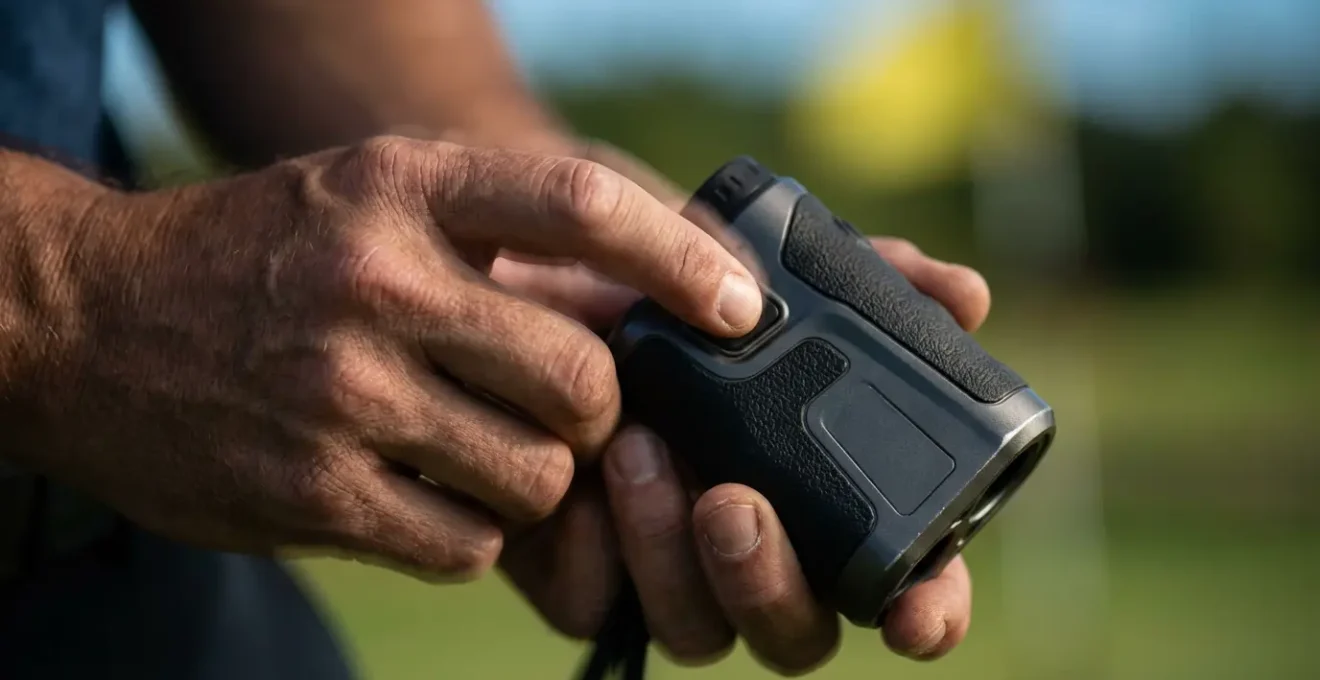
As the image above illustrates, this technology creates a direct interface between the user and the data. The jolt in your hand is an unambiguous signal that the number you see is the number to the flag. This small moment of confirmation has a significant psychological benefit, reducing target acquisition time and, more importantly, freeing up mental bandwidth to focus entirely on committing to the shot. It transforms the rangefinder from a simple measuring tool into an active partner in your decision-making process.
For the precise player, a device without this feature leaves a small but significant window for doubt to creep in, which is precisely what elite course management seeks to eliminate.
CR2 vs USB: Should You Buy a Rechargeable Rangefinder?
The power source of your rangefinder might seem like a minor detail, but it has a real impact on your pre-round preparation and long-term costs. The market is split between two primary systems: disposable CR2 lithium batteries and internal, USB-rechargeable batteries. Each has distinct advantages and disadvantages that cater to different types of golfers. A rechargeable model typically has a higher initial purchase price, but the operating cost over its lifespan is negligible.
Conversely, models using CR2 batteries are often less expensive upfront, but require you to purchase new batteries periodically. While a single CR2 can last for many rounds (6-12 months for the average golfer), there’s always the risk of it dying mid-round. The simple solution is to always carry a spare, a small but necessary piece of planning. A survey of player preferences revealed that golfers often fall into two camps: the ‘Meticulous Planner’ who prefers USB models and integrates charging into their routine, and the ‘Grab-and-Go Golfer’ who favors the reliability of a fresh CR2 battery, citing forgotten charging as their main concern.
This table breaks down the key considerations when choosing between the two power systems.
| Factor | CR2 Battery | USB Rechargeable |
|---|---|---|
| Initial Cost | Lower device price | $30-50 higher device price |
| Annual Operating Cost | $10-20 (2-4 batteries) | $0 (electricity negligible) |
| Battery Lifespan | 6-12 months per battery | 2-3 years before degradation |
| Emergency Solution | Carry spare $5 CR2 battery | Portable power bank required |
| Environmental Impact | Higher (disposable waste) | Lower (but e-waste eventual) |
There is no single “better” option. If you are diligent about charging your devices (phone, watch) before a round, a USB model offers convenience and lower long-term waste. If you prefer the certainty of a quick swap and want to avoid the risk of a forgotten charge, the classic CR2 system remains a robust and reliable choice.
Shooting the Lip: How to Use a Laser to Clear Bunkers?
A GPS watch is excellent for telling you the distance to the middle of a bunker, but it’s often useless for the most critical question: what is the *exact* number needed to carry the front lip? This is where a laser rangefinder provides immense strategic granularity. The ability to measure the distance to any point in your line of sight allows for far more sophisticated course management, especially when navigating hazards. For a forced carry over a greenside or fairway bunker, knowing the precise carry number is the difference between a birdie putt and a penalty.
The process is simple but powerful. First, you “shoot” the top of the bunker lip to get your minimum carry distance. Then, you shoot your intended target beyond it—the flagstick or a safe spot on the green—to establish your maximum distance. This gives you a specific yardage window for your approach shot. For example, if the lip is 145 yards and the pin is 165 yards, you know you have a 20-yard safe landing zone. This data empowers you to select a club with confidence, knowing its average carry distance fits comfortably within that window. This precision is unmatched by GPS, as technical comparisons show that while GPS is accurate to 3-5 yards for general hazard areas, laser rangefinders provide accuracy within 1 yard for specific edges like a bunker lip.
This level of precision planning removes guesswork and prevents the common mistake of playing for the “middle” number and coming up short in the face of the bunker.
Action Plan: Two-Step Laser Process for Bunker Clearance
- Zap the bunker lip to determine minimum carry distance required (e.g., 145 yards to clear)
- Shoot the flag or safe area beyond to establish maximum distance window (e.g., 165 to flag)
- Calculate your ‘safe landing zone’ (20-yard window from 145-165)
- Select club based on your average carry distance that fits within this window
- Commit to the shot knowing you have precise clearance margins
By turning an unknown variable into a known quantity, you can swing with the commitment needed to execute a demanding shot under pressure.
Trusting the Number: Why Lasers Eliminate Doubt Before the Swing?
The most significant advantage of a laser rangefinder for the precise player is not technical, but psychological. A GPS watch, while convenient, presents multiple numbers: front, middle, back. This can inadvertently create mental clutter and indecision. Should you hit your 150-yard club to the middle, or try to flight down a 160-yard club to a front pin? This internal debate introduces doubt at the most critical moment of the pre-shot routine. A laser, by contrast, provides data-point singularity.
When you shoot the flag, you get one number. 153 yards. It is definitive, self-acquired, and unambiguous. This is the essence of cognitive ownership. The act of personally targeting the pin and receiving a single, concrete number creates a powerful sense of trust that you cannot get from a pre-mapped GPS. This mental clarity is the foundation of “decision confidence,” allowing a player to transition seamlessly from thinking to executing. As one golf technology review put it:
A GPS offers multiple numbers (Front, Middle, Back), which can create indecision. A laser provides one, definitive number to a specific target, reducing mental clutter and freeing the player to focus on execution.
– Tom’s Guide Golf Tech Review, Golf rangefinder vs. GPS watch comparison
This isn’t just theory; it’s backed by performance data. A major analysis by Shot Scope found that golfers using laser rangefinders for approach shots demonstrated 12% better proximity to the pin compared to those using only GPS. The study attributed this directly to higher decision confidence, which leads to a more committed and aggressive swing. By eliminating the “what if” from the equation, the player can fully invest in the shot they have chosen.

For the player battling to break a scoring barrier, removing this final layer of doubt is often the missing piece of the puzzle.
Knowing Your Carry: Why Guessing Your Yardages Leads to Short Shots?
The most precise distance measuring tool in the world is useless if you don’t have an equally precise understanding of how far you hit each of your clubs. This is the second half of the course management equation. Most amateur golfers have a “vanity yardage”—the distance they hit a perfectly flushed 7-iron once. They then use this number for club selection, which is a primary reason for shots ending up short of the green. In fact, extensive research from Breaking Eighty indicates that 73% of amateur golfers overestimate their carry distances, often by as much as 8-12 yards.
A laser rangefinder is the perfect tool to combat this tendency. By using it on the practice range, you can move beyond guesswork and build a true data profile for each club. Instead of one number, you should know three: your ‘flushed’ carry, your ‘average’ or stock-shot carry, and your ‘mishit’ carry. Knowing that your 7-iron carries 155 on a solid strike but only 145 on a slight mishit is invaluable information when facing a 150-yard shot over water. This allows you to make data-driven club selections based on the risk and reward of the situation.
To build this personal yardage chart, dedicate practice sessions to mapping these numbers:
- Flushed Carry: Hit a series of shots with one club, laser the landing spot of the best strikes, and take the average.
- Average Carry: Do the same, but include all your solid, representative shots, not just the perfect ones. This is your most important number.
- Mishit Carry: Take note of where your slightly thin or heavy shots land to understand your minimum safe distance.
Armed with this three-tiered data for each club, you can use your laser on the course to match the required distance to your actual, proven abilities, not your ego.
Player and Caddie: Who Really Makes the Club Decision in Crucial Moments?
To understand how to best use distance-measuring tools, it’s insightful to look at the process of professionals and their caddies. Rarely does a tour pro rely on a single source of information. Their system is a sophisticated blend of objective data and subjective feel, mirroring the strengths of both laser and GPS technologies. A caddie’s primary role is to provide the objective data: they will use a laser to get the exact yardage to the pin, factor in wind and elevation changes from their detailed yardage book (an analog equivalent of a GPS map), and present the player with a final, “plays like” number.
However, the caddie’s data is only one input. The player then adds the subjective layer: how are they feeling? Is their tempo quick or smooth? Are they more confident with a flighted 6-iron or a full 7-iron? The final club selection is a fusion of this external data and internal feel. Studies of this dynamic show that while the player has the final say, the decision in crucial moments is heavily influenced by the caddie’s precise, laser-acquired data. This collaborative process highlights a key principle: data informs, but feel decides.
This workflow validates the use of a laser for gathering the most critical piece of objective data—the exact distance to the target. The player’s trust in that number allows them to then focus on the ‘feel’ part of the equation. They aren’t guessing at the distance; they are focusing on executing the shot that their body and mind are prepared to hit. The laser handles the “what,” freeing the player to control the “how.”
For the amateur playing without a caddie, the laser rangefinder plays the role of the objective data provider, building a foundation of fact upon which the player can layer their own feel and intuition.
Key Takeaways
- A laser’s single yardage number reduces “mental clutter” and indecision compared to a GPS’s multiple options.
- Tactile feedback (jolt/vibration) provides critical confirmation that you’ve hit the flag, boosting “decision confidence.”
- Lasers provide “strategic granularity,” allowing you to measure precise carry distances over hazards like bunker lips, something a GPS cannot do.
How to Break 80 Without Making a Single Birdie Through Course Management?
Breaking 80 is a major milestone for amateur golfers, and it’s often achieved not through more birdies, but through fewer “big numbers.” This comes down to disciplined course management, where avoiding trouble is prioritized over aggressive, low-percentage “hero” shots. In this strategy, a laser and a GPS can work together, but the laser plays the crucial role in the scoring zone. The goal is to make the game as simple as possible by playing to the largest targets and avoiding sucker pins.
A smart strategy involves using a GPS watch off the tee to understand the hole’s layout, identify hazard locations, and plan a safe tee shot into a wide fairway. From there, the laser takes over. For the approach shot, the goal is not to attack the flag, but to hit the center of the green. Use the laser to get the number to the flag, but then also use it to understand the distances to safe bailout areas. If a pin is tucked behind a bunker, flag-hunting is a high-risk play. The data shows that a center-green approach strategy dramatically improves your chances of making par by increasing your Greens in Regulation (GIR) percentage.
This table, based on extensive golf data, clearly shows the statistical impact of smart plays versus aggressive ones.
| Strategy | Average Score Impact | Success Rate | Tool Used |
|---|---|---|---|
| Flag hunting (laser to pin) | +2.3 strokes | 22% birdie chance | Laser to flag |
| Center green approach | -1.8 strokes | 68% GIR | GPS middle distance |
| Hazard avoidance layup | -2.1 strokes | 92% avoid penalty | GPS hazard distances |
| Precise carry over water | +0.5 strokes | 78% success | Laser to far edge |
The data is clear: consistently playing for the middle of the green and avoiding hazards saves strokes. A laser helps you execute this strategy by confirming the exact distance to your chosen safe target, reinforcing your discipline and preventing the temptation to go after a dangerous pin.
By combining a GPS for overview with a laser for precision execution of a conservative game plan, you can build a reliable system for lowering your scores by eliminating costly mistakes.