
Staying dry in bad weather is not about deflecting rain, but about managing moisture from both inside and out.
- True performance comes from a breathable, stretchable “system” that expels sweat as effectively as it blocks rain.
- Proper maintenance, not just the initial purchase price, dictates the long-term effectiveness and lifespan of your gear.
Recommendation: Shift your focus from a simple waterproof rating to the Moisture Vapour Transmission Rate (MVTR) and fabric construction to build a system that works with your body, not against it.
For the dedicated golfer, the crisp air of a winter morning or the soft patter of an approaching shower isn’t a deterrent; it’s a call to the course. But playing through adverse conditions introduces a variable that can derail a round faster than a three-putt: your apparel. The common advice is to “layer up” and buy a “waterproof jacket,” but this often leads to a frustrating trade-off. You might stay dry from the rain, only to become soaked from your own sweat, feeling like you’re swinging inside a plastic bag. The alternative is a bulky, noisy jacket that restricts your movement and shatters your focus at the top of your backswing.
This is the core paradox of all-weather golf apparel. Most gear focuses only on the external threat—rain. It ignores the internal one—perspiration. A truly effective layering strategy isn’t just a shield; it’s a dynamic system designed for thermal regulation and complete freedom of movement. It’s about understanding the science behind the fabrics and how they interact with your body and your swing.
This guide moves beyond the marketing claims and generic advice. We will deconstruct the technology, from the microscopic pores of a high-tech membrane to the psychological boost of a well-chosen outfit. We will explore why breathability is your secret weapon against the cold, how to find gear that moves silently with you, and how to properly care for your investment to ensure it performs for years. Forget just staying dry; it’s time to learn how to master the elements and turn your apparel into a genuine performance advantage.
This comprehensive guide explores every facet of selecting and maintaining high-performance golf apparel. Below is a summary of the key topics we will cover to help you build the perfect all-weather system.
Summary: A Technical Guide to All-Weather Golf Apparel
- Sweat vs. Rain: Why Is Breathability as Important as Waterproofing?
- The Rustle Factor: Finding Rain Gear That Is Quiet and Stretchy
- Membrane vs. Spray: Is Gore-Tex Worth the Premium Price for Golfers?
- DWR Reactivation: How to Wash Your Rain Gear to Restore Water Beading
- Headwear Strategy: Why Is a Bucket Hat Superior in Heavy Rain?
- Playing in 40mph Gusts: Survival Tips for a Windy Day at St. Andrews
- Why Is The Open Championship the Only Major Where Weather Dictates the Winner?
- Look Good, Play Good: How Elegant Golf Fashion Boosts Confidence
Sweat vs. Rain: Why Is Breathability as Important as Waterproofing?
Every golfer understands the need for a waterproof jacket. But the most common complaint about rain gear isn’t that it lets rain in; it’s that it doesn’t let sweat out. This creates a clammy, uncomfortable microclimate that can be just as detrimental to your game as being wet from rain. The key to solving this lies in a fabric’s breathability, which is its ability to allow water vapor (sweat) to escape. This process is driven by moisture vapor pressure—the difference in heat and humidity between the inside of your jacket and the outside air. When you’re working hard on a walk up a steep fairway, your body generates significant heat and moisture.
If that moisture is trapped, it condenses on the inside of your jacket, making you feel wet and cold. A breathable garment, however, allows this vapor to be pushed through the fabric, keeping you dry from the inside. This is where the true innovation in technical apparel lies. Fabrics like GORE-TEX are engineered with an incredible density of pores; for instance, some membranes feature over 1.4 billion microscopic pores per square centimeter. These pores are small enough to block water droplets but large enough to let water vapor molecules pass through.
This dual function is the foundation of a modern layering system. Without it, your expensive waterproof shell is little more than a high-tech garbage bag. Prioritizing breathability ensures your entire apparel system works in concert to manage moisture, maintain a stable body temperature, and ultimately allow you to focus on your swing, not on your discomfort. It’s the critical, and often overlooked, half of the weather-protection equation.
The Rustle Factor: Finding Rain Gear That Is Quiet and Stretchy
You’ve addressed breathability, but another performance-killer lurks in many rain suits: noise and restriction. A stiff, crinkly jacket—the “rustle factor”—can be a major distraction during the silent concentration of a golf swing. Likewise, a garment that binds or pulls across the shoulders and lats at the top of the backswing is an unforgivable flaw. High-performance rain gear for golf must be engineered for silence and mechanical stretch, moving with the body as an extension of the player, not a barrier against them.
Leading brands achieve this through advanced fabric construction. Look for multi-layer bonded fabrics that feel soft to the touch, not plasticky. Materials are often designed with a specific acoustic profile in mind. The best gear is virtually silent. When it comes to movement, the solution lies in both the fabric itself and the garment’s design. Many top-tier jackets, such as the Zero Restriction Z2000, utilize a 3-layer stretch shell. This fabric has inherent elasticity, allowing it to move with your swing without restriction. As one analysis notes, this design has proven its longevity, with users reporting years of high performance, making it ideal for walking rounds.
However, you don’t always need a loose-fitting jacket. A well-designed, athletic-fit garment with articulated sleeves and gussets under the arms can provide more freedom of movement than a poorly designed, baggy one. The key is to find a fit that is close enough to be efficient and quiet, but engineered with enough stretch and thoughtful construction to be completely unnoticeable during the swing. This table below shows how top brands balance these features.
This comparative data, drawn from a recent market analysis, highlights the metrics that matter. Notice how premium options pair high waterproof ratings with features specifically aimed at the golfer’s motion.
| Brand/Model | Waterproof Rating | Breathability (MVTR) | Key Feature |
|---|---|---|---|
| Zero Restriction Z2000 | 20,000mm | High | 3-layer stretch shell |
| Sun Mountain Cirque | 20,000mm | 2x Z2000 (claimed) | Lightweight design |
| FootJoy HydroLite | 20,000mm | Standard | Adjustable cuffs |
| Budget Options | 5,000-10,000mm | Minimal | Basic protection |
Membrane vs. Spray: Is Gore-Tex Worth the Premium Price for Golfers?
When discussing waterproof gear, the terms can be confusing. It’s essential to distinguish between a garment’s two primary lines of defense: the Durable Water Repellent (DWR) coating and the waterproof/breathable membrane. The DWR is a chemical treatment applied to the exterior fabric that causes water to bead up and roll off. It’s your gear’s first, but least durable, defense. The real workhorse is the internal hydrophobic membrane, like the famous GORE-TEX laminate, which is a physical barrier that is permanently bonded to the fabric.
This is a technical masterpiece of material science. As the Galvin Green technical team explains, “The GORE-TEX membrane contains over 1.4 billion microscopic pores per square centimeter. These pores are 20,000 times smaller than a water droplet, but 700 times larger than a water vapor molecule, allowing rain gear to be completely waterproof from the outside while allowing moisture to escape from the inside.” This dual-performance capability is what you pay a premium for. While a simple DWR spray can make a jacket water-resistant for a short time, it will quickly wear off and does nothing for breathability.
This microscopic structure is what allows a garment to achieve high performance metrics. For moderate-intensity activities like golf, a benchmark to look for is a Moisture Vapour Transmission Rate (MVTR) in the range of 10,000-15,000 g/m²/24hr. This figure quantifies how much water vapor can pass through a square meter of fabric in a day. Cheaper jackets with only a spray-on coating and no effective membrane will have a negligible MVTR. So, is GORE-TEX or a similar high-end membrane worth it? If you are a dedicated golfer who plays in varied conditions and demands performance, the answer is unequivocally yes. It’s the difference between a temporary shield and a permanent, breathable climate-control system.
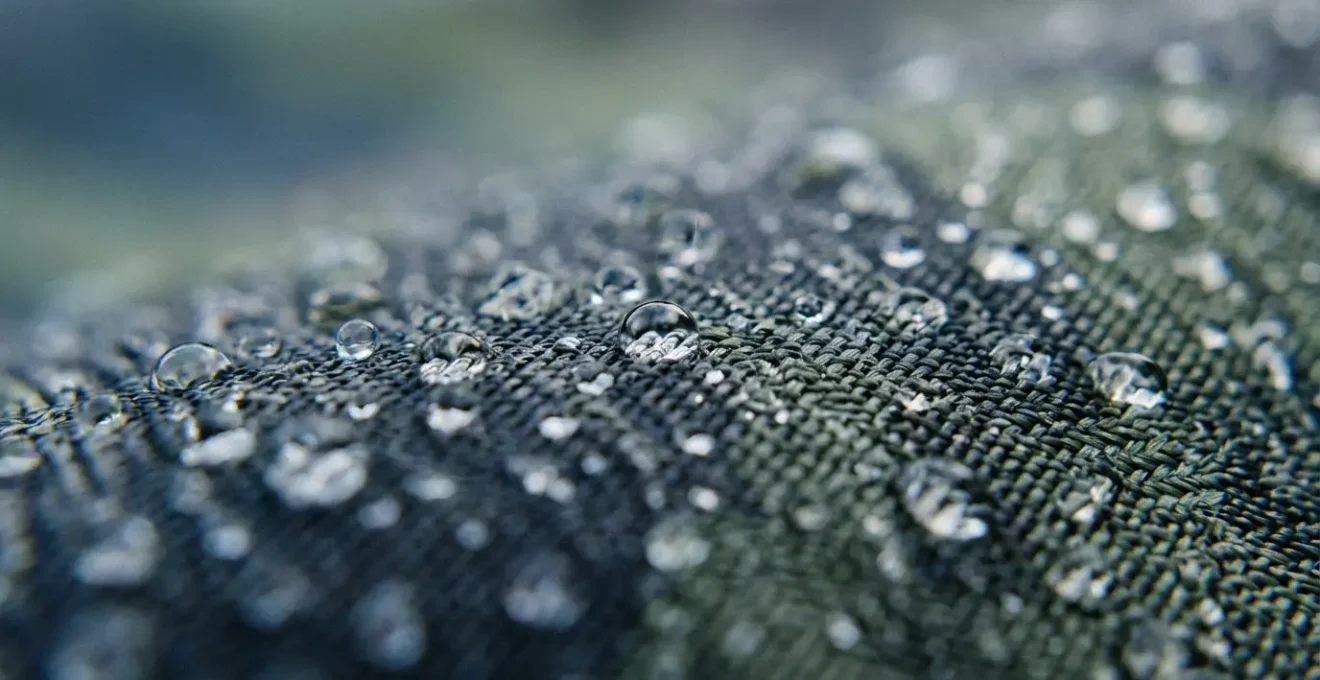
The image above illustrates how water beads on a high-tech fabric, a direct result of the membrane and DWR coating working in tandem. This beading effect is critical; if the outer fabric “wets out” or becomes saturated, the jacket’s breathability is compromised, even if the membrane prevents leaks. This is why maintaining the DWR is so important, a topic we’ll cover next.
DWR Reactivation: How to Wash Your Rain Gear to Restore Water Beading
The most common reason high-performance rain gear fails is not a fault in the membrane, but the degradation of its first line of defense: the Durable Water Repellent (DWR) coating. When your DWR is working properly, rain will bead up and roll off the surface. When it fails, the outer fabric becomes saturated, a phenomenon known as “wetting out.” While you may not get wet from the outside (thanks to the membrane), a wetted-out jacket feels heavy, cold, and, most importantly, it cannot breathe. The saturated outer layer effectively blocks the pores needed for sweat to escape.
Many golfers are afraid to wash their expensive jackets, fearing it will damage the waterproofing. The opposite is true. Dirt, body oils, sunscreen, and other contaminants are hydrophilic (water-attracting) and will rapidly break down the DWR. Regular cleaning is the single most important thing you can do to maintain performance. The key is to wash it correctly. Using standard laundry detergent is a critical mistake, as it often contains surfactants and softeners that leave behind a hydrophilic residue.
Instead, you must use a technical detergent specifically designed for waterproof-breathable fabrics. After washing, the heat from a tumble dryer is used to reactivate the DWR polymer, realigning its molecules to restore water repellency. Following a proper maintenance protocol can dramatically prolong the effective life of your gear; indeed, the Golf Digest maintenance guide confirms this can add multiple years of extended life to a quality garment. Only when heat reactivation no longer works should you consider reapplying a new DWR spray.
Your Action Plan: Never-Fail DWR Maintenance Protocol
- Check for stains and spot-treat with Nikwax or similar technical cleaner.
- Wash with technical detergent specifically designed for waterproof gear, following garment instructions.
- Tumble dry on medium heat for 20-30 minutes to reactivate the existing DWR coating.
- Perform the water droplet test – water should bead and roll off the surface.
- If beading fails after cleaning and heat treatment, apply a new DWR spray treatment evenly and repeat the heat activation step.
- Store the gear completely dry and clean to prevent mildew and coating breakdown.
Headwear Strategy: Why Is a Bucket Hat Is Superior in Heavy Rain?
An often-overlooked component of a successful rain-day strategy is headwear. A standard cotton baseball cap is the worst possible choice. It will quickly become saturated, channeling cold water down your face and neck, creating a constant, irritating distraction. To maintain focus, your headwear must be an integrated part of your waterproof system. The primary choice for golfers is between a waterproof baseball-style cap and a bucket hat.
While a waterproof baseball cap is a significant upgrade over a standard one, it has a critical design flaw for play in persistent rain: it only protects your face. Water running off the bill can be managed, but water hitting the back and sides of your head will drip down your neck and potentially into the collar of your jacket, compromising your entire system. This is where the simple, often-maligned bucket hat proves its engineering superiority.
As a 360-degree rain protection analysis confirms, a waterproof bucket hat offers comprehensive coverage that a cap simply cannot match. Its all-around brim channels water away from your face, ears, and, crucially, the back of your neck. This prevents water from finding its way down your back and ensures your focus remains on the shot, not on a trickling stream of cold water. In a light drizzle, a baseball cap may suffice, but for the dedicated golfer playing through a proper downpour, the bucket hat is not a fashion statement; it’s a piece of essential technical equipment providing superior protection.
Playing in 40mph Gusts: Survival Tips for a Windy Day at St. Andrews
Beyond rain, wind is the other great elemental challenge, particularly on links courses. Wind not only affects ball flight but also has a dramatic impact on your body’s ability to regulate temperature. The “wind chill” effect can make a mild day feel bitterly cold, rapidly sapping your energy and strength. For example, a 15 mph wind makes 50°F (10°C) feel like the low 40s (5-6°C), according to CaddieHQ’s layering guide. In the 40mph gusts common to a place like St. Andrews, this effect is exponentially more severe.
Your outer layer, therefore, must be not just waterproof but also completely windproof. A high-quality shell jacket serves this dual purpose, creating a barrier that prevents convective heat loss. This preserves the warm air trapped by your insulating mid-layers. Without a windproof shell, even the best fleece or wool sweater is rendered ineffective, as the wind will strip the warmth away instantly. This is a critical aspect of system integrity.
Surviving a truly windy day involves more than just the right jacket. Your entire apparel system needs to be streamlined. Baggy clothing will flap uncontrollably, creating noise and disrupting your balance. Opt for athletic-fit garments that stay close to the body. A warm, wind-resistant hat that covers your ears is non-negotiable to prevent heat loss and protect from the cold. Finally, wind-resistant trousers are as important as your jacket. They protect the large muscle groups in your legs, helping you maintain power and stability throughout the round. Battling the wind is as much a mental challenge as it is a physical one, and knowing your gear can handle it provides a crucial psychological edge.
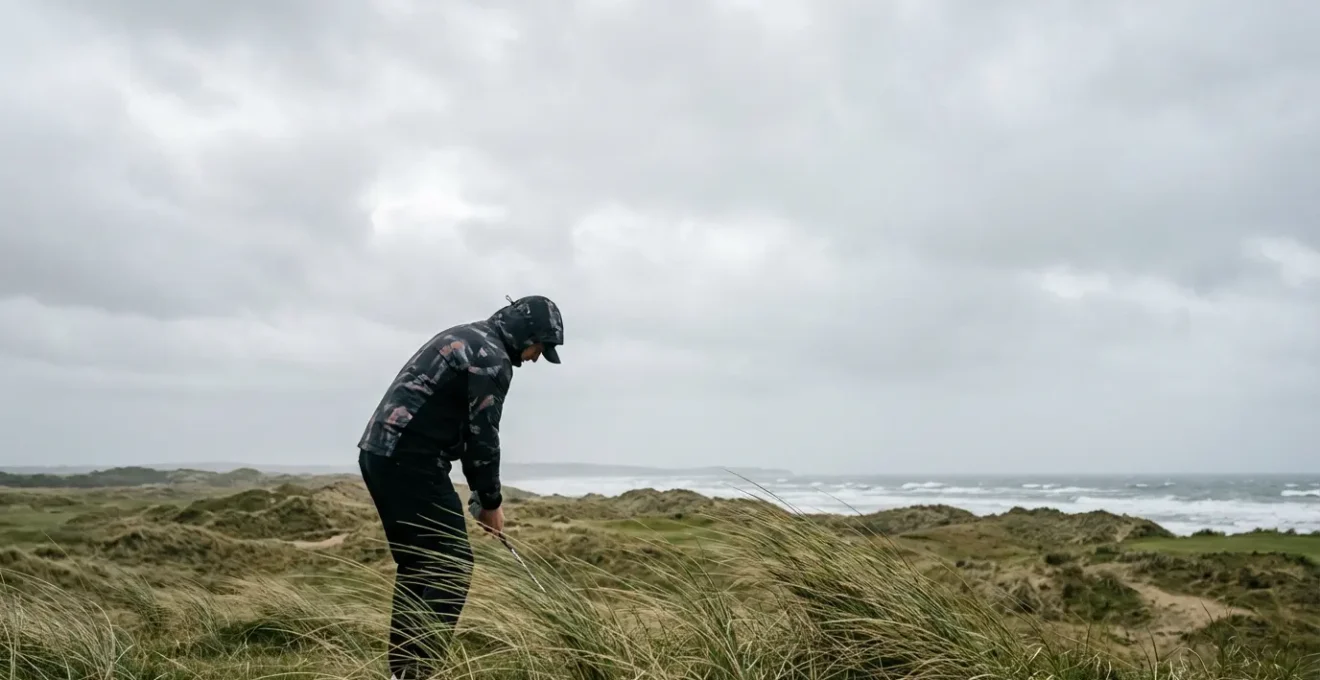
As the image shows, the challenge is often environmental. The player is not just fighting their swing, but the elements themselves. A solid stance and gear that doesn’t balloon in the wind are essential to maintaining balance and delivering the clubface squarely.
Why Is The Open Championship the Only Major Where Weather Dictates the Winner?
While every major championship can be affected by weather, The Open Championship stands alone in its capacity for the elements to be the primary arbiter of the Claret Jug’s destination. The tournament’s traditional place on coastal links courses in the UK means players are exposed to an unpredictable and often brutal maritime climate. Unlike the manicured, sheltered parkland courses of the Masters or PGA Championship, there is nowhere to hide at The Open. The luck of the draw—whether you play your round in a 30mph gale and driving rain or in a brief window of calm sunshine—can create a massive performance delta between competitors.
This is where apparel moves from being about comfort to being a decisive factor in championship golf. A player whose gear fails them—a jacket that wets out, a glove that loses its grip, layers that fail to provide warmth—is at an immediate and significant disadvantage. This was perfectly illustrated by Shane Lowry’s 2019 Open Championship victory at Royal Portrush. He navigated brutal conditions during his third round, including heavy rain and strong winds, shooting a masterful 63. His unflinching performance while others in his side of the draw struggled was a testament not only to his skill but to his complete preparedness. His waterproof system allowed him to maintain focus and control while his competitors were visibly battling the elements as much as the course.
This highlights a core truth of high-level performance in adverse conditions. The psychological impact of having complete trust in your equipment cannot be overstated. As one analysis notes, having confidence in your gear is paramount.
The confidence that comes from knowing your apparel will not fail removes a significant source of stress and anxiety, allowing a player to ‘control the controllables’ and focus solely on the golf shot, not their discomfort.
– Golf Equipment Analysis, The Open Championship Weather Impact Study
At The Open, where the weather is the great uncontrollable, mastering the controllables—like your apparel—isn’t just a good idea; it can be the difference between lifting the trophy and going home early.
Key Takeaways
- Breathability is not a luxury, it’s a necessity. A jacket that doesn’t let sweat out will make you wet and cold, defeating its purpose.
- Maintenance is performance. Regularly washing your gear with technical cleaner and reactivating the DWR is crucial for its longevity and effectiveness.
- Apparel is equipment. Like your clubs or your ball, your clothing has a direct impact on your ability to perform, both physically and mentally.
Look Good, Play Good: How Elegant Golf Fashion Boosts Confidence
After delving deep into the technical specifications of waterproof ratings, breathability metrics, and fabric construction, it’s easy to dismiss the aesthetic aspect of golf apparel as mere vanity. Yet, the old adage “look good, play good” holds a surprising amount of scientific weight. The confidence a golfer feels standing on the first tee is a complex cocktail of preparation, practice, and self-perception. The clothing you wear plays a significant role in that last, crucial ingredient.
This phenomenon is known in psychology as “enclothed cognition.” It’s the idea that clothes have a symbolic meaning and that when we wear them, we can unconsciously adopt the traits we associate with them. A sharply tailored, high-performance outfit can trigger a mindset of athleticism, precision, and success. You’re not just wearing a jacket; you’re wearing the uniform of a serious, competent golfer. This can subtly influence your posture, your mindset, and your approach to the game.
Scientific studies show the clothes we wear can systematically influence our thought processes and self-perception. Wearing an outfit you perceive as athletic and high-performance can prime you to feel and act that way.
– Sports Psychology Research, The Psychology of Athletic Apparel Performance
This doesn’t mean that an expensive outfit will magically fix a slice. But in a game where a fraction of a degree can be the difference between the fairway and the forest, and where confidence is paramount, any advantage is worth considering. When your apparel is technically sound—keeping you warm, dry, and mobile—and also aesthetically pleasing, it completes the package. It removes one more potential source of doubt or distraction, freeing your mind to focus entirely on the task at hand: executing the golf shot. The elegance is not just for show; it’s the final layer of your mental armor.
Now that you are equipped with a deeper understanding of the technology and psychology behind golf apparel, the next logical step is to audit your own closet and identify the gaps in your all-weather system.