Lessons and training
Golf improvement isn’t just about hitting balls on the range until your hands blister. It’s a multifaceted journey that combines technical understanding, strategic thinking, deliberate practice, and mental resilience. Whether you’re stepping onto the course for the first time or looking to break through a persistent plateau, understanding how to structure your learning process makes the difference between frustration and steady progress.
The modern approach to golf instruction has evolved dramatically. Players now have access to biomechanical insights, data-driven practice methods, and coaching expertise that were once reserved for tour professionals. Yet this abundance of information creates its own challenge: knowing what to focus on, when to seek help, and how to translate range sessions into lower scores. This comprehensive resource connects the fundamental building blocks of golf development, from grip pressure to green reading, from practice design to course strategy, giving you a roadmap for meaningful improvement.
The path to better golf isn’t linear, and it certainly isn’t one-size-fits-all. But by understanding the core pillars of effective training—technical fundamentals, smart practice, expert guidance, strategic awareness, scoring versatility, and mental toughness—you’ll be equipped to make informed decisions about where to invest your time and energy for maximum results.
Building Your Technical Foundation
Every consistent golf swing is built on fundamental principles that govern how the club moves and how force transfers to the ball. Understanding swing path versus face angle is perhaps the most crucial technical insight you can gain—the path determines the initial direction, while the face angle at impact dictates roughly 75% of where the ball actually goes. This explains why two swings can look similar yet produce dramatically different ball flights.
The grip represents your only physical connection to the club, making it the foundation upon which everything else is built. Strong versus weak grip positions fundamentally alter how the clubface behaves through impact, with each style offering different advantages. Grip pressure regulation affects clubhead speed, tempo, and your ability to release the club naturally. Too tight, and you restrict motion; too light, and you sacrifice control. Finding this balance is highly individual, but most effective players hover around a 4-5 on a scale of 10.
The sequence of motion—how force transfers from the ground through your body and into the club—separates efficient swingers from those who struggle with consistency and distance. Athletic power generation begins with ground force reaction: pushing into the ground to create upward force that rotates your body. This isn’t about upper body strength; it’s about timing, coordination, and using the earth as your foundation. Center of gravity management throughout the swing keeps you balanced while maximizing rotational speed.
The concept of lag—that delayed release of the club that creates tremendous speed at impact—is often misunderstood. It’s not something you actively “hold” or manufacture. Instead, it’s a natural consequence of proper sequencing, where the body leads and the arms and club follow. Trying to force lag typically creates tension and inconsistency. Focus instead on the kinematic sequence: lower body starts the downswing, torso follows, then arms, then the club whips through as the final link in the chain.
Effective Practice Strategies That Accelerate Progress
The difference between practicing and improving lies in how you structure your time. Block practice—hitting the same shot repeatedly—feels productive and builds a groove, but it creates a false sense of mastery. Random practice, where you vary targets, clubs, and shot shapes, better simulates on-course conditions and leads to more durable learning. Research consistently shows that random practice produces slower immediate improvement but superior long-term retention and transfer to actual play.
Understanding the distinction between warm-up and practice is essential. Warming up prepares your body and swing for performance; it’s about activation, not correction. Practice, by contrast, is where you work on specific skills, diagnose issues, and build new patterns through feedback loops. Trying to fix your swing ten minutes before teeing off typically undermines confidence and introduces confusion at the worst possible moment.
Optimizing practice time for course results means prioritizing based on your actual scoring profile. Most golfers spend the majority of their time on the range hitting driver and long irons, yet short game accounts for roughly 60-65% of all strokes for recreational players. The short game ladder drill—progressively working from three feet to thirty yards—builds both skill and confidence in the scoring zone. Similarly, putting gate drills provide immediate feedback on path and face control, helping you develop a repeatable stroke.
Training aids can accelerate learning when used properly, but they can also create dependency or reinforce incorrect patterns. The most effective aids provide clear, immediate feedback on a specific movement pattern. Impact tape shows you where contact occurs on the face. Alignment sticks reveal your actual setup versus your perception. Speed training systems with lighter and heavier clubs can systematically increase clubhead speed. The key is understanding what each tool teaches and using it as a temporary scaffold, not a permanent crutch.
Navigating Professional Instruction
The “YouTube trap” ensnares countless golfers: consuming endless instruction videos, trying different tips each range session, and developing a swing that’s a chaotic blend of conflicting advice. While video content can provide valuable insights, it cannot replace personalized instruction from a qualified professional who can diagnose your specific movement patterns and create a coherent development plan.
Finding the right coaching match involves more than credentials. Communication style, teaching philosophy, and personality compatibility all matter. Some instructors focus heavily on biomechanics and video analysis; others emphasize feel and on-course performance. Neither approach is inherently superior—what matters is alignment with how you learn best. A skilled teacher recognizes that video analysis pitfalls exist: the camera shows positions but not the feels or intentions that created them. The best instruction integrates objective data with subjective experience.
Lesson frequency should match your practice capacity and goals. Weekly lessons without sufficient practice between sessions often leads to information overload. Conversely, spacing lessons too far apart can allow compensations to develop unchecked. Many players find that lessons every 2-4 weeks, combined with regular practice implementing the concepts, produces optimal progress. Remote lessons via video submission have become increasingly effective, offering convenience and the ability to capture your actual swing rather than a “lesson swing.”
Understanding the regression phase prevents unnecessary panic. When changing established patterns, performance often temporarily declines before improving. Your old pattern, however flawed, was familiar and somewhat reliable. The new pattern feels awkward initially and may produce inconsistent results until it becomes grooved. This is normal, expected, and temporary—but it requires trust in the process and patience with yourself.
Strategic Course Management Beyond Ball-Striking
Course management separates good ball-strikers from good scorers. The psychology of hazard placement reveals that architects design holes to tempt you into risky plays. That bunker positioned exactly where your natural shot shape wants to go isn’t coincidence—it’s strategic design. Learning to read the layout for hidden dangers means looking beyond the obvious trouble to understand how slope, wind, and angles compound risk.
The eternal tension between course management and hero shots defines countless rounds. Hero shots—the aggressive play over water, the tight draw through trees—offer excitement and the potential for brilliant results. They also dramatically increase your dispersion of outcomes. Strategic decision-making weighs potential gain against probable cost. On a tight hole with trouble left and right, even professional players aim for the wide part of the fairway, not the flag. This isn’t timid golf; it’s smart golf.
Target selection extends beyond choosing a line. It involves identifying the optimal miss. Where can you afford to be wrong? On a par 5 with water right and rough left, the strategic play attacks from the left side, where a miss leaves a recovery opportunity rather than a penalty stroke. Pre-round planning identifies these key decisions before pressure affects your judgment. Club selection gaps—those yardages where you’re between clubs—require particular attention. Most players score better taking more club and swinging smoothly than forcing a hard swing with less club.
Recovery shots demonstrate strategic thinking under pressure. When you find trouble, the priority is returning to position, not attempting a miracle. The error of aggressive play from bad lies compounds mistakes. Accepting that a bogey from deep rough is often a good result prevents the snowman (8) that wrecks your entire round. Strategic patience is a scoring skill.
Developing Versatility Around the Greens
Short game versatility transforms good ball-strikers into consistent scorers. While the standard pitch and chip handle many situations, specialized shots expand your options and lower your scores. The hinge and hold technique creates consistent contact on tight lies by setting wrist angles early and maintaining them through impact. Using the bounce prevents digging and enables clean contact from various lies—the sole of the wedge is designed to glide through turf and sand, but only if you present it correctly.
The flop shot generates tremendous height and minimal roll, perfect for tight pins and obstacles. It requires speed, an open face, and trust in the technique. Conversely, the bump and run maximizes roll, keeping the ball low and reducing variables. Understanding bump and run ratios—how much the ball carries versus rolls for different clubs—gives you precise distance control. A 7-iron might carry one-third and roll two-thirds, while a sand wedge reverses that ratio.
Lie reading determines shot selection. A ball sitting up in light rough invites a lofted approach; a ball nestled down requires a lower, more penetrating trajectory. Adapting to uneven lies means understanding ball position, weight distribution, and expected ball flight. From an uphill lie, the ball naturally launches higher and curves right (for right-handed players). Fighting these tendencies creates inconsistency; embracing and planning for them builds reliability.
Putting versatility completes your scoring arsenal. Adapting your stroke to variable surface conditions separates one-putters from three-putters. Understanding Stimpmeter mechanics—how green speed is measured—helps you calibrate touch. A green stimping at 9 requires significantly different speed control than one at 12. Downhill putting demands exceptional touch and often benefits from dying the ball into the cup. Grain influence, particularly on warm-season grasses, can dramatically affect both speed and break. Uphill putts require confident acceleration through impact to hold the intended line.
The Mental Game: Psychology and Performance
Golf is played on a five-inch course: the distance between your ears. Mental management of scoring opportunities determines whether you capitalize or collapse. When you reach a par 5 in two or face a birdie putt from 12 feet, can you maintain routine consistency despite elevated excitement or pressure?
The aggressive versus defensive mindset debate misses the point. The best mental approach is situational. With a three-shot lead and water fronting the green, defensive strategy makes sense. Dormie in a match, with nothing to lose? Aggressive play is justified. The skill lies in making these decisions consciously based on context, not defaulting to one approach regardless of circumstances.
Line visualization before putting or chipping creates a clear picture of the shot’s path. This isn’t wishful thinking—it’s purposeful mental rehearsal that programs your neuromuscular system. Combined with breathing techniques that regulate arousal and maintain focus, visualization builds confidence and reduces anxiety. Three deep breaths before important shots physically calm your nervous system, lowering heart rate and reducing muscle tension.
The acceptance mindset might be golf’s most powerful mental tool. Accepting that even perfect execution produces imperfect results occasionally, that bad breaks happen, and that frustration is normal but manageable prevents the emotional spirals that turn one bad hole into a ruined round. Target orientation—focusing on where you want the ball to go rather than where you fear it might—keeps your attention forward-looking and positive.
Athletic Development for Consistent Power
Distance isn’t everything in golf, but it certainly helps. Athletic power generation through proper training can add significant yardage without sacrificing control. Overspeed training, using clubs lighter than your gamer, teaches your neuromuscular system to move faster, with gains often transferring to your regular swing speed. The key is maintaining good sequencing while moving faster, not just swinging wildly.
Flexibility limitations often go undiagnosed but significantly restrict both distance and consistency. If you cannot physically achieve certain positions due to mobility constraints, no amount of practice will get you there. A structured flexibility program addressing hip rotation, thoracic spine mobility, and shoulder range of motion creates the physical capacity for an efficient swing. Age considerations matter here—a swing pattern that worked at 25 may need modification at 55 as mobility naturally decreases.
Ground force reaction principles apply to all golfers but require training to maximize. Learning to push into the ground during the downswing, creating upward force that aids rotation, transforms your lower body from passive support to active power generator. This isn’t about leg drive in the traditional sense—it’s about force vectors and timing. Specialized training with force plates can reveal your force application patterns, but simple drills like the step-through drill or jumping while swinging teach the sensation without expensive technology.
The beautiful paradox of golf improvement is that it never ends. Each milestone reveals new horizons, each solution creates new questions. By building on the fundamental pillars outlined here—technical understanding, purposeful practice, expert guidance, strategic thinking, scoring versatility, mental resilience, and athletic development—you create a framework for continuous improvement. The journey from beginner to confident player isn’t about perfection; it’s about progress, understanding, and the pure satisfaction of hitting shots you once thought impossible.

One Wedge, Three Shots: How to Manipulate Trajectory Around the Green?
For the creative golfer, a limited short-game vocabulary is the ultimate frustration; the solution lies not in memorizing shots, but in mastering the physics of impact. True trajectory control comes from understanding how the wedge’s sole (bounce and grind) interacts…
Read more
Chasing Speed: How to Add 20 Yards to Your Drives Without Wrecking Your Swing
Contrary to popular belief, chasing clubhead speed isn’t about swinging harder or more violently. That approach often leads to injury and inconsistent strikes. This guide reframes the pursuit of speed as a quest for efficiency. You will learn that true,…
Read more
Sweepers vs Diggers: How to Strike Fairway Woods Cleanly off the Deck?
Hitting a fairway wood cleanly isn’t about forcing a “sweeping” motion; it’s about matching your setup and club choice to your natural swing DNA. Ball position is the #1 cause of topped shots. Adjust it based on whether you’re a…
Read more
Why You Tense Up Over a Birdie Putt but Hole the Par Putt Easily?
The tension you feel over a birdie putt isn’t a flaw in your technique; it’s a predictable neurological reaction called “loss aversion.” Your brain fears losing the opportunity for a birdie more than it desires the gain, causing you to…
Read more
How to Adjust Your Putting Stroke When Green Speed Changes Drastically?
In summary: Mastering speed is not about “hitting softer” but about recalibrating your sensory system to new friction and impact dynamics. Advanced techniques like striking the ball on the putter’s toe can deaden impact for controlling downhill putts on glassy…
Read more
How to Break 80 Without Making a Single Birdie Through Course Management?
Breaking 80 isn’t about hitting better shots; it’s about making smarter, mathematically-backed decisions that eliminate costly errors. Success comes from aiming based on your personal shot dispersion pattern, not the flagstick. Every decision, from a hero shot to a lay-up,…
Read more
One-Plane vs Two-Plane: Which Swing Plane Suits Your Body Type?
The optimal golf swing plane is not a choice between models, but a direct consequence of your unique body mechanics. Common swing flaws like a slice or lack of power are often symptoms of a mismatch between your swing’s geometry…
Read more
Why Bashing Balls Without Structured Drills Is a Waste of Time and Money
Your practice fails to transfer to the course because it lacks diagnostic precision and systematic fault isolation. Effective drills are not about repetition; they are engineered protocols to deconstruct and correct a single mechanical flaw. Progressive overload—methodically increasing a drill’s…
Read more
Why 3 Golf Lessons Will Improve Your Score More Than a $500 Driver
Investing in a new driver is a bet on technology; investing in lessons is a bet on yourself—and it pays far higher dividends for a plateaued golfer. A coach diagnoses the root cause of your swing flaws, while new equipment…
Read more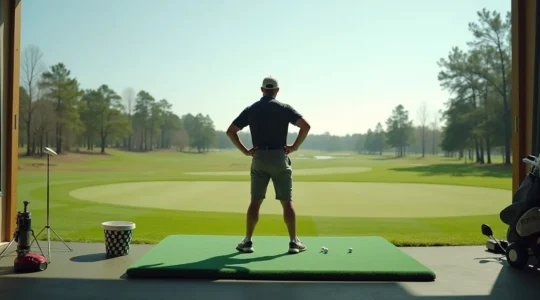
Your Driving Range Swing Is a Lie. Here’s How to Practice for Lower Scores.
The brutal truth is your range practice is making you a great range player, not a better golfer. Hitting off synthetic mats creates false confidence by masking fat shots and altering spin. Mindless, repetitive “block” practice fails to simulate the…
Read more