
The choice between spiked and spikeless golf shoes is not about wet or dry conditions; it is a critical biomechanical decision about how your body manages ground reaction forces.
- Spiked shoes create a “locked-in” platform, maximizing shear force resistance for powerful, high-speed swings.
- Spikeless designs enhance proprioception and allow for more natural foot rotation, reducing torsional stress on joints like the knees and back.
Recommendation: Match your footwear to your unique swing mechanics and physical needs, not just the weather forecast, to optimize both performance and long-term joint health.
That unsettling feeling of a foot slipping mid-swing, especially on a damp morning, can shatter a golfer’s confidence and ruin a shot. The immediate reaction is to blame the conditions or the shoes, leading to the age-old debate: spiked or spikeless? For years, the conventional wisdom has been simple: spikes for wet weather grip, spikeless for dry weather comfort. This binary choice, however, overlooks the complex physics at play between your feet, the ground, and your body’s power chain.
As a footwear biomechanist, I can state that the optimal choice is far more nuanced. It’s not just about grip; it’s about managing ground reaction forces (GRF), controlling torsional stress on your joints, and enhancing proprioception—your body’s awareness in space. Simply choosing a shoe for the weather is like choosing a club based only on its brand. The true key to stability lies in understanding how your footwear functions as a piece of performance equipment that must be matched to your specific swing, strength, and even your age.
This article moves beyond the surface-level discussion. We will deconstruct the science behind golf shoe traction. We’ll analyze how different designs influence your ability to generate power, manage fatigue over 18 holes, and ultimately, protect your body from injury. By understanding these biomechanical principles, you can make an informed decision that provides a truly stable foundation, regardless of the conditions.
This in-depth analysis will explore the specific performance characteristics of both spiked and spikeless footwear. The following summary breaks down the key topics we will cover to help you build a stable, powerful, and pain-free golf swing from the ground up.
Summary: Deconstructing Golf Shoe Stability from the Ground Up
- Ground Anchor: How Spikes Help You Generate More Power from the Ground?
- The Fatigue Factor: Are Spikeless Shoes Better for Walking 18 Holes?
- Soft Spikes evolution: How Modern Cleats Protect the Putting Surface?
- Street Style: Can You Wear Sneaker-Style Golf Shoes in Serious Conditions?
- Worn Nubs: How Often Should You Change Your Spikes for Safety?
- Hold the Finish: Why You Can’t Hold Your Pose Without Core Stability?
- Pushing the Ground: How Using Your Legs Generates Vertical Force?
- Why a Strong Core Is the Secret to a Pain-Free Golf Swing After 50?
Ground Anchor: How Spikes Help You Generate More Power from the Ground?
The golf swing is a dynamic sequence of movements designed to generate immense clubhead speed. This power doesn’t originate in the arms; it starts from the ground up. To maximize this energy transfer, a golfer must create a stable base that resists the rotational and lateral forces of the swing. This is where the biomechanical function of spiked shoes becomes paramount. They act as a “ground anchor,” creating a secure coupling between the foot and the turf. This connection is essential for resisting what scientists call shear forces—the horizontal forces that cause your foot to slip laterally during the downswing and follow-through.
By locking the foot into the ground, spikes allow a player to push against a firm platform, converting rotational energy into linear force more efficiently. Any slip, however minor, is an “energy leak” that reduces power and accuracy. This is particularly true for players with high swing speeds. In fact, comprehensive testing confirms that players with faster swing speeds benefit from the ground connection that spikes provide, as it allows them to harness their full power potential without fear of instability. The superior grip directly translates to more efficient power generation.
This principle is well-understood at the professional level. As Masun Denison, the Global Footwear Director at Adidas Golf, explains, “Traction levels are typically higher and can remain strong due to the replaceability of the spikes. This is one of the main reasons why many professionals prefer spiked golf shoes.” This preference isn’t about tradition; it’s a calculated decision based on the physics of performance.
Ultimately, for the power player, the superior shear force resistance of spikes offers a measurable advantage in converting leg drive into clubhead speed.
The Fatigue Factor: Are Spikeless Shoes Better for Walking 18 Holes?
While spikes offer unmatched stability for power generation, a round of golf is more than just a series of explosive movements; it’s also an endurance event. It’s not uncommon for golfers to walk over 6 miles in an 18-hole round, often over uneven and hilly terrain. This is where the biomechanical advantages of spikeless shoes come to the forefront, particularly concerning the fatigue factor. Spikeless shoes are generally lighter and more flexible, with midsoles designed more like running or walking shoes. This construction reduces the metabolic energy required with each step, leading to less cumulative fatigue over four to five hours of play.
Furthermore, the rigid plate and receptacles required for spikes can create pressure points on the sole of the foot. Spikeless designs, with their integrated traction nubs, distribute pressure more evenly across the foot’s surface. This enhanced comfort is not merely a luxury; it’s a performance factor. As physical fatigue sets in during the back nine, a player’s core stability can waver, leading to poor swing mechanics and inconsistent shots. By reducing foot fatigue and overall physical strain, spikeless shoes help a golfer maintain their mechanical integrity for longer.

The impact of this comfort-first approach was famously demonstrated by a professional athlete who prioritized physical well-being.
Case Study: Fred Couples’ Spikeless Revolution
At the 2010 Masters, Fred Couples, then 50 years old, arrived on the first tee wearing what many traditionalists considered glorified sneakers. The 1992 Masters champion chose spikeless Ecco golf shoes specifically because they reduced stress on his famously temperamental back. His remarkable performance, leading after the first round, sparked a revolution. It proved that comfort-focused spikeless designs could perform at golf’s highest level while significantly reducing the physical strain associated with walking long rounds, especially for players managing chronic injuries.
By minimizing energy expenditure and impact forces, spikeless footwear provides a tangible advantage for golfers who walk the course and prioritize end-of-round performance.
Soft Spikes evolution: How Modern Cleats Protect the Putting Surface?
The memory of aggressive metal spikes tearing up pristine putting greens is a distant one, thanks to a significant evolution in cleat technology. The shift to “soft spikes” was initially driven by course preservation, but modern designs have become sophisticated biomechanical systems. They are engineered to provide exceptional traction while minimizing their impact on the delicate turf of a putting green. This is achieved through a combination of flexible materials and multi-component engineering that distributes the golfer’s weight intelligently.
Instead of a single, rigid point of contact, today’s soft spikes feature multiple flexible “legs” or contact points. When a golfer walks on a firm surface like a green, these points flex and spread the load over a wider area, drastically reducing the pressure per square inch. This “green-friendly” design prevents the deep indentations and damage caused by older spike models. However, during the powerful rotational movements of a golf swing on a softer fairway, these same components dig in to provide the necessary rotational resistance and grip. It’s a dual-function design that adapts to the force applied.
This advanced engineering means golfers no longer have to choose between performance and course etiquette. The technology inside a modern cleat is surprisingly complex, balancing flexibility, energy return, and grip in a single, small component.
Action Plan: Verifying Modern Cleat Technology
- Flexible Contact Points: Look for designs with multiple (e.g., eight) flexible legs that offer traction while flexing with the ground and your swing’s motion.
- Reactive Components: Check for multi-component designs (e.g., 16-part) that are built to react and respond to every angle of force during the swing.
- Energy Return Systems: Inspect for features like arched webbing or similar structures designed to deliver instant energy return when the cleat is compressed.
- Spike Retention System: Ensure the shoe uses a modern locking system (like the Fast Twist 3.0 system) that secures the spike and prevents it from loosening during a round.
- Green-Friendly Shape: Confirm the overall design disperses weight through its multiple contact points to minimize surface damage on the green.
Thus, the modern soft spike represents a triumph of material science and engineering, delivering tour-level traction without compromising the playing surface for others.
Street Style: Can You Wear Sneaker-Style Golf Shoes in Serious Conditions?
The rise of sneaker-inspired, spikeless golf shoes has blurred the lines between on-course performance and off-course style. While their comfort and versatility are undeniable, a common concern persists, especially for the golfer who has experienced a slip: can these “street style” shoes truly perform in serious, wet conditions? For years, the answer was a definitive “no.” Early spikeless models offered minimal traction and were best reserved for dry, casual rounds. However, technology has advanced dramatically.
Modern spikeless outsoles are no longer simple, flat rubber surfaces. They are complex traction systems featuring strategically placed lugs, nubs, and channels made from multiple rubber compounds. These designs are engineered to provide multi-directional grip, essential for maintaining footing on sidehill lies, in wet rough, or on dewy morning fairways. Many premium models also incorporate fully waterproof membranes, keeping the foot dry and stable from within. This combination of advanced tread patterns and weather protection has significantly narrowed the performance gap.
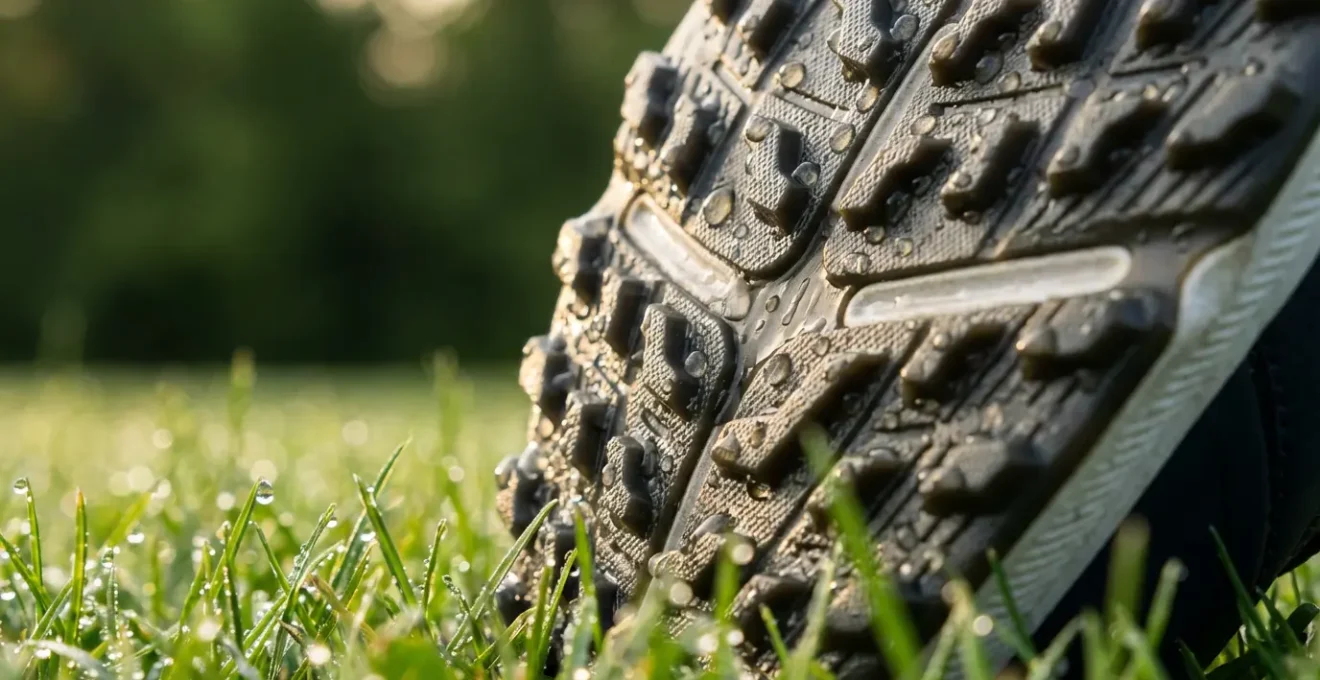
While a fully-sodden, muddy course will still favor a deep-penetrating spiked shoe, extensive testing shows that the trade-off is smaller than ever.
Modern spikeless shoes have closed the performance gap in wet weather. While spiked shoes still win in soggy conditions, many of today’s spikeless models include waterproof membranes and aggressive tread patterns.
– MyGolfSpy Testing Team, 2025 Golf Shoe Testing Results
The ultimate proof of their capability comes from the highest level of the sport, where stability is non-negotiable. An increasing number of elite players are now trusting spikeless technology in major championships, demonstrating its viability under the most demanding conditions. These professionals, including Adam Scott, Justin Rose, and Tyrell Hatton, have proven that modern spikeless technology can handle the pressure of tour-level play, thanks to sophisticated outsole engineering.
For the vast majority of rounds, a high-quality, modern spikeless shoe offers more than enough traction and protection to be worn with complete confidence.
Worn Nubs: How Often Should You Change Your Spikes for Safety?
The replaceable nature of spikes is a clear advantage for maintaining peak traction. However, this benefit is only realized if the spikes are replaced in a timely manner. Playing on worn-down spikes is not just a performance issue; it is a significant safety hazard. As the traction elements round over and compress, their ability to penetrate the turf and resist shear forces diminishes dramatically. This can lead to the very slips and instability a golfer sought to avoid by choosing spikes in the first place.
More critically, worn spikes create an inconsistent and unstable platform underfoot. As one expert noted, the danger extends beyond just slipping during the swing. It’s about the subtle but damaging effects of an uneven base.
The real safety issue with worn spikes isn’t just slipping, but the unstable platform created when some spikes are more worn than others. This inconsistency can lead to subtle swing compensations and increase the risk of rolled ankles or knee strain, especially during aggressive weight transfers in the golf swing.
– Professional perspective, MyGolfSpy
This uneven wear forces the small stabilizing muscles in your ankles and knees to work overtime, leading to fatigue and an increased risk of injury. Therefore, regular inspection is crucial. The frequency of replacement depends heavily on how often you play, whether you walk or ride, and the typical conditions of your course. A golfer who walks 3-4 times a week in a wet climate may need to change spikes multiple times a season, while a casual cart-rider in a dry region might only need to do so annually. Visual inspection is the best guide.
To ensure you maintain a safe and stable foundation, it’s essential to follow a consistent inspection routine. According to guidelines from golf retailers, you should check for the following signs of wear:
- Wear Indicator: The primary sign is the rounding over of the sharp traction elements.
- Fatigue Marks: Look for small stress marks or cracks on the legs of the spike.
- Compression: A noticeable reduction in the spike’s original height indicates it’s time for a change.
- Uneven Wear: If some spikes are significantly more worn than others, replace the full set to ensure a level platform.
Ultimately, treating your spikes like the tires on a car—inspecting and replacing them regularly—is fundamental to ensuring both safety and performance on the course.
Hold the Finish: Why You Can’t Hold Your Pose Without Core Stability?
The ability to hold a balanced, poised finish is more than just a photogenic conclusion to a golf swing; it’s a direct indicator of core stability and proper deceleration. If you frequently find yourself stumbling out of your swing or unable to hold your finish, it’s a sign that your body’s stabilizing systems are being overwhelmed. While core strength is the primary factor, your choice of footwear plays a crucial role in either supporting or challenging this stability.
Your connection to the ground provides essential feedback to your nervous system, a concept known as proprioception. This feedback tells your brain where your body is in space, allowing it to make micro-adjustments to maintain balance. Spiked and spikeless shoes influence this system differently. A spiked shoe creates a rigid, locked-in base. This provides immense external stability, which in turn reduces the immediate demand on your core muscles to maintain balance. The shoe is doing a large portion of the stabilizing work.
Conversely, a spikeless shoe allows for more micro-movement and rotation between the foot and the ground. This enhances “ground feel” and proprioceptive feedback, but it also requires your core to engage more actively to control that motion and maintain balance through impact and into the finish. An unstable base, such as from worn-out spikes or inadequate spikeless traction, forces your core into excessive compensation, leading to fatigue and an unstable finish.
The relationship between your footwear and the demands placed on your body’s stabilizing muscles is a key consideration, as detailed in the following comparison.
| Footwear Type | Core Demand | Proprioception Effect |
|---|---|---|
| Spiked Shoes | Lower core demand due to locked-in stability | Less ground feel, more reliance on shoe grip |
| Spikeless Shoes | Higher initial core engagement | Enhanced body awareness through ground contact |
| Worn/Unstable Base | Excessive core compensation leading to fatigue | Compromised balance feedback |
Therefore, an inability to hold your finish is a symptom. The root cause may lie not just in a weak core, but in a mismatch between your footwear’s stability profile and your body’s ability to manage the forces of the swing.
Pushing the Ground: How Using Your Legs Generates Vertical Force?
While golfers often focus on the rotational (horizontal) forces in the swing, a significant component of power comes from pushing vertically into the ground. Elite golfers use their legs like powerful springs, squatting slightly in the downswing and then explosively extending their lead leg through impact. This generates a powerful vertical ground reaction force that propels the club upward and through the ball, creating speed and a high launch angle. To execute this move effectively, the golfer’s lead foot must have an unbreakable connection to the ground.
Any amount of slip at this critical moment will dissipate the vertical force, causing a massive loss of power and control. Imagine trying to jump high off a sheet of ice; without traction, you can’t push down effectively to propel yourself up. The same principle applies in the golf swing. For players generating elite levels of speed, maximizing this vertical force is non-negotiable. With the average club head speed on Tour being 115.26 mph, these athletes require a footwear platform that can withstand immense forces without any slippage.
This is where spiked shoes offer a distinct biomechanical advantage. The cleats anchor the foot, allowing the player to apply maximum downward pressure with the lead leg, knowing the ground will push back with equal force. This concept of a “solid foundation” is central to athletic movement.
One of the most crucial aspects to any golf swing is a solid foundation, and spiked golf shoes provide just that. When golfers have a locked-in, reliable foundation, they are able to focus on improving.
– Paul McMullen, DICK’S Sporting Goods
In essence, using the ground effectively is a fundamental skill, and the right footwear is the critical interface that makes the efficient transfer of both vertical and horizontal forces possible.
Key Takeaways
- The choice between spiked and spikeless shoes is a biomechanical trade-off between maximizing ground reaction force (spiked) and reducing fatigue and torsional stress (spikeless).
- Modern spikeless shoes offer significant all-weather performance due to advanced tread designs and waterproof membranes, making them viable for most conditions.
- Core stability and footwear stability are intrinsically linked; an unstable base from worn shoes or a poor match for your swing can lead to poor balance and potential injury.
Why a Strong Core Is the Secret to a Pain-Free Golf Swing After 50?
For golfers over 50, longevity in the game often shifts from a quest for maximum power to a focus on consistency, efficiency, and injury prevention. A strong, stable core is the undisputed epicenter of a pain-free swing. It acts as a crucial shock absorber and force distributor, protecting the lower back and other joints from the high-speed rotational forces of the golf swing. However, another, often-overlooked, element in the injury prevention equation is footwear, specifically how it manages torsional stress.
Torsional stress is the twisting force that occurs on joints like the ankles and knees during the pivot. A spiked shoe, by design, locks the foot to the ground. While this is excellent for generating power, it can also transmit more of that twisting force up the kinetic chain to the knee and hip. For an older golfer with pre-existing joint issues or reduced flexibility, this can exacerbate pain and increase injury risk. Spikeless shoes, by allowing a small amount of rotation or “slip” between the outsole and the turf, can act as a safety valve. This subtle decoupling reduces the amount of torque transmitted to the knee, providing a significant benefit for joint health.
This principle was a key factor in Fred Couples’ decision to switch to spikeless shoes, a move that likely extended his competitive career.
Case Study: Spikeless Shoes and Torsional Stress Reduction
When Fred Couples adopted spikeless shoes at age 50, it wasn’t just about comfort for his back. The natural rotation allowed by the spikeless design reduced the torque transmitted to his knee joints compared to the fully locked-in feel of spiked shoes. This biomechanical advantage offers significant injury prevention benefits, allowing older players to maintain their careers by mitigating the cumulative stress of thousands of golf swings on their joints.
For the senior golfer, developing a comprehensive footwear strategy is as important as a stretching routine. The goal is to create a system that supports the body, minimizes unnecessary strain, and allows the core to do its job effectively without being compromised by foot fatigue or excessive joint torque.
- Reduce Weight: Choose lighter spikeless shoes to reduce metabolic energy expenditure over long walks.
- Maximize Cushioning: Opt for shoes with advanced cushioning technologies to minimize joint impact on every step.
- Allow Rotation: Consider the natural rotation of spikeless designs to reduce knee torque during the pivot.
- Prioritize Comfort: Select a comfortable shoe to help maintain core stability and good posture, especially late in a round when fatigue sets in.
By intelligently matching your footwear to your body’s needs, you can build a stable and powerful swing that is not only effective but, most importantly, sustainable for years to come.