
Hitting a fairway wood cleanly isn’t about forcing a “sweeping” motion; it’s about matching your setup and club choice to your natural swing DNA.
- Ball position is the #1 cause of topped shots. Adjust it based on whether you’re a natural “digger” or “sweeper” to find the low point of your swing consistently.
- For most amateurs, a 5-wood or 7-wood offers more consistency and often more usable distance than a 3-wood due to higher launch and better contact efficiency.
Recommendation: Stop fighting your 3-wood. Test a higher-lofted fairway wood and focus on a ball position that promotes a centered strike rather than trying to change your fundamental swing motion.
The scene is all too familiar for many golfers. You’re facing a long par-4 or a reachable par-5. You pull out the 3-wood, the “hero club,” ready to send the ball soaring down the fairway. You take your swing, and then you hear it: the sickening click of the club’s leading edge hitting the top half of the ball. The result is a weak, low-flying shot that barely travels a hundred yards. This frustration is often met with the same generic advice: “You have to sweep it, not dig at it.” While not entirely wrong, this advice misses the fundamental point. The key to pure fairway wood contact isn’t about forcing a specific motion; it’s about understanding your unique swing DNA and making the right adjustments in setup and club selection.
Many golfers who struggle with their woods have a slightly steeper angle of attack—they are natural “diggers,” similar to how they hit their irons. Trying to force a “sweeping” motion on them is like asking them to write with their non-dominant hand. It feels unnatural and often makes the problem worse. The real solution lies in a more nuanced approach. It involves choosing the right tool for the job (often a higher-lofted wood), placing the ball in the correct position for your swing, and developing a strategy that plays to your strengths rather than fighting your tendencies. This guide will move beyond the platitudes and give you a concrete framework for turning your fairway woods from a source of anxiety into a reliable weapon in your long game.
This article will guide you through the technical and strategic adjustments needed to master your fairway woods. We will dissect everything from equipment choice to course management, providing a clear path to finally striking the ball cleanly off the deck.
Summary: Mastering Fairway Woods From the Fairway
- Why a 5-Wood Is Often Longer Than a 3-Wood for Average Golfers?
- Ball Position Errors: Are You Playing Your Woods Too Far Forward?
- Teeing It Low: Why You Should Not Tee Your Fairway Wood High?
- Wood out of Rough: When Is It Safe to Hit a Fairway Wood from Deep Grass?
- The 7-Wood Revolution: Why Pros Are Putting High-Loft Woods Back in the Bag?
- How Adding 400 Yards to the Course Changes Your Approach Strategy Completely?
- Go for Green or Lay Up: The Math Behind the 2-Shot Strategy?
- Chasing Speed: How to Increase Swing Speed Without Ruining Your Mechanics?
Why a 5-Wood Is Often Longer Than a 3-Wood for Average Golfers?
The first step in improving your fairway wood play is to check your ego at the door and question your equipment. Many amateurs believe a 3-wood is inherently longer than a 5-wood simply because of its lower loft. While this is true in a perfect, robot-tested environment, it rarely holds up on the course for the average player. The lower loft of a 3-wood (typically 15 degrees) demands a much more precise strike to get the ball airborne with optimal spin. For players without elite swing speed or a perfectly shallow angle of attack, this often results in thin shots, low-launching hooks, or shots that never reach their peak height, sacrificing carry distance.
In contrast, a 5-wood (around 18-19 degrees) is significantly more forgiving. The added loft makes it easier to launch the ball high, even on slight mishits. This higher launch translates to more carry distance, which for many amateurs, is the primary component of their total distance. It’s not uncommon for a golfer to find their 5-wood carry distance is equal to, or even greater than, their 3-wood carry. A well-struck 5-wood that flies 180 yards and lands softly is far more valuable than a thinned 3-wood that skitters 190 yards into a bunker. Data confirms this: for higher handicap players, the distance gap between clubs shrinks dramatically due to inconsistent contact. The ultimate goal is usable distance, not theoretical maximums.
Case Study: Amateur Golfer Discovers Consistency with a 5-Wood
In a self-conducted test, an amateur golfer hitting both a 3-wood and 5-wood found the 5-wood produced a much straighter and higher ball flight. These two factors combined to create more total distance on average. More importantly, the consistency was vastly improved; out of several shots, only one was mishit with the 5-wood, and the majority landed on or within 5 yards of the green. This demonstrates how improved launch and forgiveness can directly lead to better performance and lower scores, even if the club has a higher loft number stamped on it.
The key takeaway is to measure your actual on-course performance, not just assume the 3-wood is the longer club. For many, switching to a 5-wood as their primary fairway option leads to more confidence, better strikes, and ultimately, more effective long-game play. It’s about maximizing your contact efficiency, not just the club’s potential.
Ball Position Errors: Are You Playing Your Woods Too Far Forward?
If you consistently top your fairway woods, there is a very high probability the issue lies with your ball position. The common advice is to play the ball “off your lead heel,” just like a driver. This is a critical error for most amateurs. A driver is hit off a tee, allowing you to hit up on the ball. A fairway wood is hit “off the deck,” meaning the club must strike the ball at the absolute bottom of the swing arc or with a slightly descending blow. Playing the ball too far forward places it ahead of your swing’s low point, forcing the club to catch the ball on the upswing, leading to the dreaded thin or topped shot.
The optimal ball position for a fairway wood is player-dependent, but a universal starting point is about two to three inches inside your lead heel. For right-handers, a good visual cue is to position it directly below your left pectoral muscle or, as GOLF Magazine recommends, somewhere under your heart. This positions the ball closer to the bottom of your natural swing arc, promoting a level or slightly downward strike that catches the ball cleanly before interacting with the turf. A simple way to find your low point is to take a few practice swings on the range and see where the club consistently brushes the grass. That spot is where the center of the ball should be.
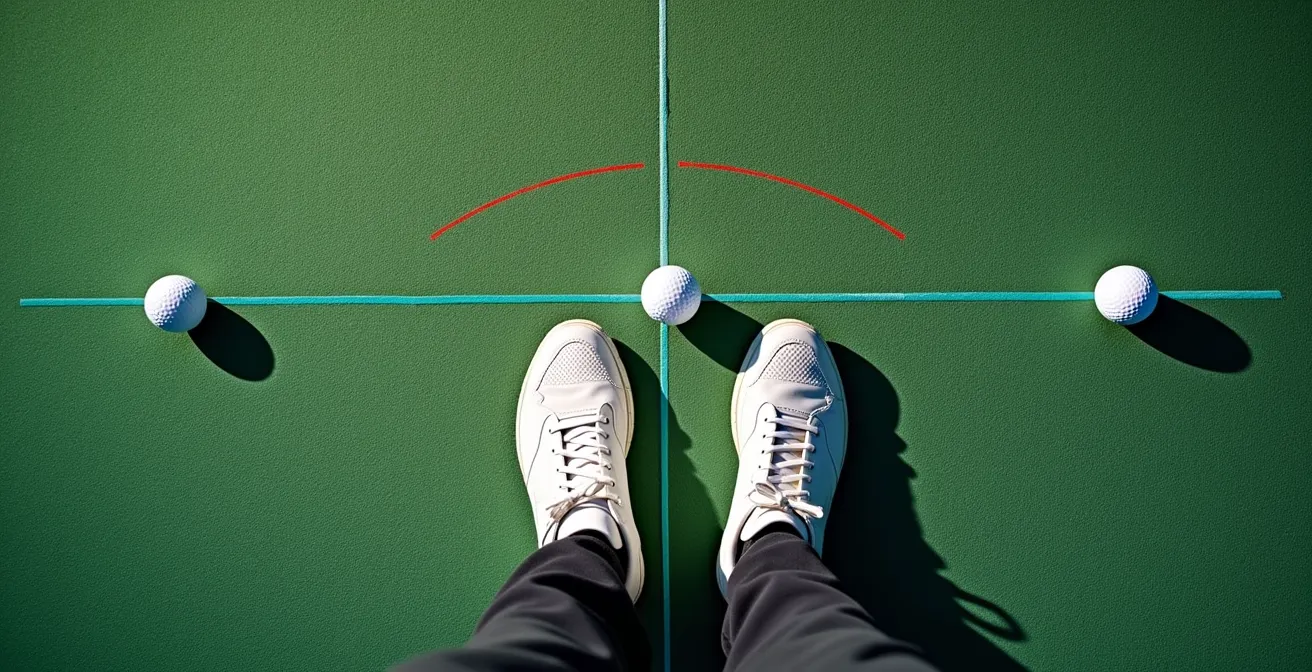
This adjustment must also account for your swing DNA. Are you a “sweeper” with a very shallow, wide arc, or a “digger” with a more iron-like, steeper angle of attack? This table breaks down the subtle adjustments needed for each player type.
| Player Type | Ball Position | Typical Miss | Adjustment Needed |
|---|---|---|---|
| Sweeper | Inside lead heel | Thin shots if too forward | Move back 1 ball width |
| Digger | 2 balls inside lead heel | Fat shots if too back | Move forward slightly |
| Variable striker | Center-forward | Inconsistent contact | Practice with alignment stick |
Experimenting with an alignment stick on the range can help you commit to a consistent ball position. Don’t be afraid to move the ball slightly back in your stance until you start making crisp, ball-first contact. This single adjustment is often the “eureka” moment for golfers who have struggled with fairway woods for years.
Teeing It Low: Why You Should Not Tee Your Fairway Wood High?
How you practice with a fairway wood on the tee directly impacts your ability to hit it off the fairway. Many golfers, seeking extra distance and an easy launch, tee their 3-wood or 5-wood too high—sometimes half a ball or more above the clubface. While this might produce some towering drives on the range, it builds a critical swing flaw. Teeing the ball high encourages an upward angle of attack, the very motion that leads to topped shots when you try to replicate it off the deck. To master fairway woods, you must practice them in a way that simulates their primary function: hitting them from the turf.
The correct method is to tee the ball as low as possible, creating a “perfect lie” rather than propping it up. The goal is to have the ball sitting just on top of the grass, as if it were on a pristine fairway. A good rule of thumb is to push the tee almost all the way into the ground, with only the very top visible. This forces you to trust the club’s loft and deliver the sole of the club to the bottom of the ball, brushing the grass in the process. This practice ingrains the feeling of a level or slightly descending strike, the exact sensation you need on the course.
By teeing it low, you are essentially training your body to find the bottom of the swing arc correctly. You are learning to let the club do the work of launching the ball, rather than trying to help it into the air with an upward scooping motion. This builds confidence and creates a seamless transition from hitting a fairway wood off a tee to hitting one off the fairway. If you can strike it purely from a low tee, you have the mechanical foundation to strike it purely from the turf. It removes the variables and teaches one consistent, repeatable swing for all non-driver tee shots and fairway approaches.
Wood out of Rough: When Is It Safe to Hit a Fairway Wood from Deep Grass?
One of the biggest course management mistakes an amateur can make is attempting a “hero shot” with a fairway wood from the rough. The wide sole and low center of gravity that make a fairway wood so effective from the fairway become a liability in longer grass. The club head can easily get snagged, twisting the face and leading to a chunked or pulled shot that advances the ball only a few yards. However, not all rough is created equal. Knowing when to attempt the shot and when to take your medicine is a key skill.
The decision comes down to a quick but critical assessment of the lie. The most important factor is how much of the ball is visible. If the ball is sitting up on top of the grass, with more than 50% of it visible, a fairway wood can be a viable option. If the ball is nestled down, or worse, completely buried, the odds of a successful outcome plummet. Furthermore, the club choice is crucial. According to testing data, the 5-wood’s smaller head and increased loft help it cut through the grass more effectively than a 3-wood. A 3-wood from anything but a perfect lie in the rough is an extremely low-percentage shot and should almost always be avoided.
To make this decision-making process more systematic, use a simple checklist every time you find your ball in the rough and are considering a fairway wood.
Go/No-Go Rough Assessment Checklist
- Visibility Check: Is the ball sitting up with more than 50% visible (Go), nestled down with 25-50% visible (Caution), or buried with less than 25% visible (No-Go)?
- Grass Type/Condition: Is the grass thin and the ground firm (Go), or is it thick, wet, and the ground soft (No-Go)?
- Club Selection: From any questionable lie, always default to the higher-lofted wood (5-wood or 7-wood over a 3-wood) as its smaller head is more efficient at cutting through resistance.
- Technique Adjustment: If you proceed, play the ball slightly further back in your stance and make a steeper, more V-shaped swing to ensure a downward blow on the ball, minimizing contact with the grass before impact.
- Risk vs. Reward: If there’s water, a bunker, or out-of-bounds in play, the risk of a mishit far outweighs the potential reward. Choose a wedge and lay up to a safe distance.
By being disciplined and honest about your lie, you can avoid the scorecard-wrecking shots that come from overly aggressive play. A safe layup with an iron or hybrid is always a better outcome than a failed attempt with a fairway wood that leaves you in an even worse position.
The 7-Wood Revolution: Why Pros Are Putting High-Loft Woods Back in the Bag?
If you’re still skeptical about shelving your 3-wood for a higher-lofted option, look no further than the bags of the world’s best players. In recent years, there has been a significant trend on the PGA Tour of players adding 7-woods to their arsenal. This isn’t a coincidence; it’s a strategic move towards versatility and consistency. Top professionals have access to launch monitor data that proves a 7-wood can be a more effective tool in a variety of situations. In fact, GOLF.com reports that top professionals including Dustin Johnson, Collin Morikawa, and Joaquin Niemann all carry 7-woods, replacing long irons or lower-lofted hybrids.
Why are they making this switch? A 7-wood (typically 21 degrees of loft) launches the ball significantly higher and with more spin than a 3- or 4-iron. This results in a steeper landing angle, allowing players to hold greens on long approach shots, a feat that is much more difficult with a lower-launching club. For amateurs, this benefit is even more pronounced. A 7-wood is incredibly easy to hit high from the fairway, light rough, or even off the tee on a tight par-4. It combines the forgiveness of a hybrid with the high, soft-landing ball flight that is essential for scoring.
The versatility of the 7-wood is its greatest asset. It bridges the difficult gap between a 5-wood and a player’s longest iron, offering a reliable option for a wide range of distances and lies. The table below highlights its advantages over common alternatives.
| Situation | 7-Wood Performance | Alternative Club | Advantage |
|---|---|---|---|
| Off the tee (short par 4) | More accurate than driver | Driver | +15% fairway accuracy |
| Long approach (220 yards) | Higher launch than 3-wood | 3-wood/4-iron | Lands softer on green |
| Light rough | Cuts through better | Long iron | More consistent contact |
The “7-wood revolution” is a powerful lesson for all golfers: choose the club that delivers the best results, not the one that is supposed to go the farthest. Embracing higher-lofted fairway woods can fill a critical gap in your bag and provide a level of confidence on long shots that many players have never experienced.
How Adding 400 Yards to the Course Changes Your Approach Strategy Completely?
Modern golf courses are getting longer, and this trend has a profound impact on amateur strategy. On a 6,800-yard course, a long hitter might face approach shots with mid-to-short irons. On a 7,200-yard course, that same golfer is now facing long irons, hybrids, and fairway woods into the greens. This is where mastering your fairway woods becomes not just a bonus, but a necessity. The challenge is no longer simply about advancing the ball; it’s about strategic positioning. You must think of the hole in reverse, planning your shots backward from the green.
On these longer holes, the primary goal of your second shot is often not to hit the green, but to place your ball at your favorite wedge distance for your third. If you are most confident with a 100-yard shot, your target landing area for your second shot is 100 yards from the pin. This is where a reliable fairway wood is invaluable. Instead of taking a full, risky swing with a 3-wood trying to get as close as possible, a smooth, controlled 5-wood aimed at the widest part of the fairway can be the smarter play. This mindset shifts the fairway wood from a high-risk “go” club to a high-percentage “positioning” club.
Developing this strategy requires knowing your game inside and out. You need to know your precise carry distances with each club, your typical dispersion patterns, and your most comfortable shot shapes. Simply blasting away with a 3-wood on every long par-5 is a recipe for big numbers. A more calculated approach, using your fairway woods to navigate the hole and set up a high-percentage third shot, will lead to more consistent scoring on longer courses.
Your Fairway Wood Strategy Audit
- Map Your Scoring Zone: List your comfortable carry distances with your pitching wedge, gap wedge, and sand wedge. These are your target “layup” yardages.
- Plan Backwards: On a long par-4 or par-5, identify the ideal spot in the fairway that leaves you a shot from your scoring zone. This is your new target.
- Select the Right Tool: Choose the fairway wood (or hybrid) that reliably reaches that target layup spot with a comfortable, 80% effort swing. Prioritize accuracy over maximum distance.
- Track Your Dispersion: During practice, note your typical miss with each fairway wood. Do you tend to miss left or right? Plan your layup targets to account for your common shot shape.
- Refine Your Options: Based on your audit, identify which fairway wood in your bag is the most reliable for strategic positioning. This, not necessarily your longest, becomes your go-to “money” club.
This strategic discipline transforms how you see the course. Every long hole becomes a puzzle to be solved with intelligent positioning, and your fairway woods become the key pieces to solving it.
Go for Green or Lay Up: The Math Behind the 2-Shot Strategy?
The decision to “go for it” or “lay up” is one of the most exciting and consequential in golf. For amateurs, it’s often a decision driven by emotion rather than logic. However, shot-tracking data provides a clear mathematical framework for making the smarter choice. The question you should ask is not “Can I get there?” but rather, “Which choice will result in the lowest average score?” More often than not, the conservative play is the correct one, especially when a fairway wood is in your hands.
Data consistently shows that amateurs have a very low percentage of hitting the green from typical fairway wood distances (200+ yards). Even a 15-handicap player might only hit the green 5-10% of the time from that range. The other 90-95% of shots end up in bunkers, rough, or other trouble, leading to a higher average score. In contrast, laying up to a comfortable full-wedge distance (e.g., 100 yards) dramatically increases the chance of hitting the green in regulation and leaving a reasonable putt for par. A single statistic drives this point home: according to comprehensive shot tracking data, a 3-hybrid consistently outperforms a 5-wood in terms of strokes to finish from the same distance, simply because its higher launch and forgiveness lead to better outcomes and leave the player in a better position for the next shot. The same logic applies when comparing a risky fairway wood shot to a safe layup.
Consider the probabilities. A successful “go for it” shot might lead to an eagle putt (a low probability event). A failed one often leads to a bogey or worse (a high probability event). A successful layup leads to a short-iron approach and a likely two-putt par (a very high probability event). Over the long run, the strategy that produces the most pars and avoids the “others” will lower your handicap. This doesn’t mean you should never go for the green. If you have a clean lie, a wide-open green with no hazards, and are feeling confident, the reward may outweigh the risk. But this should be the exception, not the rule. The default play for most amateurs should be to use their fairway wood to lay up to a number that gives them the best chance to make a confident swing with a scoring club.
Key Takeaways
- Clean contact with fairway woods stems from matching ball position to your swing DNA (sweeper vs. digger), not forcing a specific motion.
- For most amateurs, higher-lofted woods (5W, 7W) provide more usable distance and consistency than a 3-wood due to better launch and forgiveness.
- Strategic use of fairway woods for positioning and laying up to a favorite wedge distance will lower scores more than aggressively “going for the green.”
Chasing Speed: How to Increase Swing Speed Without Ruining Your Mechanics?
Once you have established solid fundamentals with your fairway woods—a proper ball position and consistent center-face contact—it’s natural to want more distance. The desire to “chase speed” is common, but it’s a dangerous path if pursued incorrectly. Simply trying to swing harder often leads to a breakdown in mechanics, loss of sequence, and worse contact, ultimately resulting in less distance, not more. The key is to increase swing speed in a structured way that preserves, and even enhances, your technique.
Efficient speed comes from proper sequencing and width, not brute force. Great players create speed by generating a wide swing arc and maintaining their tempo. A common tempo ratio observed in elite golfers is 3:1—meaning their backswing takes three times as long as their downswing to impact. Rushing the backswing is a primary cause of poor sequencing and lost speed. By focusing on a smooth, deliberate takeaway and a patient transition at the top, you allow the body to store energy correctly, which can then be released powerfully through the ball. The goal is to be fast where it matters: at the bottom of the swing.
Speed training should be progressive. Start by making swings at 70% of your maximum effort, focusing entirely on a center-face strike. As your contact quality improves, gradually increase the effort by 5% each week. This allows your body to adapt to the new speeds without your mechanics falling apart. Remember that clubhead speed is only one part of the equation. Ball speed is what truly matters, and that is a product of both clubhead speed and contact quality (smash factor). Impressive PGA Tour tracking data reveals players generated 106mph club speed with a 5-wood, but the crucial element was a smash factor of 1.47, indicating an incredibly efficient energy transfer. Gaining 5 mph of club speed is useless if your smash factor drops and the ball comes off the face slower.
Train for speed intelligently. Focus on a wide arc, a 3:1 tempo, and a gradual increase in effort. By prioritizing the quality of your mechanics over the raw pursuit of speed, you’ll unlock more distance in a sustainable way that translates to better scores on the course.
Begin by auditing your current fairway wood setup and performance on the range. The path to clean, powerful strikes starts with an honest assessment and a commitment to prioritizing smart strategy over brute force.