In Summary:
- Pace of play is a shared, civic responsibility, not just an individual race against the clock.
- Embracing “Ready Golf” over traditional honors in casual rounds is the single biggest time-saver.
- Small, systemic efficiencies like smart cart positioning and off-green scoring prevent “time leakage” that leads to long rounds.
- Choosing the right tees based on data (“Tee Reality”) prevents course-wide traffic jams.
- Consistent poor etiquette and slow play can have real consequences, including penalties and loss of playing privileges.
We’ve all been there: standing on a tee box, watching the group ahead still waiting on their approach shots, with the sinking feeling that this is going to be another five-hour-plus round. The frustration is a universal language among golfers. The common advice is to “play faster,” a vague command that often leads to rushed, sloppy swings and diminished enjoyment. We’re told to be ready and not to waste time, but these platitudes rarely address the root of the problem.
The truth is, slow play is rarely caused by one “slow player.” It’s a systemic issue born from inefficient habits and a breakdown in a foursome’s collective flow. But what if the solution wasn’t about rushing your swing, but about revolutionizing the 95% of the time you spend between shots? This guide isn’t about playing faster; it’s about playing smarter. We will shift the focus from individual speed to systemic efficiency and on-course awareness. It’s a change in mindset from “my shot” to “our pace.”
By adopting a series of small, conscious protocols, your group can work as a single, fluid unit, eliminating the countless moments of “time leakage” that accumulate into a marathon round. This article will deconstruct the common bottlenecks on the course and provide a practical, civic-minded framework for reclaiming the four-hour standard. We’ll explore how to transform your foursome into a pace-of-play powerhouse, ensuring a more enjoyable experience for everyone on the course.
This guide breaks down the essential strategies for a smoother, faster round. Explore each section to master the art of efficient play and become a true advocate for a better golfing experience for all.
Summary: A Golfer’s Manual for Efficient Pace of Play
- Honors vs Ready: Why Traditional Order of Play Is Obsolete in Casual Rounds?
- 3 Minutes Only: Why You Must Abandon the Search for a Lost Ball Quickly?
- Move Up a Box: How Playing the Wrong Tees Causes Traffic Jams?
- Drop and Drive: How to Manage Cart positioning to Save Time?
- Marking the Score: Why You Should Never Write Your Score on the Green?
- The Hidden Cost of “Tee Ego” on a 5-Hour Round for Your Foursome
- 6 Hours on the Coast: Dealing with Slow Play on a Crowded Resort Course
- How Poor Course Etiquette Can Get You Banned from Your Local Club?
Honors vs Ready: Why Traditional Order of Play Is Obsolete in Casual Rounds?
The tradition of “playing honors” is deeply ingrained in golf’s culture, a gentlemanly nod to the player with the best score on the previous hole. While essential in formal competitions, in a casual weekend round, it is one of the single greatest—and most unnecessary—sources of slow play. The alternative, “Ready Golf,” is not about chaos or playing out of turn unsafely; it’s a simple, logical agreement: if you’re ready and it’s safe to play, you play. This philosophy prioritizes the group’s forward momentum over rigid ceremony.
Implementing Ready Golf means the first person to their ball who has a clear shot, plays. It means shorter hitters can tee off first while a longer hitter waits for the green to clear. The data overwhelmingly supports this shift. Research from Golf Australia confirms its success, revealing that 94% of clubs that promoted ready golf enjoyed pace improvement, with a quarter achieving significant success. This isn’t a minor tweak; it’s a fundamental change that directly attacks dead time.
Adopting this requires a pre-round conversation with your group to establish it as the day’s protocol. The core principle is simple: maintain on-course awareness. Instead of waiting for the person furthest away, you prepare for your shot. When it’s clear and safe, you hit. This simple pact transforms a static, sequential process into a dynamic, parallel one, building a collective flow that saves minutes on every single hole.
3 Minutes Only: Why You Must Abandon the Search for a Lost Ball Quickly?
It’s a frustrating moment: a promising drive disappears into the rough. The natural instinct is to search relentlessly. However, this is a major point of “time leakage” with a massive ripple effect. The Rules of Golf were updated for a reason, reducing the search time from five minutes to three. This wasn’t an arbitrary change; it was a direct measure to combat slow play. Adhering strictly to this three-minute search rule is a non-negotiable act of good golf citizenship.
The impact of a prolonged search extends far beyond your own group. It creates a bottleneck that cascades backward through every group on the course. To put it in perspective, research shows that just two extra minutes of searching costs the entire course 30 cumulative minutes. Your five-minute search for a $5 ball has just stolen a half-hour from dozens of fellow golfers. The best practice is to declare and hit a provisional ball anytime you think a ball might be lost or out of bounds. It’s the ultimate insurance policy against slow play.

When a search is necessary, it should be a coordinated team effort, not a solo mission. As shown above, players should spread out and mark landmarks to create a systematic search grid. Once the three-minute mark is hit, it’s time to move on. Drop a ball under the appropriate rule or proceed with your provisional. Abandoning the search isn’t quitting; it’s respecting the time of everyone else on the course.
Move Up a Box: How Playing the Wrong Tees Causes Traffic Jams?
One of the most significant and ego-driven causes of slow play is selecting a tee box that doesn’t match a player’s actual ability. This concept, often called “Tee Ego,” creates traffic jams across the entire course. When players choose tees that are too long for their driving distance, they are consistently left with long, difficult approach shots. This leads to more missed greens, more short-game recovery shots, more searching for errant balls, and ultimately, a slower pace for everyone behind them.
The solution is to embrace “Tee Reality”—a data-driven approach to tee selection. It’s not about machismo; it’s about setting yourself up for success and enjoyment. A good rule of thumb is to play from a set of tees that allows you to reach the greens in regulation with mid-to-short irons. If you are consistently hitting hybrids and fairway woods into par 4s, you are likely playing from too far back. This simple adjustment can dramatically improve your scoring and, more importantly, the pace of play.
The following guide provides a clear, objective framework for choosing the right tees. It removes ego from the equation and replaces it with simple logic that benefits both your scorecard and the flow of the course.
| Tee Box | Average Drive | Typical Handicap | Course Length |
|---|---|---|---|
| Championship | 270+ yards | 0-5 | 7000+ yards |
| Back | 240-270 yards | 5-10 | 6500-7000 yards |
| Middle | 200-240 yards | 10-20 | 6000-6500 yards |
| Forward | Under 200 yards | 20+ | 5500-6000 yards |
By honestly assessing your average drive and choosing tees accordingly, as suggested by these tee selection guidelines, you contribute to a more fluid experience for all. Playing from the correct tees is a fundamental act of course stewardship.
Drop and Drive: How to Manage Cart positioning to Save Time?
The golf cart can be a powerful tool for maintaining pace or a significant source of “time leakage.” Inefficient cart usage, where both players drive to one ball, wait, then drive to the second ball, can add 30-45 seconds of wasted time per shot. Across an 18-hole round, this quickly adds up to 15-20 minutes. The key is to master cart choreography, treating the two players in the cart as a logistical team, not just passengers.
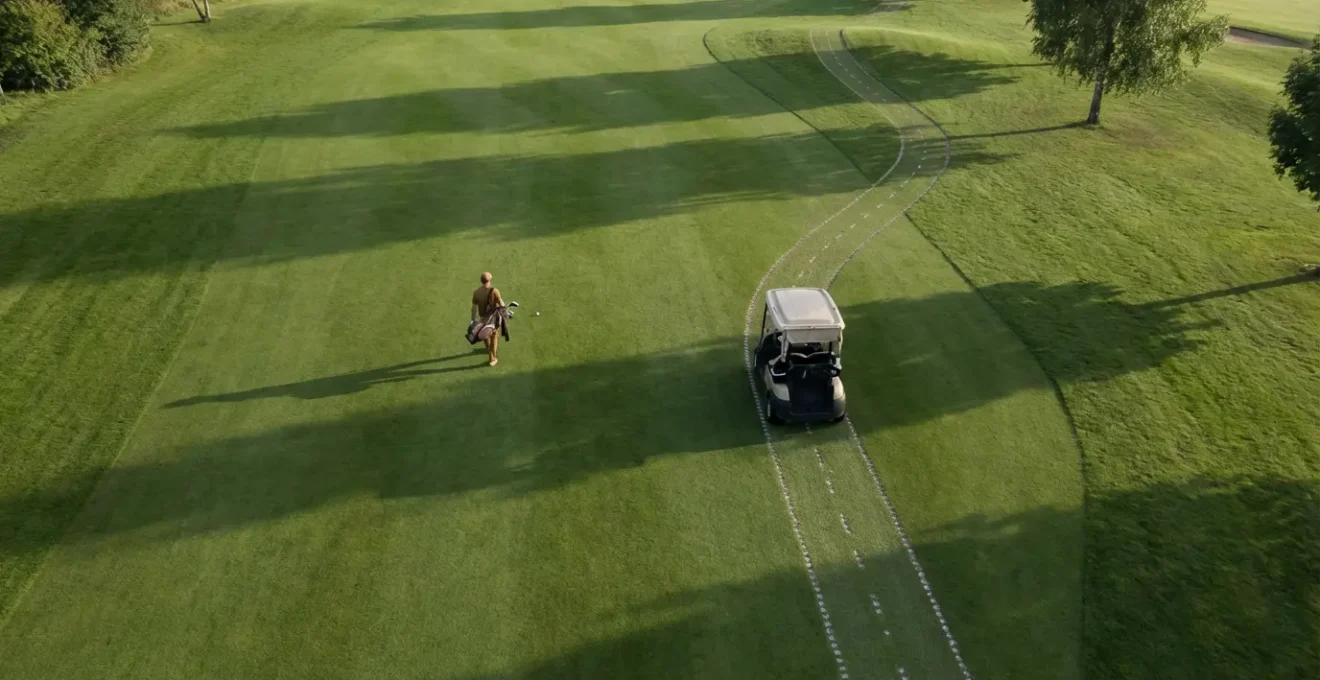
The most efficient method is the “drop and drive.” The driver proceeds to the first player’s ball, drops them off with a few club choices, and then immediately drives ahead to their own ball. This allows both players to assess their lies, select their clubs, and begin their pre-shot routines in parallel rather than sequentially. This continuous forward momentum is a hallmark of an efficient group.
Furthermore, cart positioning after the shots is just as critical. The cart should always be parked in a location that facilitates a quick exit to the next tee, typically on the cart path behind or to the side of the green. Leaving a cart in front of the green forces you to backtrack after holing out, a classic rookie mistake that adds unnecessary delays. Efficient cart management is a system, and every player has a role in making it work.
Action Plan for Cart Choreography
- Drop the passenger at their ball with their clubs, then proceed directly to your own ball to prepare.
- Always park the cart level with or slightly ahead of the first ball to be played, never behind both.
- After hitting approach shots, drive the cart to the back or side of the green, positioning it for a quick exit.
- Park the cart on the path between the current green and the next tee box to minimize walking back and forth.
- On “cart path only” days, both players should take multiple clubs (e.g., their expected club plus one more and one less) to their ball to avoid returning to the cart.
Marking the Score: Why You Should Never Write Your Score on the Green?
The 18th green is not your group’s personal office. One of the most common and easily avoidable pace-of-play killers is lingering on or around the putting green to mark scorecards, tally scores, and discuss the hole. While the intention is innocent, the effect is disastrous for pace. This single habit can add two to three minutes of stationary time per hole, forcing the group behind you to wait unnecessarily before they can hit their approach shots.
The marking of score cards should not be done at the green if this may delay play of the group behind.
– Golf Victoria, Golf Victoria Pace of Play Guidelines
The proper etiquette is clear and absolute: once your group has finished putting, immediately clear the green and walk to the next tee box. The scorecard should only come out once you are safely at the next tee and the following group is not waiting to hit. This is not just a suggestion; it’s a core tenet of efficient play. As a case in point, the University Golf Course at UGA actively promotes a policy where players leave their clubs on the side of the putting green closest to the next tee and wait until they arrive at that next tee to record their scores. This creates a culture of continuous forward movement.
Think of the green as a “no-parking zone.” Your job is to complete your task (putting out) and move on. The administrative work of scoring can and must wait. This disciplined approach keeps the course flowing and shows respect for every other golfer on the property. It’s a small change in habit that yields a massive collective benefit.
The Hidden Cost of “Tee Ego” on a 5-Hour Round for Your Foursome
We’ve discussed choosing the correct tees, but it’s crucial to understand the deep, hidden costs of “Tee Ego.” When a player insists on playing from the tips despite lacking the required 270+ yard drive, they aren’t just challenging themselves; they are placing a tax on the time of their entire foursome and everyone behind them. This decision, often made to project an image, directly translates into more shots, more searching, and more waiting for everyone involved. It’s the primary reason a hole designed to be played in 15 minutes takes 20.
This isn’t about shaming players. It’s about a realistic self-assessment for the good of the group. The goal of golf is to score well, not to hit the longest possible tee shot. Playing from a shorter, more appropriate tee box leads to more greens in regulation, more birdie putts, and a faster, more enjoyable round. It’s a strategic decision that benefits your scorecard and the collective flow of the course. Breaking this cycle requires a shift in focus from distance to scoring.
Here are several practical ways to break the “Tee Ego” cycle and embrace “Tee Reality”:
- Base your tee choice on your average, consistent drive, not the one-in-a-hundred bomb you hit last year.
- Use the “Rule of 28”: multiply your average driving distance by 28 to find a recommended total course yardage.
- Experiment by playing one tee box forward for a round. Track your score and time; you will likely see improvements in both.
- Measure your success by greens in regulation and overall score, not by the color of the tee marker you played from.
- Remember that playing well and scoring low is far more impressive than playing long and struggling.
Key Takeaways
- Faster play comes from systemic efficiency and eliminating “time leakage,” not from rushing your shots.
- Pace of play is a collective responsibility; your group’s habits impact everyone else on the course.
- Data, not ego, should determine your tee box. Playing from the correct yardage is crucial for course flow.
6 Hours on the Coast: Dealing with Slow Play on a Crowded Resort Course
Nowhere is the challenge of pace of play more acute than on a packed weekend at a premier resort course. These tracks are often difficult, visually intimidating, and filled with golfers of varying skill levels who are there for a once-in-a-lifetime experience. This combination can easily turn a 4-hour round into a 6-hour ordeal. Indeed, as pace of play research shows weekend rounds average 4 hours 23 minutes, and on tough, crowded courses, this number can climb much higher.
While you can’t control the groups in front of you, you can control your own group’s “bubble.” On a crowded course, it is your civic duty to apply every principle of efficient play: embrace Ready Golf, position your cart strategically, and most importantly, keep up with the group in front. The goal is not to push them, but to ensure there is no gap between your groups. A marshal’s primary concern is these gaps, which indicate a bottleneck.
Resort courses themselves struggle with this balance. A notable case study is Pebble Beach, which famously removed its “4:30 pace” messaging from range balls after golfers complained it created pressure during their premium experience. This highlights the delicate dynamic: golfers are paying top dollar for enjoyment, but that enjoyment is diminished by glacial pace. By managing your own group’s efficiency, you become part of the solution, not the problem, and maximize your own enjoyment despite the crowds.
How Poor Course Etiquette Can Get You Banned from Your Local Club?
While we’ve focused on the civic-minded benefits of good pace, it’s critical to understand that there are tangible consequences for failing to uphold these standards. Chronic slow play and poor course etiquette are not just annoyances; they are violations of club rules that can lead to serious repercussions. For the health of the club and the enjoyment of all members, management must enforce these standards.
Consequences can range from a polite warning from a course marshal to formal letters from the club committee. Repeated offenses can result in restricted tee times, mandatory “etiquette refreshers,” and, in the most severe cases, suspension or even termination of membership. These are not empty threats. As a powerful example, the PGA of America enforces a strict pace of play policy in its Playing Ability Tests, issuing warnings for a player’s first 40-second shot violation, a one-stroke penalty for a second violation, and potential disqualification for further offenses. If it’s enforced at the professional entry level, it can certainly be enforced at your club.
Ultimately, a four-hour round is the standard we should all strive for. As GOLF Magazine Top 100 Teacher Kellie Stenzel advises, “For four players, target four hours. For three players, target 3.5 hours.” This isn’t an arbitrary number; it’s the benchmark of an efficient, well-run course and a respectful golfing community. Playing with good pace and etiquette is not just about avoiding trouble; it’s about being the kind of golfer everyone wants to play with and ensuring the long-term health of the game we love.
By embracing these strategies not as a burden but as a shared commitment to a better game, we can collectively bring the four-hour standard back to the forefront of golf. The next step is to have this conversation with your regular foursome before your next round and agree to make these principles your new normal.