The gap between a tour professional and a skilled teaching pro isn’t about hitting perfect shots; it’s about superior statistical outcomes and unwavering process discipline under pressure.
- Elite performance is defined by the quality of misses and scrambling, not just fairway hits.
- How you practice (random vs. block) and the consistency of your pre-shot routine have more impact than raw talent.
Recommendation: Shift your focus from buying a new driver to investing in data-informed coaching to identify and fix the specific areas where you lose the most strokes.
For any aspiring pro or low-handicap amateur, the gap between your game and that of a top tour player can feel like a chasm. It’s easy to assume the difference lies in raw power or a magical touch around the greens. We’re often told to “hit more fairways” or “be mentally tougher.” But these platitudes barely scratch the surface and often misdirect our efforts. The real story, the one that separates the top 0.1% from the top 1%, is written in the subtle, yet relentless, language of statistics and process.
But what if the key wasn’t simply hitting the ball farther, but controlling the dispersion of your misses? What if the secret to a great short game wasn’t a “magic” feel, but a statistically proven ability to get up and down from specific distances? The true separation between elite tour players and highly skilled teaching pros isn’t a single, glaring talent. It’s a compounding advantage built on statistically superior decision-making, ruthless process consistency, and a data-informed approach to every single aspect of the game, from fitness to caddie collaboration.
This analysis will dissect the key performance indicators that create this divide. We will move beyond generic advice and explore the measurable benchmarks in ball-striking, scrambling, routine, fitness, and strategic thinking. By understanding these statistical margins, you can start building a practice plan and on-course strategy that genuinely mirrors the habits of the world’s best.
This guide breaks down the critical, data-backed differentiators that elevate a player to the highest echelons of professional golf. Discover the specific skills and habits you should be measuring and improving.
Contents: The Statistical Blueprint of an Elite Golfer
- Distance or Fairways: What Do Top 10 World Players Prioritize More?
- Getting Up and Down: The Skill That Save Par 60% of the Time for Pros
- Why Every Top Player Uses a Pre-Shot Routine Under 40 Seconds?
- The Fitness Shift: How Modern Pros Extend Their Careers Beyond 40?
- Player and Caddie: Who Really Makes the Club Decision in Crucial Moments?
- Block Practice vs Random Practice: Which One Prepares You for pressure?
- The 10-Second Rule: Why Changing Your Routine for Birdie Kills Success?
- Why 3 Private Coaching Sessions Are Worth More Than a New Driver?
Distance or Fairways: What Do Top 10 World Players Prioritize More?
The age-old debate in golf instruction is distance versus accuracy. For decades, the mantra “drive for show, putt for dough” suggested fairways were paramount. However, modern analytics, particularly the Strokes Gained framework, tells a different story. The elite player’s priority isn’t simply hitting the fairway; it’s advancing the ball as far as possible to create shorter, higher-percentage approach shots. The data is surprisingly clear: tour pros are not laser-accurate off the tee. In fact, professional golf statistics show that nearly 40% of fairways are missed on the PGA Tour.
This doesn’t mean accuracy is irrelevant. It means the quality of the miss is more important than the fairway-hit statistic itself. A 320-yard drive into the first cut of rough, leaving a wedge into the green, is almost always statistically superior to a 280-yard drive in the fairway that leaves a 7-iron. Tour players understand this calculus. They optimize for proximity to the hole on the second shot.
Even from a perfect lie, hitting it close is incredibly difficult. The gap between expectation and reality is huge, even for the best. For example, from a prime distance of 60-80 yards in the fairway, pros hit it inside 8 feet just 25.4% of the time. This highlights that the primary advantage comes from creating shorter approach shots, which statistically lead to closer proximity and more birdie opportunities, even with a degree of variance. The teaching pro might prioritize a high fairway percentage, but the tour pro prioritizes a high probability of a low score on the hole.
Getting Up and Down: The Skill That Save Par 60% of the Time for Pros
If distance is about creating scoring opportunities, scrambling is about damage control. The ability to save par after missing a green in regulation is arguably the most significant separator between a good player and an elite one. This isn’t just about having a “good feel”; it’s a measurable, repeatable skill that holds up under pressure. The benchmark for elite scrambling is exceptionally high. While a 60% up-and-down rate is a solid target for a low-handicap amateur, top tour pros consistently exceed this.
The very best are masters of turning a potential bogey into a stress-free par. For instance, according to an analysis of the 2024 FedEx Cup season, Xander Schauffele maintained an incredible scrambling percentage of 70.49% for the season. This level of proficiency doesn’t happen by chance. It’s the result of thousands of hours spent honing specific shots from various lies and distances, turning a complex motor skill into an automatic response.
This skill is fundamentally about proximity control from off the green. A teaching pro might be happy to get the ball anywhere on the putting surface, but a tour pro is focused on leaving a putt inside the high-probability make range (typically inside 6 feet). The visual below illustrates the critical zone pros aim for to maximize their chances of a one-putt.

As you can see, the difference between a saved par and a bogey often comes down to just a few feet. A teaching pro might get up and down 50% of the time, but that extra 10-20% conversion rate of a tour pro translates into 1-2 strokes saved per round, or 4-8 strokes over a tournament. This is the statistical margin that defines an elite career.
Why Every Top Player Uses a Pre-Shot Routine Under 40 Seconds?
If there is one universal trait among elite golfers, it’s the unwavering commitment to a pre-shot routine. For an amateur, a routine might be a loose collection of waggles and practice swings. For a tour pro, it’s a non-negotiable, time-managed sequence designed to switch the brain from analytical to athletic mode. It’s not just about having a routine; it’s about its consistency and efficiency, especially under pressure.
Research and observation show that most tour pros execute their routine, from the moment they pull the club to the start of the swing, in under 40 seconds. This isn’t an arbitrary number. Biometric data suggests that this window is optimal for achieving the right level of focus and physiological readiness (measured by Heart Rate Variability) without allowing negative or technical thoughts to creep in. The process is typically broken into two phases:
- Decision Phase: This happens behind the ball. It involves assessing the lie, wind, and target, and making a final club selection. Tour pros spend the bulk of their time here, committing 100% to the shot they are about to play.
- Execution Phase: Once they approach the ball, this phase is almost automatic. It’s a series of physical triggers—a specific number of looks at the target, a familiar waggle, a deep breath—that signal the body it’s time to perform.
The real separator is the variance. A teaching pro might average 38 seconds for their routine, but under pressure, this can fluctuate by +/- 5 seconds or more. For a tour pro, that variance is often less than half a second (+/- 0.5s). This incredible consistency ensures that the process for a tap-in par is identical to the one for a putt to win a major. It’s a mental fortress that insulates them from the stakes of the moment.
The Fitness Shift: How Modern Pros Extend Their Careers Beyond 40?
The image of the professional golfer has transformed over the last two decades. The era of players succeeding on raw talent and a questionable diet is largely over. Today’s tour pro is a high-performance athlete, and their commitment to physical fitness is a primary reason why careers are extending well into their 40s. Fitness in golf is not about building bulky muscle; it’s about creating a foundation for endurance, stability, and injury prevention.
Endurance is perhaps the most underrated benefit. A 72-hole tournament, often played in grueling heat and humidity over five or six days (including practice rounds), is a marathon. Physical fatigue directly leads to mental errors and a breakdown in swing mechanics. A well-conditioned player can maintain their physical and cognitive performance from the first tee shot on Thursday to the final putt on Sunday. This level of consistency is impossible without a dedicated fitness regimen.
This commitment to physical preparedness manifests as incredible consistency in their results. Look at Scottie Scheffler’s performance at the start of the 2024 season: he played 42 consecutive rounds without a single round over par. That is not just good golf; it’s a testament to a physical and mental state that can withstand the weekly grind of the tour. While a teaching pro may play 2-3 times a week, a tour pro’s body must be resilient enough to handle intense competition and cross-country travel for 25+ weeks a year. This requires a professional approach to strength training, flexibility, and recovery—an approach that is now a non-negotiable part of the job.
Player and Caddie: Who Really Makes the Club Decision in Crucial Moments?
The relationship between a player and their caddie has evolved from simple bag-carrying to a deeply integrated strategic partnership. On the surface, the player always has the final say. But in crucial moments, the decision-making process is a collaborative effort built on trust, data, and a shared understanding of the player’s game. This partnership is a key component of the tour pro’s performance ecosystem.
A modern tour caddie is a course management expert. They are responsible for much more than just yardages. They chart greens, analyze weather patterns, and often have access to detailed player statistics that inform club selection. They act as a crucial sounding board, confirming the player’s instincts or offering a different perspective based on objective data. The caddie’s role is to ensure the decision is based on a sound process, not just emotion or a “gut feeling.”
This collaborative dialogue is most visible during their discussion over a shot. The player brings the feel and execution, while the caddie brings the data and strategic oversight. The best tandems work to remove doubt, allowing the player to commit 100% to the chosen shot.
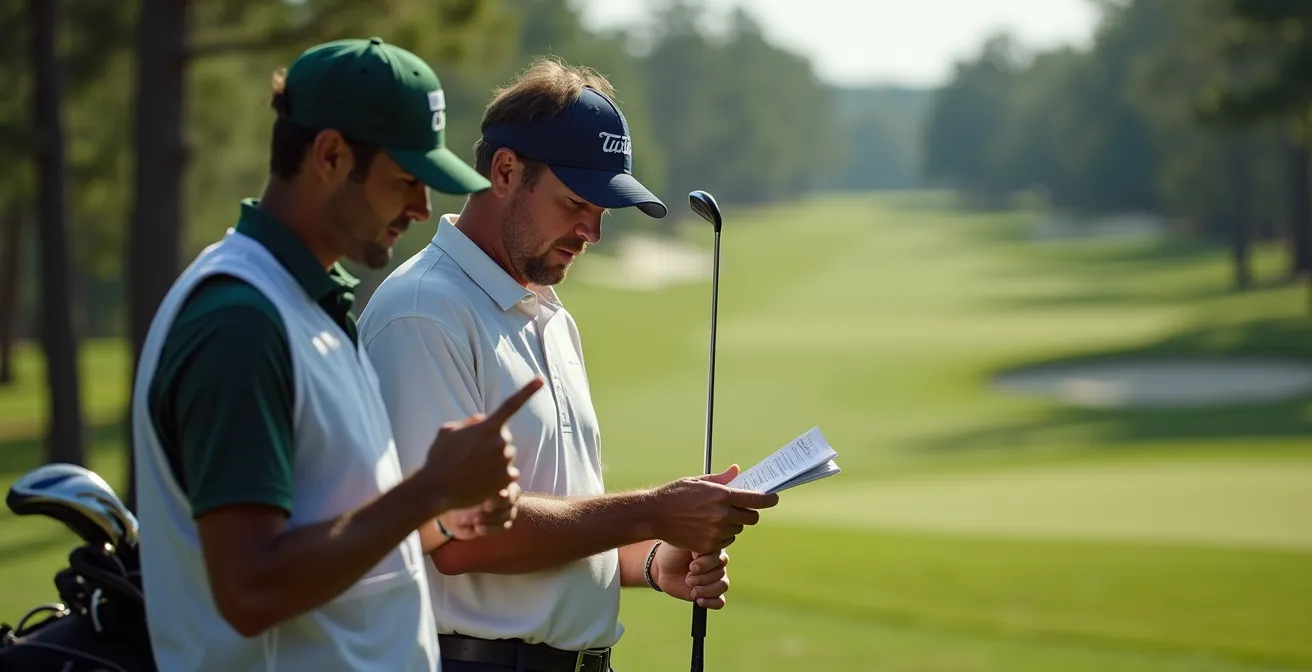
Unlike a weekend golfer who might get a yardage from a friend, the tour pro’s decision is a filtered, data-informed choice. This process minimizes costly mental errors. For an aspiring pro, developing a system for making decisions—even if you are your own caddie—is critical. This means having a clear process for evaluating every shot variable before you pull the trigger.
Your Player-Caddie Decision-Making Audit
- Information Gathering: Do you systematically check all variables before every shot (lie, wind, elevation, trouble)? List all the data points you use.
- Shot Selection: Do you identify a conservative target and a more aggressive one? Document your thought process for choosing between them.
- Commitment Check: Before you swing, do you verbally or mentally confirm your 100% commitment to the club and target you’ve selected?
- Contingency Planning: Have you identified the “best place to miss”? Is your target selection biased away from major trouble?
- Post-Shot Review: After the round, do you analyze your key decisions? Differentiate between a good process with a bad outcome and a bad process with a lucky outcome.
Block Practice vs Random Practice: Which One Prepares You for pressure?
How you practice is just as important as how much you practice. The distinction between block and random practice is a fundamental concept in motor learning, and it’s a major reason why tour pros perform better under pressure. Block practice is what most amateurs do: hitting the same club to the same target repeatedly. It’s great for grooving a new swing change and building initial confidence, but it does very little to prepare you for the realities of a golf course.
Random practice, on the other hand, mimics the on-course experience. It involves changing the club, target, and shot type with every ball. You might hit a driver, then a wedge, then a 7-iron, just as you would during a round. This method is more challenging and often feels less productive because your success rate per shot is lower. However, it forces your brain to retrieve and execute a different motor plan for each shot, which is exactly what golf demands. This process, known as contextual interference, dramatically improves long-term retention and performance transfer to the course.
Tour pros spend a significant portion of their practice time in a random or variable format. They create games, simulate holes, and put themselves under self-imposed pressure. This is how they “pressure-proof” their game. When they face a tough 170-yard shot over water in a tournament, they have already hit that shot hundreds of times in a practice environment that demanded the same level of mental focus. As the creator of the Strokes Gained statistic, Mark Broadie, notes, data helps coaches pinpoint the most critical areas for this type of practice.
You can break down a golfer’s strengths and weaknesses fairly accurately [using strokes gained] and that allows a coach like Sean Foley to focus his instruction on what will give the biggest bang for the buck.
– Mark Broadie, Every Shot Counts
This targeted, random practice is what builds a game that travels from the range to the course. Scottie Scheffler’s dominance, where he gained over 2.6 strokes per round on the field, is not just a result of a great swing, but of a practice structure that prepares him for the chaos of tournament golf.
The 10-Second Rule: Why Changing Your Routine for Birdie Kills Success?
Pressure changes everything. A 10-foot putt for par feels very different from a 10-foot putt for birdie, which feels different again from a 10-foot putt on the 18th hole to win. The amateur golfer often succumbs to this pressure by altering their process. They take extra time, add more practice strokes, or second-guess their read. This is a fatal flaw. Tour pros, by contrast, adhere to a “10-Second Rule” of consistency: the final 10 seconds before they start their stroke are identical for every single putt, regardless of the situation.
This unwavering commitment to process is a mental shield. It automates the execution and prevents the conscious, analytical brain from interfering. When the stakes are high, the instinct is to try harder or be more careful. But this extra effort often introduces tension and disrupts the finely tuned motor pattern of the putting stroke. The tour pro trusts the routine that has been honed over thousands of hours. The routine is the constant in a sea of variables.
It’s also important to have realistic expectations, which a consistent routine helps to manage. Even the best putters in the world are not perfect. According to putting statistics, half of all 8-foot putts are missed by the world’s best players. Understanding this fact can be liberating. It removes the self-imposed pressure to make every single putt. The goal is not perfection; the goal is to execute a good process and hit a good putt. The routine is what guarantees the process. If you can do that consistently, the results will take care of themselves over the long term. Abandoning your routine in a crucial moment is the fastest way to guarantee failure.
Key Takeaways
- Data Over Dogma: Elite players prioritize Strokes Gained and distance over traditional metrics like fairway percentage.
- Process is King: A consistent, time-bound pre-shot routine and random practice methods are more valuable than raw talent for performing under pressure.
- Invest in Skill, Not Just Gear: Data-informed coaching provides a significantly higher return on investment for score improvement than new equipment.
Why 3 Private Coaching Sessions Are Worth More Than a New Driver?
In the quest for lower scores, the amateur golfer’s first instinct is often to look for a technological solution. We are bombarded with marketing that promises more distance and forgiveness from the latest driver. While modern equipment is fantastic, its impact on your scorecard is often marginal compared to the impact of targeted, professional coaching. The tour pro understands that their performance is a product of their skill and strategy, not just their tools.
A new driver might give you an extra 5-10 yards, which is valuable. However, a good coach armed with data can identify the specific areas where you are losing the most strokes and provide a plan to fix them. As PGA of America Golf Professional Brendon Elliott explains, data identifies the problem, but coaching provides the solution.
I had a member losing 2.5 strokes per round on approach shots. Strokes gained told us that much. Took three lessons to figure out he was using the wrong clubs for his distances. Stats identify, coaching fixes.
– Brendon Elliott, PGA of America Golf Professional
This is where the return on investment becomes clear. The money spent on a few lessons can address fundamental flaws in course management, short game technique, or practice structure—areas that a new driver will never touch. The table below, based on analysis from shot tracking systems, illustrates the potential impact of different investments.
| Investment Type | Typical Cost | Potential Strokes Gained | Impact Areas |
|---|---|---|---|
| New Driver | $500-600 | 0.2 strokes/round | Off-the-tee only |
| 3 Coaching Sessions | $450-600 | 0.5-1.0 strokes/round | Multiple: Off-the-tee (0.5), Approach (0.3), Mental (0.2) |
| Shot Tracking System | $200-300/year | 0.3-0.5 strokes/round | Strategic decisions, club selection |
As this comparative analysis shows, the potential improvement from coaching far outweighs that of new equipment for a similar cost. It addresses multiple facets of the game, leading to more comprehensive and lasting improvement. The tour pro has a team—a swing coach, a short game coach, a mental coach—because they know that investing in their skills is the only sustainable path to elite performance.
Your journey to lower scores begins not in a retail store, but on the practice tee with a clear, data-informed plan. Start by tracking your stats to understand where you’re really losing strokes, and invest your time and money in the proven processes that separate the best from the rest.