
The choice between titanium and carbon isn’t about which material is “better,” but how engineers use each to manipulate mass for optimal distance and forgiveness.
- Carbon’s lower density creates “discretionary weight” to boost MOI (forgiveness), while titanium offers proven durability and a classic acoustic profile.
- The real gains in modern drivers come from improved aerodynamics and weight placement, not just a “hotter” face.
Recommendation: The best material for you depends on your swing. A professional custom fitting is the only way to determine which head/shaft combination will truly add yards to your drive.
As a gear enthusiast with a trusty driver that’s seen five seasons, you’re standing at a crossroads. The market is saturated with two competing material philosophies: the industry-standard titanium and the revolutionary carbon composite. Marketing claims promise explosive distance gains, but the underlying science often gets lost in the noise. You’ve likely heard the common refrains: “carbon is lighter, so it’s faster” or that titanium has a superior “trampoline effect.” While there’s a kernel of truth in these statements, they oversimplify a complex engineering reality.
The conversation around driver materials has become fixated on a simple binary choice. However, this misses the fundamental point. The quest for more yards isn’t about the raw material itself, but about what that material allows an engineer to achieve. The true key to unlocking performance lies in the strategic manipulation of mass properties—the center of gravity (CG) and moment of inertia (MOI). Each material offers a different set of tools to solve this complex physics problem.
This article moves beyond the surface-level debate. From a materials engineering perspective, we will dissect how titanium’s strength and carbon’s low density are leveraged to influence everything from ball speed and sound to durability and swing dynamics. We’ll explore the engineering trade-offs and explain why the most significant advancements may not be where you think they are. By the end, you won’t just know which material is which; you’ll understand the core principles that will empower you to choose a driver that is truly optimized for your swing, not just one that follows the latest trend.
To navigate this technical landscape, this guide breaks down the critical performance differences between titanium and carbon composite heads. We will examine the physics of impact, the practicalities of durability, and the ultimate role of custom fitting in maximizing your potential off the tee.
Summary: Titanium vs Carbon Composite: Which Driver Material Adds 10 Yards to Your Swing?
- Trampoline Effect: What Is “Smash Factor” and How Does Titanium Help?
- Why Does Your Titanium Driver Sound Loud While Carbon Sounds Muted?
- Can You Crack a Titanium Face with a High Swing Speed?
- Head Heavy: How Titanium Heads Affect the Swing Weight and Shaft Choice?
- Old Titanium: Is a 10-Year-Old Driver Still Competitive with Modern Tech?
- Speed Sticks: Does Training with Lighter Clubs Really Make You Faster?
- Shortening the Driver: How Losing an Inch Can Find More Fairways?
- Is Custom Fitting Worth the Money for a Mid-Handicap Golfer?
Trampoline Effect: What Is “Smash Factor” and How Does Titanium Help?
From an engineering standpoint, the “trampoline effect” is a measure of energy transfer efficiency at impact. We quantify this with a metric called smash factor: the ball speed divided by the clubhead speed. A higher smash factor means a more efficient transfer of energy. For decades, titanium alloys have been the material of choice for driver faces precisely because their high strength-to-weight ratio allows for the construction of a thin, flexible face that rebounds powerfully at impact. This face flexion is strictly regulated by governing bodies, and according to engineering calculations, the maximum achievable smash factor with a legal driver is around 1.50 (often cited as 1.495).
Carbon composite enters this equation not by being “bouncier” than titanium, but by fundamentally changing the mass properties of the clubhead. A carbon face is significantly lighter. As TaylorMade’s case study on their Stealth driver shows, the carbon face is 40% lighter than an equivalent titanium version. This saved weight—known as discretionary weight—can be redistributed to other areas of the head, typically low and back, to increase the Moment of Inertia (MOI). A higher MOI makes the club more stable on off-center hits, helping to preserve ball speed and, by extension, maintain a higher average smash factor across the entire face, not just on perfect center strikes.
The following table illustrates how crucial a high smash factor is, especially for amateur golfers. While a Tour Professional is already maximizing their efficiency, the average player has a significant opportunity to gain distance by improving their energy transfer through better strike quality or technology that aids off-center hits.
| Player Level | Average Smash Factor | Ball Speed (100mph swing) | Distance Gain Potential |
|---|---|---|---|
| Tour Professional | 1.50 | 150 mph | Maximized |
| Elite Amateur | 1.48-1.50 | 148-150 mph | 0-2 yards |
| 14-Handicapper | 1.43 | 143 mph | 10-15 yards |
| Average Golfer | 1.40-1.45 | 140-145 mph | 10-20 yards |
Therefore, the debate isn’t about which material has a better trampoline effect in isolation. Both are engineered to push the legal limits. The key difference is the strategy: titanium focuses on direct face flexion, while carbon’s primary advantage is the mass savings it provides, which engineers then use to enhance forgiveness and preserve ball speed on mishits.
Why Does Your Titanium Driver Sound Loud While Carbon Sounds Muted?
The acoustic difference between titanium and carbon drivers is one of the most immediate and noticeable characteristics, and it is a direct result of their inherent material properties. Sound is simply the vibration of a material. Titanium is a metal with a highly crystalline structure, which allows it to vibrate freely and for a longer duration upon impact. This vibration produces the loud, high-frequency “crack” or “ping” that has defined the sound of the modern driver for over two decades. This sound has become synonymous with power and a well-struck shot for many golfers.
Carbon composite, on the other hand, behaves very differently. It is a matrix of carbon fibers held together by a polymer resin. This composite structure is exceptionally good at acoustic damping. When the face is struck, the vibrations are quickly absorbed and dissipated throughout the layered material. This prevents the sound waves from propagating and resonating as they would in a uniform metal structure. The result is a much shorter, lower-frequency “thud” or “thwack” that is often described as muted, solid, or even persimmon-like by veteran players.
Interestingly, engineers are acutely aware of the golfer’s psychological connection to sound. As an analysis of TaylorMade’s acoustic engineering reveals, they did not eliminate metal entirely. Instead, they used the internal titanium frame not just for structure, but specifically to tune the club’s acoustics. By carefully designing the internal armatures, they could engineer a more satisfying sound profile than a pure carbon head might produce, blending the modern benefits of carbon with the powerful sound golfers crave. This demonstrates that sound is not an accident but a deliberately engineered component of the user experience.
Ultimately, neither sound is technically “better”—it is a matter of player preference. Some golfers feel the loud feedback of titanium inspires confidence, while others prefer the solid, muted feel of carbon, finding it more pleasing and indicative of a powerful, compressed strike. This subjective feel is a critical component in a player’s confidence over the ball.
Can You Crack a Titanium Face with a High Swing Speed?
The question of durability is a primary concern for any golfer investing in a new driver, especially with the introduction of novel materials. Titanium has a long and proven track record. It is an incredibly strong and fatigue-resistant metal, which is why it has been the standard for over 20 years. While it’s not impossible, cracking a titanium driver face is a rare event, typically resulting from a manufacturing defect or extreme, repeated impacts in a specific spot, rather than being a function of high swing speed alone. The material is engineered to withstand the forces generated by even the fastest swingers on the planet.
Carbon composite faces, being a newer technology, naturally face more skepticism. Engineers have addressed this by using multiple layers of material. The TaylorMade Stealth face, for example, is composed of 60 layers of carbon fiber sheets fused with resin. This layered construction provides a high degree of structural integrity and durability, designed to match what golfers expect from titanium. The primary advantage of this construction is weight savings; a modern the carbon face is approximately 20 grams lighter than its titanium counterpart, which is the “discretionary weight” engineers use to improve other performance aspects like MOI.
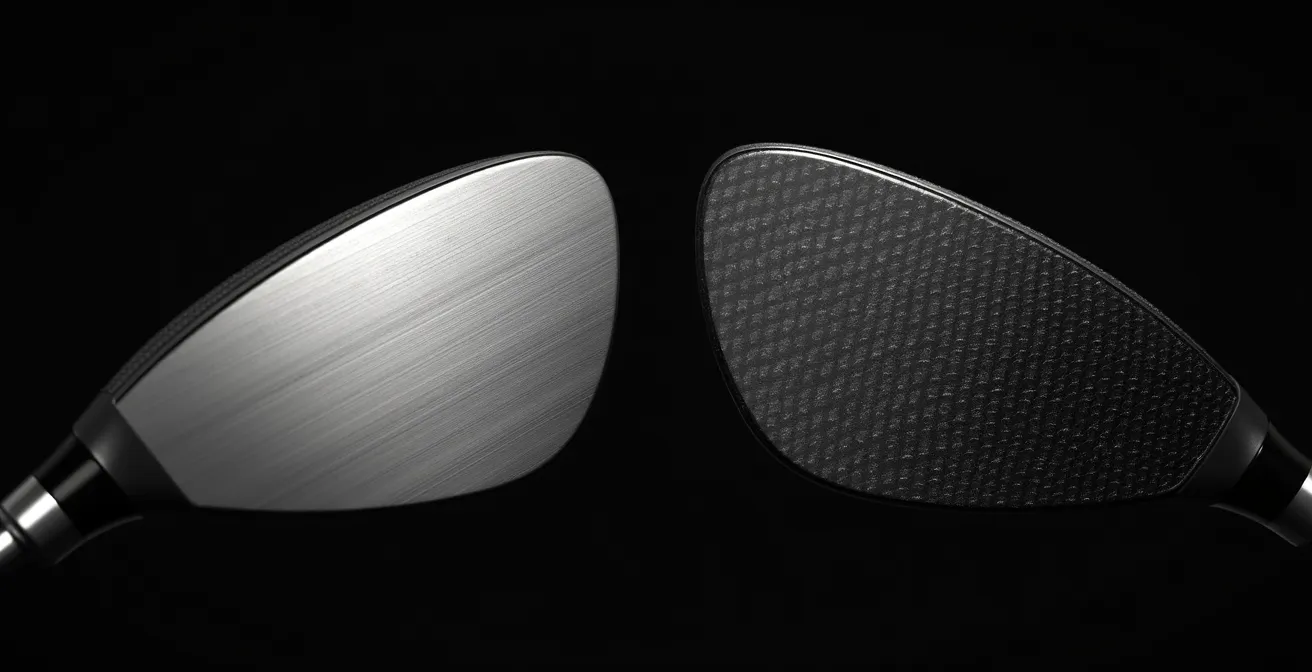
However, all materials have vulnerabilities. Both titanium and carbon faces are most susceptible to damage from impacts with foreign objects (like a stray rock or tee marker), or from repeated use with hard, abrasive range balls, which can accelerate wear. Cold weather can also make materials more brittle and increase the risk of fracture. While a high swing speed alone is unlikely to crack a well-made face of either material, proper care is essential to maximizing the life of your club.
Action Plan: Driver Face Durability Best Practices
- Visual Inspection: Regularly clean and check your driver face for any surface changes, stress marks, or hairline cracks, especially near the edges.
- Impact Awareness: Avoid hitting old, hard, or sandy range balls exclusively, as their abrasive nature accelerates face wear more than premium golf balls.
- Storage Protocol: Always use a headcover during transport and storage to prevent accidental dings and impacts from other clubs in the bag.
- Temperature Caution: Be mindful in extremely cold weather (near freezing), as materials can become more brittle and susceptible to fracture on mishits.
- Warranty Documentation: If you notice any potential issue, document it with photos immediately and contact the manufacturer to inquire about warranty coverage.
In summary, both materials are engineered for high performance and durability. While carbon is newer, its multi-layer design is built to withstand the rigors of the game. For the average golfer, the risk of cracking either type of face due to swing speed is exceptionally low, and proper care remains the most important factor in longevity.
Head Heavy: How Titanium Heads Affect the Swing Weight and Shaft Choice?
Swing weight is a crucial but often misunderstood aspect of club fitting. It’s a measure of how heavy the club feels during the swing, not its total static weight. It’s determined by the balance point of the club and is heavily influenced by the head’s mass. This is where the material choice of titanium versus carbon has a significant downstream effect on the entire club system, particularly the shaft.
A traditional all-titanium head is inherently heavier. To achieve a standard swing weight (typically in the D2-D4 range for men), club fitters must pair it with a shaft that has enough mass to counterbalance the head. If the shaft is too light, the club will feel overly “head-heavy,” which can disrupt a golfer’s tempo and timing, often leading to an early release of the club and a loss of power and control. Consequently, all-titanium drivers are often paired with shafts in the 65-75 gram range to maintain a balanced feel and provide stability for players who benefit from feeling the head’s position throughout the swing.
Carbon composite’s main engineering benefit—discretionary weight—radically changes this equation. Because a significant amount of mass is saved from the face and body, the overall head is lighter. This gives fitters a much wider range of options. They can use the saved weight to increase MOI while still being able to pair the head with a lighter shaft (in the 55-65 gram range, or even lighter) and maintain a standard swing weight. A lighter overall club can help many players generate more clubhead speed. This is a key reason why carbon-based drivers are often marketed as “speed-inducing.”
The following table from D’Lance Golf provides a general overview of how the driver type influences the typical shaft weight and resulting performance characteristics.
| Driver Type | Typical Shaft Weight | Launch Characteristics | Player Profile |
|---|---|---|---|
| All-Titanium | 65-75g | Higher launch needed | Players needing stability |
| Carbon Composite Body | 55-65g | Lower launch possible | Players seeking speed |
| Hybrid (Ti/Carbon) | 55-70g | Variable launch | Wide fitting range |
The material of the head is not an isolated component; it is the starting point that dictates the optimal shaft pairing. A heavier titanium head requires a heavier shaft for balance, promoting stability. A lighter carbon head allows for a lighter shaft, promoting speed. Finding the right combination for your specific swing mechanics is the essence of a good driver fitting.
Old Titanium: Is a 10-Year-Old Driver Still Competitive with Modern Tech?
For a gear enthusiast looking to upgrade a 5-year-old, or even 10-year-old, driver, a critical question is: what real performance have I been missing? The answer is more nuanced than marketing suggests. In terms of pure face “hotness,” your old driver is likely not far behind. The measurement for this is the Coefficient of Restitution (COR), which is essentially the trampoline effect. As one analysis notes, drivers hit the maximum legal limit of 0.830 COR over a decade ago. Since then, as TaylorMade engineers have stated, “Designers couldn’t make the face any thinner without losing structural integrity.” This means the raw ball speed from a perfect center strike hasn’t dramatically increased.
The real evolution has been in forgiveness and aerodynamics, two areas where new materials like carbon composite have been game-changers. The discretionary weight saved by using carbon has allowed engineers to dramatically increase the Moment of Inertia (MOI). A higher MOI means the clubhead twists less on off-center hits. For you, this translates to straighter shots and, more importantly, much better ball speed retention when you don’t catch the exact center of the face. Your 10-year-old titanium driver might be just as long on a perfect hit, but it is almost certainly shorter and less accurate on your average miss.

Furthermore, aerodynamics have advanced significantly. As the illustration shows, older drivers had simpler, more rounded shapes. Modern drivers, using the lightweight properties of carbon to shape the crown and sole, feature complex aerodynamic designs with trip steps and Kammback tails. These shapes reduce drag during the downswing, allowing a player to generate more clubhead speed with the same amount of effort. This is “free speed” that your older driver simply cannot provide.
Designers couldn’t make the face any thinner without losing structural integrity
– TaylorMade Engineers, Carbon Fiber Gear Analysis
So, is your 10-year-old driver competitive? On the launch monitor, on a single, perfectly struck ball, perhaps. But over the course of a full round, with the inevitable mishits, a modern high-MOI, aerodynamically-optimized driver (whether all-titanium or carbon-based) will deliver more average distance and find more fairways. The upgrade is not about a hotter face; it’s about a more efficient and forgiving overall system.
Speed Sticks: Does Training with Lighter Clubs Really Make You Faster?
The concept of Overspeed Training, popularized by “speed sticks,” is based on a simple neuromuscular principle: by swinging something lighter than your normal driver, you teach your body to move faster. Your central nervous system learns to fire your muscles in a quicker sequence, raising your potential top speed. When you return to your normal-weight driver, you retain a portion of that increased speed. This training method has been proven effective for golfers at all levels.
Interestingly, the advent of ultra-lightweight carbon composite drivers has created a form of “built-in” speed training. As we’ve discussed, the primary benefit of carbon is its low density, which enables the construction of a lighter overall club. For a player accustomed to a heavier, all-titanium driver from a few years ago, switching to a modern, lightweight carbon model can feel like picking up a speed stick. The reduced total weight can immediately help a player generate more clubhead speed, simply because there is less mass to accelerate.
According to a case study on the Wilson Dynapower drivers, carbon excels in club heads due to its ability to redistribute weight, which can yield lower spin rates. This lightweight construction inherently leads to the potential for higher swing speeds, mirroring the effect of a dedicated training aid. However, this comes with a critical caveat. Speed without control is useless. A club that is too light for a player can disrupt their tempo and lead to wild inconsistency. The key is to find the “sweet spot” where the weight is light enough to increase speed but still heavy enough to maintain stability and control over the clubface.
Integrating this concept into your game requires a systematic approach. You can’t just grab the lightest club off the rack. Consider the following steps for safely exploring a lighter setup:
- Start with your current driver’s total weight as a baseline measurement.
- Test shafts that are 10-15 grams lighter to see if your clubhead speed increases without a significant loss of control.
- Use impact tape or a launch monitor to monitor your strike pattern; a lighter club can sometimes lead to more off-center hits.
- If you decide to go lighter, decrease the weight gradually over several weeks to allow your body to adapt.
- Consider counterbalanced shafts or grips if a standard lightweight setup feels unstable or too “whippy.”
In essence, a modern lightweight driver can act as a dual-purpose tool: a piece of playing equipment and a subtle speed-training device. The key is to approach it with the same discipline as a dedicated training program, ensuring that the pursuit of speed doesn’t come at the cost of on-course playability.
Shortening the Driver: How Losing an Inch Can Find More Fairways?
In the relentless pursuit of distance, driver shafts have become progressively longer, with many off-the-rack models measuring 45.5 inches or more. From a physics perspective, a longer lever can generate more speed at its end. However, from a practical, human perspective, a longer club is significantly harder to control and strike consistently in the center of the face. For many amateur golfers, this trade-off results in a net loss: the extra potential speed is negated by poor strikes, leading to lower ball speed and wider dispersion. This is why many club fitters advocate for shortening the driver.
Losing even half an inch or a full inch from your driver can dramatically improve your ability to deliver the clubface squarely to the ball. This leads to a higher percentage of center-face strikes, which maximizes smash factor and tightens your shot pattern, helping you find more fairways. The common fear is a significant loss of distance, but this is where the material construction of the driver head becomes highly relevant.
A modern, high-MOI driver, often built with a lightweight carbon composite body, is the perfect candidate for this strategy. Because these heads are so stable and forgiving, they lose less ball speed on off-center hits. An older, lower-MOI titanium head is far more punishing on mishits, so shortening it might lead to a more dramatic drop in distance. With a high-MOI carbon head, you can gain a substantial amount of control and accuracy by shortening the shaft, while sacrificing only a minimal amount of distance. This is a trade-off that would benefit a huge percentage of mid-handicap golfers.
The following data highlights this trade-off, showing how a high-MOI head (typical of modern carbon designs) loses less yardage than a lower-MOI head when the shaft is shortened.
| Shaft Length Change | Low-MOI Titanium | High-MOI Carbon | Fairway Accuracy Gain |
|---|---|---|---|
| -0.5 inch | -3 to -5 yards | -2 to -3 yards | +10-12% |
| -1.0 inch | -8 to -10 yards | -4 to -5 yards | +18-22% |
For a gear enthusiast looking to upgrade, this presents a powerful strategy. Pairing a modern, forgiving carbon head with a slightly shorter shaft could be the secret to not only hitting the ball farther on average (due to better strikes) but also hitting it significantly straighter. It’s a counter-intuitive approach that prioritizes control to unlock more playable distance.
Key Takeaways
- Driver “hotness” (COR) was maxed out years ago; modern gains come from forgiveness (MOI) and aerodynamics, both areas where carbon composite offers engineering advantages.
- The choice between titanium and carbon influences the entire club system, especially the shaft weight required to achieve a balanced swing feel.
- A material’s sound is a direct result of its damping properties; titanium’s “ping” and carbon’s “thud” are both deliberately engineered features, not accidents.
Is Custom Fitting Worth the Money for a Mid-Handicap Golfer?
After dissecting the material science and engineering trade-offs between titanium and carbon, one conclusion becomes inescapable: the material is just one variable in a complex performance equation. For a mid-handicap golfer, a custom fitting is not a luxury; it is the most effective way to ensure your significant investment in a new driver translates into real, on-course improvement. Buying an expensive, high-tech driver off the rack is like buying a performance sports car but never adjusting the seat or mirrors. You simply won’t get the most out of it.
A fitting session with a professional using a launch monitor removes the guesswork. It provides objective data on your swing—clubhead speed, attack angle, dynamic loft—and measures the results of different head and shaft combinations. This is where the titanium vs. carbon debate is truly settled, not in a forum, but on the screen in front of you. You might find that a high-MOI carbon head with a shorter shaft gives you the best combination of distance and accuracy. Or, you might discover that the stable feel of a heavier, all-titanium setup helps you groove a more consistent swing path. As the fitting team at True Fit Clubs emphasizes, “The shaft is the part of the club that has the most impact on distance, consistency and accuracy.” A fitting is the only way to find the optimal pairing for your unique swing.
The shaft is the part of the club that has the most impact on distance, consistency and accuracy
– True Fit Clubs Fitting Team, 2024 Driver and Shaft Recommendations
Furthermore, the return on investment can be substantial. Many golfers assume a fitting just adds cost, but it can actually save you money. Expert club fitters often report that a properly fitted older driver can outperform a poorly fit brand-new model. This could save a golfer hundreds of dollars while simultaneously improving their performance. With recent surveys showing that 35% of golfers received their fitting for free with the purchase of a club, the financial barrier is lower than ever. A fitting ensures your money is spent on equipment that is guaranteed to work for *you*, eliminating the costly cycle of buying and selling drivers that don’t perform as advertised.
Action Plan: Find Your Ideal Driver Upgrade
- Establish Baseline: Get your current driver measured on a launch monitor to record your swing speed, ball speed, launch angle, spin rate, and typical miss.
- Demo Heads & Shafts: Test a variety of heads (both titanium and carbon) and shafts (different weights, flexes, and profiles) to see how they affect your baseline numbers.
- Compare Data: Work with a fitter to analyze the launch monitor data. Look for the combination that produces the best ball speed, optimal launch/spin, and tightest dispersion.
- Evaluate Feel & Sound: Beyond the numbers, pay close attention to which club feels the best in your hands and gives you the most confidence at address.
- Finalize & Fit: Once the best head/shaft combination is identified, have the fitter build it to your exact specifications, including length, grip size, and swing weight.
For the gear enthusiast, the fitting process is the final, essential step. It transforms you from a consumer of technology into an informed user, armed with a piece of equipment that is precisely tailored to your swing’s DNA. This is how you truly add 10 yards to your swing.