
The essence of a “major” championship lies not in prize money, but in its unique and uncompromising philosophy of testing a golfer’s complete skill set.
- Unlike standard tournaments, each of the four majors presents a distinct challenge: The Masters tests creativity, the U.S. Open demands discipline, The Open requires adaptability, and the PGA Championship measures depth of talent.
- This differentiation in course setup, field composition, and historical pressure creates a crucible that defines a player’s legacy in a way no other event can.
Recommendation: As you watch the next major, look beyond the leaderboard and try to identify the specific “test” the championship is posing and which players are best equipped to solve it.
For any new fan of professional golf, a certain reverence surrounds four specific weeks on the calendar. The broadcasts feel more significant, the crowds seem larger, and the pressure is visibly more intense. These are the major championships. But what truly elevates The Masters, the PGA Championship, the U.S. Open, and The Open Championship above the dozens of other professional tournaments held each year? The easy answers often point to larger purses, more world ranking points, and greater media attention. While true, these are merely symptoms, not the cause.
The fundamental distinction is one of philosophy. A standard tour event aims to identify the player who is playing the best that particular week. A major championship, by contrast, is a deliberately constructed, often punishing, examination designed to test a specific and enduring facet of a golfer’s physical and mental fortitude. Each major possesses a unique architectural and competitive identity, a core philosophy of what it means to be a champion. They are not simply harder tournaments; they are different kinds of tests entirely. Understanding these distinct philosophies is the key to appreciating why winning just one can define a career, and why winning all four is the sport’s most sacred achievement.
This article will deconstruct the identity of each of the four majors, exploring the unique philosophy that makes it a true test of greatness. We will examine the immense difficulty of conquering all four, the specific pressures players face, and finally, how you as a fan can plan a trip to witness these historic events in person.
Summary: The Four Pillars of a Major Championship
- Why The Open Championship Is the Only Major Where Weather Dictates the Winner?
- Why Does the USGA Make the US Open the Hardest Test in Golf?
- How the PGA Championship Field Is Stronger Than the Other Three Majors?
- Winning All Four: Why Only 5 Men Have Achieved the Career Grand Slam?
- Friday Afternoon Sweats: How the Cut Line Determination Changes Strategy?
- Leading on Sunday: Why 50% of Leaders Fail to Close the Deal at the Masters?
- 12 Months Out: Why You Need to Plan Years Ahead for Top Courses?
- Bucket List Travel: How to Plan a Trip to Major Championship Venues?
Why The Open Championship Is the Only Major Where Weather Dictates the Winner?
The Open Championship, governed by The R&A, is the oldest of the four majors and is defined by its chosen battleground: the historic links courses of the United Kingdom. Its philosophy is a test of imagination and adaptability against the rawest elements of the game. Unlike the manicured parkland courses common in the U.S., links land is shaped by nature—undulating, firm, and exposed to the whims of the wind and rain. The champion is not the player who imposes their will on the course, but the one who best negotiates with it.
The weather is not merely a factor at The Open; it is an active participant. The draw can be a lottery, with players on one side of the day facing benign conditions while the other half battles gales and downpours. This introduces a level of unpredictability unmatched in the other three majors. As the PGA Tour staff noted during one particularly grueling Open, weather can completely transform the nature of the challenge. This sentiment was captured perfectly in an official report:
Relenting rains and winds turned Royal Troon’s back nine into a slugfest during Round 3, as the final players on the course slowly drifted back toward par
– PGA Tour Staff, PGA Tour Official Report
Players must master a completely different type of golf: low, running shots that stay under the wind, creative chipping from tight lies, and putting on vast, slower greens. The 2002 Open at Muirfield provides a stark example, where Tiger Woods, then chasing a single-year Grand Slam, was caught in a freak Saturday storm. His score ballooned to an 81, a testament to how quickly The Open’s elemental challenge can derail even the most dominant player in history.
Why Does the USGA Make the US Open the Hardest Test in Golf?
If The Open tests a player’s adaptability, the U.S. Open, run by the United States Golf Association (USGA), is a test of discipline and precision. The USGA’s philosophy is explicit: to provide the most rigorous and complete examination of a golfer’s skills. They achieve this through a specific and punishing course setup, regardless of the venue. Hallmarks of a U.S. Open setup include narrow fairways, punishingly thick rough, and lightning-fast, firm greens that repel all but the most perfectly struck approach shots.
The goal is to penalize any shot that is not executed with near perfection. There is little room for creativity or scrambling; the U.S. Open demands control and mental fortitude. The champion is typically the player who demonstrates the most resilience and avoids major mistakes, often finishing at a score at or even over par. This philosophy of difficulty extends to the tournament’s structure. For instance, the U.S. Open has the strictest 36-hole cut of any major championship, allowing only the top 60 players and ties to advance to the weekend. This ensures that only those who have survived the initial brutal test get to compete for the title.
This unforgiving setup is designed to identify the most complete golfer, one who can drive it straight, hit precise iron shots, and maintain their composure under relentless pressure. It is a mental and physical grind from the first tee to the final putt.
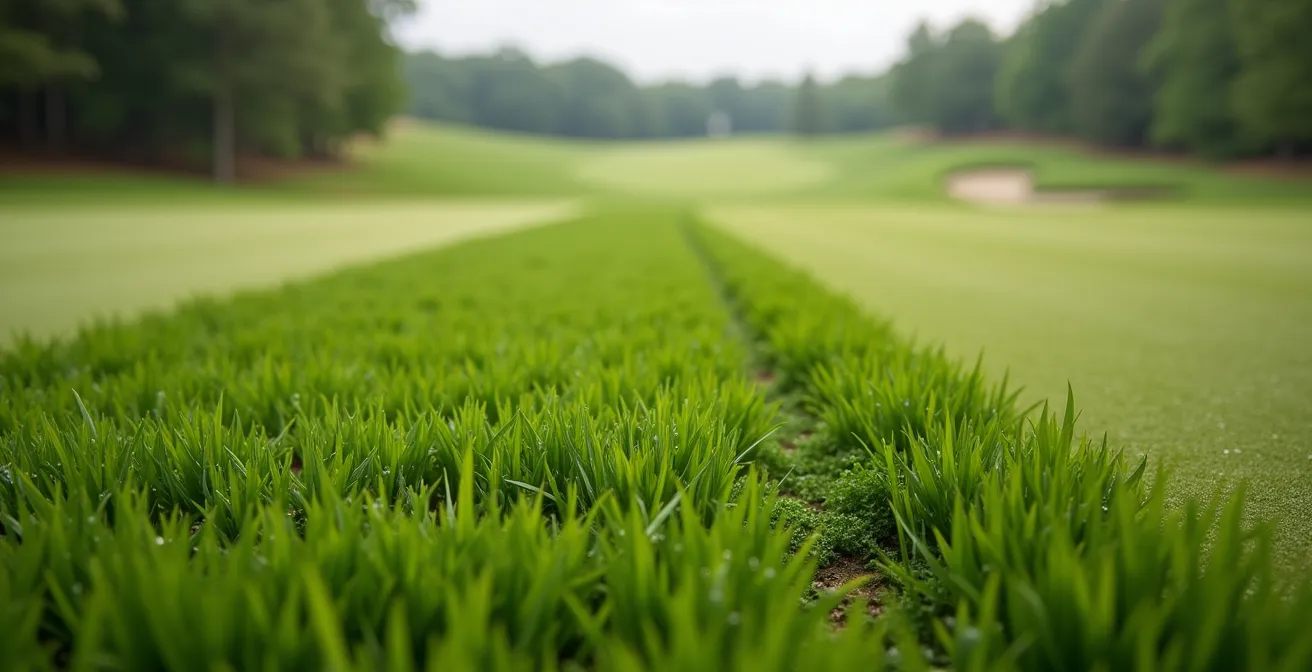
As the image above illustrates, the stark contrast between the playable short grass and the penal rough defines the strategic demand. A miss of only a few feet can result in a dropped shot, making every swing a high-stakes decision.
How the PGA Championship Field Is Stronger Than the Other Three Majors?
While the other majors derive their identity from the course or the conditions, the PGA Championship’s philosophy is rooted in its competitors. Its brand is a test of depth and strength, priding itself on annually assembling what is arguably the strongest field in golf. Run by the PGA of America, the tournament’s primary distinction is that its field is composed exclusively of professional golfers. Unlike The Masters, U.S. Open, and The Open, it does not extend invitations to amateur players.
This “all-pro” model means that from top to bottom, the field is packed with the world’s best, including a large contingent of PGA club professionals who earn their spot through qualifiers. This creates an environment where there are no “easy” pairings and every player is capable of shooting a low score. The result is a leaderboard that is often tightly bunched, demanding four rounds of consistently excellent golf to win. While the other majors have their own exemption criteria, the PGA’s focus on professional-only status gives it a unique claim to competitive density.
The following table, based on information from an analysis of major tournament structures, highlights the key differences in field composition that bolster the PGA Championship’s claim to being the toughest to win from a strength-of-field perspective.
| Major Championship | Professional Only | Amateurs Allowed | Past Champions Exempt |
|---|---|---|---|
| PGA Championship | Yes | No | Limited |
| Masters | No | Yes | Lifetime |
| US Open | No | Yes | 10 years |
| The Open | No | Yes | Until age 60 |
This structure ensures that victory at the PGA Championship requires defeating a field with unparalleled professional depth, solidifying its identity as “Glory’s Last Shot” and a true test for the game’s elite.
Winning All Four: Why Only 5 Men Have Achieved the Career Grand Slam?
The ultimate testament to the distinct philosophies of the four majors is the sheer difficulty of winning all of them. The Career Grand Slam is the pinnacle of golfing achievement, a feat so rare that it distinguishes legends from mere champions. In the history of the modern game, winning all four majors constitutes the career Grand Slam, an achievement accomplished by only five players: Gene Sarazen, Ben Hogan, Gary Player, Jack Nicklaus, and Tiger Woods.
Why is this number so small? Because it requires a golfer to be more than just great; it requires them to be versatile. As we’ve explored, each major demands a different, and sometimes conflicting, set of skills. A player might possess the perfect creative touch for Augusta but lack the grinding discipline for a U.S. Open. Another might have the power for the PGA Championship but not the imaginative shot-making for a windy links course. To win all four, a player must master every facet of the game.
The distinct skill sets required to conquer each major championship showcase why the Grand Slam is such a monumental challenge:
- The Masters: Demands unparalleled creativity, touch, and precision around Augusta National’s severely sloped greens and requires capitalizing on risk-reward opportunities.
- US Open: A test of pure mental toughness, driving accuracy, and an ability to grind through punishing conditions without losing patience.
- The Open: Requires masterful ball-flight control, imagination, and adaptability to ever-changing weather and the unique bounces of links golf.
- PGA Championship: A measure of all-around strength, rewarding power and consistency against the deepest professional-only field in golf.
To achieve the Career Grand Slam, a golfer must not only reach the highest level of the sport but also possess the complete arsenal of skills to solve four fundamentally different puzzles. It is this demand for total mastery that makes it the most revered achievement in golf.
Friday Afternoon Sweats: How the Cut Line Determination Changes Strategy?
Before a player can even dream of a green jacket or a Claret Jug, they must first survive the tournament’s initial crucible: the 36-hole cut. The cut is the guillotine that falls after the second round, reducing the field to roughly half its size for the weekend. While all tour events have a cut, the pressure is magnified exponentially at a major. Missing the cut at a major is a significant blow, both for a player’s confidence and their place in the history books. This pressure is most acute on Friday afternoon, as players on the bubble grind to make a crucial par or birdie that will allow them to play the weekend.
Strategy changes dramatically for those hovering around the projected cut line. Aggressive, birdie-seeking game plans are often shelved in favor of conservative, percentage golf. The primary goal is no longer to climb the leaderboard but simply to survive. Players will aim for the center of greens, lay up on par-5s, and prioritize avoiding bogeys over chasing birdies. Every shot is fraught with tension, as a single mistake can mean the difference between playing for a championship and going home early.
Interestingly, the cut rules vary slightly between the majors, creating subtle differences in that Friday afternoon pressure. These differences dictate the size of the weekend field and a player’s chances of survival.
| Major Championship | Cut Rule | Typical Field After Cut |
|---|---|---|
| The Masters | Top 50 and ties | ~50-60 players |
| US Open | Top 60 and ties | ~65-75 players |
| The Open | Top 70 and ties | ~75-85 players |
| PGA Championship | Top 65 and ties | ~70-80 players |
While the rules differ, the experience is universal: a nerve-wracking test that serves as the first major hurdle in the long journey to becoming a major champion.
Leading on Sunday: Why 50% of Leaders Fail to Close the Deal at the Masters?
Surviving the cut is one thing; winning is another. And no major championship illustrates the immense pressure of closing out a victory quite like The Masters. Held every April at Augusta National Golf Club, it is the only major played at the same venue each year. This familiarity breeds a unique kind of tension. The course, and particularly its famous back nine on Sunday, is designed for drama. It is a masterpiece of risk-reward architecture, offering tempting opportunities for eagles and birdies but punishing even the slightest miscalculation with double bogeys or worse.
This is why holding the lead on Sunday at the Masters is considered one of the most mentally taxing positions in all of sports. The leader knows the history. They know that a two-shot lead can vanish with one swing at the par-5 13th or 15th, or with a single splash into Rae’s Creek at the par-3 12th. The roars of the crowd, echoing through the Georgia pines, signal charges from competitors, adding to the psychological burden. The knowledge that the iconic green jacket is so close, yet so agonizingly far, can cause even the most seasoned professionals to falter.
Augusta National’s Back Nine: A Theater of Triumph and Heartbreak
The history of The Masters is written on its back nine. As detailed in analyses of major golf tournament dynamics, every corner of the course whispers stories that magnify the pressure on a Sunday leader. From Gene Sarazen’s “Shot Heard ‘Round the World” in 1935, which propelled him to an unlikely victory, to the myriad of collapses at Amen Corner, to Tiger Woods’s incredible comeback victory in 2019, the course is a living museum of triumph and disaster. A leader on Sunday is not just battling the course; they are battling the ghosts of everyone who has succeeded and failed before them.
This combination of a volatile, risk-reward course design and the weight of immense historical precedent creates a pressure cooker unlike any other. It explains why so many 54-hole leaders fail to convert their advantage into a victory, and why the player who ultimately dons the green jacket is the one who has conquered not just the course, but their own nerves.
12 Months Out: Why You Need to Plan Years Ahead for Top Courses?
For golf fans, the allure of the majors extends beyond watching on television. It sparks a desire to walk the hallowed grounds themselves. This leads to the ultimate “bucket list” dream for many golfers: playing a major championship venue. However, the prestige and history that define these courses also create incredible demand, making access a significant challenge that requires extensive advance planning. The moment a course is announced as a future major host, the clock starts ticking for anyone hoping to secure a tee time.
This is especially true for the publicly accessible courses in the major rotation. For iconic venues like the Old Course at St. Andrews, the primary method for securing a time is through a ballot system. As a result, the St Andrews Old Course typically requires applications to be submitted more than a year in advance, with no guarantee of success. For private U.S. Open venues, the challenge is even greater. Access is often limited to members and their guests, and the demand among this exclusive group intensifies dramatically in the years leading up to the championship.
Once a course like Oakmont or Shinnecock is announced as a future US Open host, the demand for guest play in the preceding years skyrockets among a small, connected group, making already-impossible tee times even harder to secure.
– GolfPass Travel Advisor
Whether you’re aiming for a public course or hoping for a rare private invitation, the key takeaway is the same: spontaneity is not an option. Gaining access to these historic layouts is a long-term project that requires research, patience, and often, a bit of luck. The planning process must begin not months, but often years, in advance.
Key takeaways
- A “major” is defined by a unique philosophy that tests a specific aspect of a golfer’s game, not just their current form.
- The four majors require four different skill sets: creativity (Masters), discipline (U.S. Open), adaptability (The Open), and depth (PGA).
- Accessing these historic venues as a fan or player requires significant advance planning, often years in the making, due to immense demand.
Bucket List Travel: How to Plan a Trip to Major Championship Venues?
While playing every major championship course is a near-impossible dream, experiencing them is not. Whether by attending a tournament or playing one of the more accessible venues, a trip to a major site is a pilgrimage for any serious golf fan. Planning such a trip requires a strategic approach, as access varies dramatically from course to course. The first step is to understand the different tiers of accessibility and to set realistic goals based on your budget and connections.
Some of the most famous courses in the world are, in fact, open to the public. Venues like Bethpage Black and Pebble Beach (both U.S. Open hosts) and the entire Open Championship rota are playable, though securing a tee time often involves navigating ballot systems or booking well in advance. For the ultra-exclusive private clubs, the path is much narrower. Augusta National, for example, is famously inaccessible, with play limited to members and their invited guests. Therefore, for most fans, the most realistic way to experience these clubs is by attending the tournament itself, which also requires planning through ticket lotteries or the secondary market.
To successfully plan your own major championship journey, it is essential to have a clear roadmap. The following plan outlines the key steps and considerations for tackling this ultimate golf adventure.
Your Action Plan: A Tiered Guide to Experiencing Major Venues
- Tier 1 (Publicly Accessible): Identify your target courses like Bethpage Black, Pebble Beach, or St Andrews. Research their specific booking methods, such as phone reservations for Bethpage or the advance ballot system for the Old Course, and be prepared to act the moment the booking window opens.
- Tier 2 (Limited Private Access): For Open venues like Royal St. George’s or Muirfield, check their official websites for designated “visitor days.” These are limited and book up far in advance, so plan your travel around their availability.
- Tier 3 (Nearly Impossible to Play): For private U.S. clubs like Augusta National or Oakmont, shift your focus from playing to attending. Enter the annual ticket lotteries for The Masters and U.S. Open as soon as they are announced.
- Alternative Strategy: Consider booking with a reputable golf tour operator. They often have pre-reserved, guaranteed tee times at top courses, which can simplify the process, albeit at a premium cost.
- Logistical Planning: Once you have a potential tee time or ticket, immediately plan your accommodation and transportation. In the small towns that host many majors (like St Andrews or Augusta), lodging becomes scarce and expensive very quickly.
With this deeper understanding of what defines a major, your next viewing experience will be transformed. You can now appreciate not just the shots being played, but the unique philosophical test each championship presents, and why succeeding on golf’s greatest stages is the ultimate mark of a legend.
Frequently Asked Questions About What Defines a “Major” Championship and Separates It from Standard Tour Events?
Can the public play Augusta National?
No, Augusta National is strictly private. The only way to play is as a guest of a member.
What’s the best way to secure St Andrews Old Course tee times?
Apply through the advance ballot system 12+ months ahead, try the daily ballot 48 hours before, or book guaranteed times through tour operators.
Which major venues are most accessible to the public?
Bethpage Black (US Open), Pebble Beach (US Open), and several Open Championship rota courses offer public play.