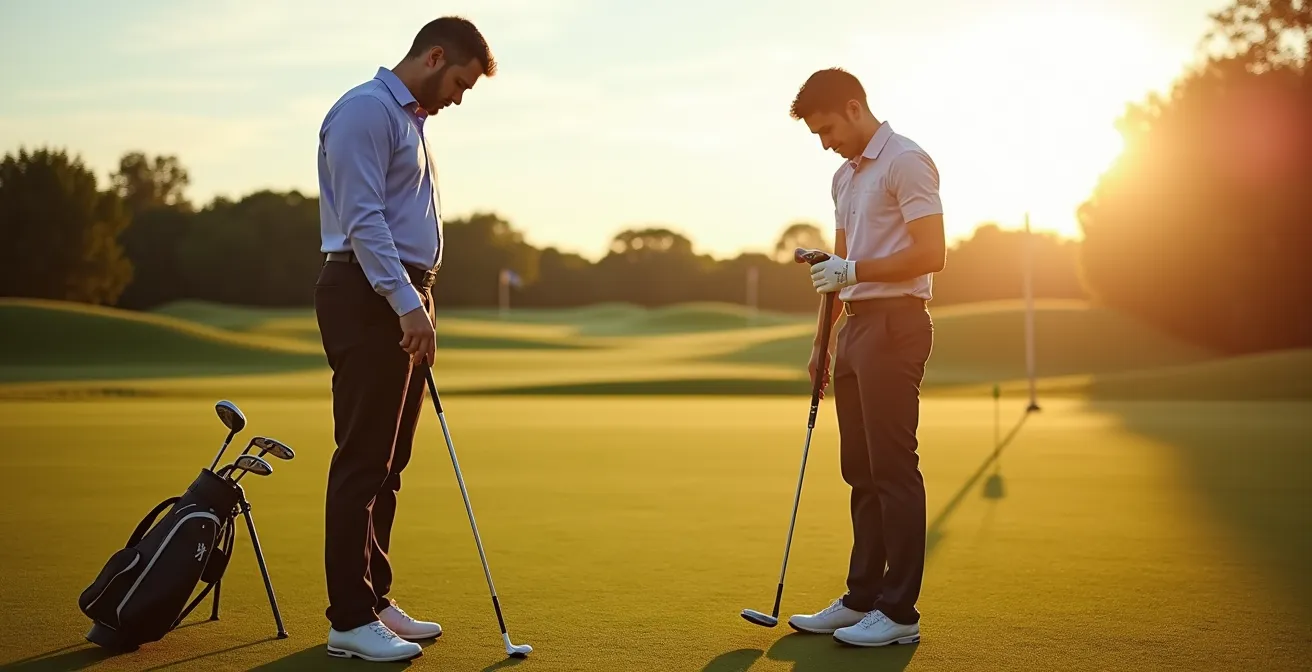
Contrary to popular belief, a “PGA Professional” and a “golf pro” are not interchangeable terms; one is a job description, while the other represents a rigorous, university-level career certification.
- PGA Professionals complete extensive training in business management, coaching science, and equipment technology.
- Certification requires passing a demanding Playing Ability Test, extensive work experience, and continuous education.
- For junior golfers, PGA Professionals offer a vetted, safe, and structured learning environment backed by background checks and child protection courses.
Recommendation: When selecting an instructor for your child, always prioritize a certified PGA Professional to guarantee a safe, structured, and holistic development path in the sport.
As a parent, wanting to give your child the best start in a new sport like golf is a natural instinct. You start looking for lessons, and you’re immediately faced with a confusing landscape of titles. You see “Golf Pro,” “Teaching Pro,” and “PGA Professional.” It’s tempting to think these are all the same, or that the “best” coach is simply the one with the most impressive personal scorecard. This is a common and understandable misconception. The terms are not synonymous, and the distinction is not just a matter of semantics—it’s a fundamental difference in qualification, expertise, and commitment that has profound implications for your child’s development, safety, and long-term enjoyment of the game.
The reality is that anyone can call themselves a “golf pro.” The title has no formal barrier to entry. A PGA Professional, however, has earned a designation that is the culmination of a multi-year, comprehensive educational program. This journey goes far beyond simply knowing how to swing a club. It involves mastering complex business operations, understanding the biomechanics and psychology of teaching, staying current with cutting-edge technology, and, most importantly for any parent, adhering to the highest standards of safety and ethics. This article is not just about defining a title; it is about revealing the depth of the career path. We will unpack the rigorous business skills required for certification, differentiate the mindset of a teacher from that of a player, and show why trusting a PGA Professional is the most important first investment you can make in your child’s golfing journey.
To fully grasp the comprehensive nature of this distinction, this guide will explore the specific pillars of expertise that define a PGA Professional. We will delve into their business acumen, teaching philosophy, fitting expertise, role in junior development, and commitment to technology, providing a clear picture of the value they bring to your child and the entire golf community.
Summary: The True Value of a PGA Professional
- Beyond the Swing: What Business Skills Must a PGA Pro Master to Get Certified?
- Teaching Pro vs Tour Pro: Why the Best Players Are Not Always the Best Teachers?
- Why You Should Trust a PGA Pro for Fitting Over a Retail Store Clerk?
- Junior Programs: How PGA Pros Create the Next Generation of Golfers?
- Keeping Up with Tech: How PGA Pros Stay Current with Trackman and Force Plates?
- Tech-Heavy vs Feel-Based: How to Choose a Coach That Matches Your Learning Style?
- The Interview: How to Prepare for the Membership Committee Meeting?
- Why 3 Private Coaching Sessions Are Worth More Than a New Driver?
Beyond the Swing: What Business Skills Must a PGA Pro Master to Get Certified?
One of the most significant, yet least understood, aspects of the PGA Professional certification is its intense focus on business management. A modern golf facility is a complex enterprise, and a PGA Professional is trained to be a key executive within that operation. Their education is not just about golf; it’s a business degree specialized for the golf industry. This is a far cry from the simple image of an instructor on the driving range. They are expected to be proficient in every facet of running a successful retail and service business, from financial planning to marketing and human resources.
The curriculum demands mastery of sophisticated operational skills. This includes creating and maintaining merchandise assortment plans, establishing strategic vendor relationships to foster growth, and utilizing industry-proven pricing strategies to meet business objectives. A core component is inventory management, a critical skill in a market where the inventory management software market is expected to reach $2,191.2 million by the end of 2024. A PGA Professional must be adept at using these systems for ordering, stocking, tracking, and valuing merchandise. They monitor key sales and inventory performance metrics to ensure the financial health of the golf shop. This comprehensive business acumen ensures that the professional you entrust with your child’s development is also a capable and responsible leader within their facility.
Teaching Pro vs Tour Pro: Why the Best Players Are Not Always the Best Teachers?
A pervasive myth in golf is that the best players make the best teachers. Parents, understandably, might seek out an instructor with a decorated playing career, assuming their skill will translate directly to their child. However, the roles of a “Tour Pro” and a “PGA Professional” (often a “Teaching Pro”) are fundamentally different in their objectives, mindsets, and daily activities. The Tour Pro’s world is one of intense self-focus, whereas the PGA Professional’s world is centered on the improvement of others.
As the editorial team at Golf Monthly notes, “The modern tour pro is an athlete who will spend every day trying to improve – practising golf, working on fitness, nutrition, mental strength… Exploring all avenues to give them a competitive edge.” Their entire focus is on optimizing their own performance. The process is inherently selfish, as it must be to compete at the highest level. In contrast, a PGA Professional’s expertise lies in diagnosing faults in hundreds of different swing types, communicating complex ideas simply, and tailoring instruction to an individual’s specific needs, age, and learning style. Their success is measured not by their own score, but by the progress and enjoyment of their students.
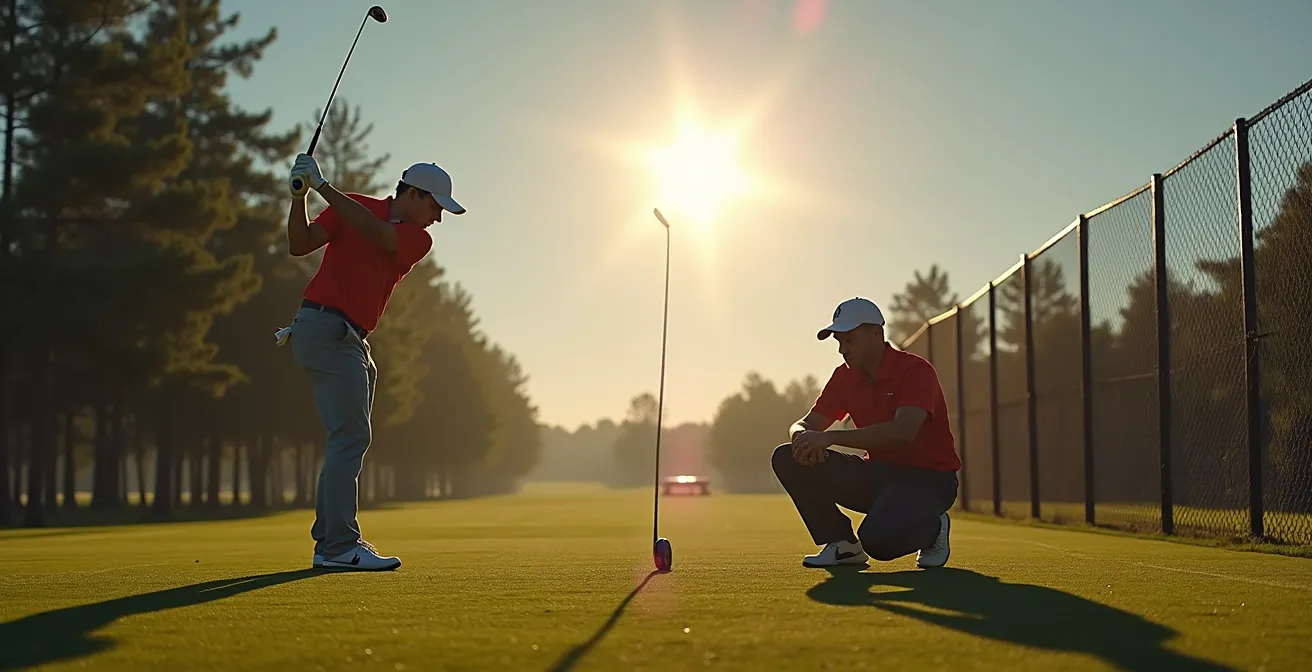
This image perfectly captures the distinction. On one side, the solitary pursuit of perfection; on the other, the collaborative and patient act of education. A great player may struggle to explain the “feel” of their swing because it has become intuitive after millions of repetitions. A certified PGA teaching professional, however, is trained in the science of motor learning and pedagogy. They have a toolbox of drills, analogies, and communication techniques to help a beginner like your child build a swing from the ground up. They are, first and foremost, educators.
Why You Should Trust a PGA Pro for Fitting Over a Retail Store Clerk?
When it’s time to buy your child’s first set of clubs or upgrade their equipment, the temptation is to head to the nearest big-box retail store. While convenient, this path often means entrusting one of the most critical aspects of game improvement to a sales clerk with minimal training. A club fitting with a PGA Professional is an entirely different experience—an educational investment rather than a simple transaction. The difference in training, motivation, and approach is stark and directly impacts your child’s ability to develop their skills.
A PGA Professional undergoes years of education in club mechanics, swing dynamics, and fitting technology. A retail clerk’s training might last only a few weeks. This chasm in expertise leads to a fundamentally different fitting process. The clerk is often focused on launch monitor data and making a sale, potentially influenced by sales commissions. The PGA Professional takes a holistic view of your child’s game. They consider their physical attributes, swing characteristics, learning goals, and how the new clubs will integrate into their long-term development. This ensures the equipment works with the student’s swing, not against it, preventing the formation of bad habits.
The following table, adapted from industry training materials, highlights the key differences:
| Aspect | PGA Professional | Retail Store Clerk |
|---|---|---|
| Training Duration | 3+ years formal education | Days to weeks |
| Playing Ability Requirement | PAT certified (top 20% skill level) | None required |
| Long-term Relationship | Follow-up sessions included | Transaction ends at sale |
| Fitting Approach | Holistic game analysis | Launch monitor data focus |
| Brand Independence | Best fit regardless of brand | May be commission-driven |
For a developing junior, a proper fitting from a PGA Professional is not a luxury; it is essential. It ensures the equipment supports their learning process and builds a foundation of trust between the coach, the parent, and the student. It’s about building a relationship, not just completing a sale.
Junior Programs: How PGA Pros Create the Next Generation of Golfers?
For any parent, the single most important factor when choosing an activity for their child is safety and a positive, structured environment. This is where the PGA Professional’s role in junior golf becomes indispensable. They are not just coaches; they are certified architects of youth development programs, a responsibility that is underpinned by rigorous safety and educational requirements. When you enroll your child in a program run by a PGA Professional, you are placing them in a system designed for their protection and holistic growth.
The credibility of these programs is built on a non-negotiable foundation of trust. Before a PGA Professional can work with children, they must meet a strict set of prerequisites that go far beyond golfing ability. This creates a secure environment where children can learn and thrive. The success of this structured approach is evident in programs like the University of Central Oklahoma’s Bachelor of Business Administration in PGA golf management, which boasts 100% job placement upon completion, demonstrating the high demand for these well-rounded professionals.
For a parent, knowing what to look for is key. The following checklist outlines the essential qualifications that a PGA Professional must have to be a leader in junior development.
Your Junior Coach Qualification Checklist
- Coaching Certification: Ensure the coach has, at minimum, an ASQ level 2 certificate in coaching golf, a baseline for teaching methodology.
- Emergency Preparedness: Verify they hold a current emergency first aid certification to handle any situation on the course or range.
- Child Protection Training: Confirm they have passed appropriate and up-to-date child protection courses, a critical element of safety.
- Background Screening: The professional must have undergone and passed comprehensive background checks as a prerequisite for certification.
- Continuous Learning: Ask about their ongoing professional development, which is maintained through frameworks like the PGA Excel program.
This rigorous vetting process is the hallmark of a PGA-led junior program. It provides parents with the peace of mind that their child is not only learning the game correctly but is also in the safest possible hands.
Keeping Up with Tech: How PGA Pros Stay Current with Trackman and Force Plates?
The modern golf lesson can look more like a biomechanics lab than a traditional range session. Technologies like Trackman launch monitors and force plates provide data on every conceivable aspect of the golf swing. A common concern for parents might be whether an instructor is equipped to leverage this technology effectively. The PGA of America ensures its members are not just aware of these tools but are trained to integrate them meaningfully into their teaching. A PGA Professional’s training emphasizes adaptability and continuous learning, making them fluent in the language of modern golf technology.
This commitment to staying current is not optional; it’s a core tenet of the profession. As PGA Member Support Managers have stated, “The biggest value of the PGA Member has always been in the adaptability they can offer to a golf business.” This adaptability is on full display in their approach to technology. They learn not just *what* the data says, but *why* it matters and *how* to translate it into a simple, actionable feeling for a student. They can filter the noise and pinpoint the one or two key metrics that will unlock a breakthrough for your child, preventing the dreaded “paralysis by analysis.” This approach is reflected across the industry, as industry data reveals that nearly three-quarters of golf retailers and facilities are planning some form of supply chain and technology transformation.
A PGA Professional acts as the essential human interface between complex data and the student. They can use a Trackman to show a junior golfer exactly how a small change in their club path affects the ball’s flight, or use force plates to help them understand how to use the ground more effectively. But they also know when to turn the technology off and focus on rhythm, tempo, and feel. This balanced approach, blending cutting-edge science with time-honored teaching wisdom, is a hallmark of the modern PGA Professional.
Tech-Heavy vs Feel-Based: How to Choose a Coach That Matches Your Learning Style?
Every student learns differently. Some thrive on data, charts, and video feedback, while others connect more with feelings, analogies, and a hands-on approach. The beauty of the comprehensive PGA Professional training program is that it equips coaches to communicate effectively across this entire spectrum. A truly great coach for your child will be one whose teaching style aligns with your child’s learning style. The key for a parent is knowing what questions to ask to identify that match.
A PGA Professional’s education, which has evolved over more than 50 years, now produces graduates capable of working in over 80 different roles worldwide. This modern training requires them to be bilingual, speaking both the “tech” language of launch monitors and the “feel” language of kinesthetic learning. They are trained not to have one single method, but to have a diverse toolkit of teaching strategies. Your role as a parent is to interview a potential coach to discover their primary approach and their ability to adapt. This isn’t about testing their knowledge, but about finding the best personality and methodological fit for your child.
To help in this process, here are five key questions you can ask a potential instructor to better understand their teaching philosophy:
- “How do you typically use video analysis or a launch monitor in a lesson with a junior?” This will reveal if they are data-first or use tech as a secondary tool.
- “Can you explain a concept like ‘shaft plane’ using both data and a feeling or an analogy?” This tests their ability to translate the technical into the tangible.
- “What certifications or continued education have most influenced your teaching methodology?” This shows their commitment to learning and what school of thought they follow.
- “For a beginner, what’s the first feeling you’d want them to focus on in their swing?” This gets to the heart of their “feel-based” communication style.
- “How do you adapt your teaching when a student isn’t grasping a concept?” This is the most important question, revealing their patience, creativity, and student-centered approach.
The answers to these questions will give you a clear picture of the coach’s style and help you find a professional who can unlock your child’s potential and foster a love for the game.
Key Takeaways
- A PGA Professional is a certified business manager and educator, a qualification that requires years of study far beyond playing ability.
- Elite playing skill (Tour Pro) does not automatically equate to effective teaching ability; the two are distinct professions with different goals.
- PGA certification guarantees a holistic and ethical approach to club fitting, junior development, and safety, backed by background checks and continuous education.
The Interview: How to Prepare for the Membership Committee Meeting?
To truly appreciate the “PGA Professional” title, it is helpful to understand just how rigorous the path is to earn it. Before an individual can even be called a PGA Professional, they must successfully navigate a multi-year journey as a PGA Associate, culminating in a final membership interview. This is not a formality; it is a final validation of their knowledge, experience, and commitment to the sport’s highest standards. Understanding this process reveals why the title is a credential of trust and expertise, joining an elite group of nearly 30,000 PGA Members nationwide.
The journey begins with the Playing Ability Test (PAT), a formidable hurdle that screens for a high level of golfing competence. Candidates must prove they can perform under pressure. From there, associates embark on a program that can take up to eight years, though the average is four. Throughout this period, they must be employed full-time at a recognized golf facility, applying their academic learning in a real-world setting under the mentorship of a Class A PGA Professional. They complete coursework and exams covering everything from turf grass management to advanced teaching theory.
The final step is appearing before the membership committee. This interview is a comprehensive review of their portfolio, work experience, and understanding of the PGA Constitution. They are judged not just on their knowledge of golf, but on their character, professionalism, and readiness to be an ambassador for the game. Passing this final test is what transforms a “PGA Associate” into a “PGA Professional,” a title earned through years of dedicated work, study, and a proven passion for serving the golf community.
Why 3 Private Coaching Sessions Are Worth More Than a New Driver?
In a world of aggressive marketing, it’s easy to believe that the secret to better golf lies in the next piece of equipment. We are told a new driver will add 20 yards or a new putter will cure our woes on the green. For a developing golfer, however, the most valuable investment is not in equipment, but in expertise. Three well-structured lessons with a qualified PGA Professional will provide a return on investment that no new driver can match, offering a foundation of knowledge and skill that lasts a lifetime.
A new driver might fix a slice for a day, but a PGA Professional gives your child the understanding to diagnose and correct their own swing for years to come. They don’t just offer a quick fix; they provide a personalized roadmap for improvement. This includes swing instruction, short game strategy, course management, and the mental aspects of the game. It is a holistic education that a piece of technology, no matter how advanced, simply cannot replicate. This is the core value proposition of the certification.
Being an accredited PGA Professional adds validity to any individual who aspires to work, grow and succeed in the golf industry.
– PGA Professional Author, Lightspeed Golf Industry Guide
That “validity” is your assurance of quality. The knowledge gained from just a few sessions—understanding grip, posture, alignment, and ball flight laws—is infinitely more valuable than a marginal equipment upgrade. It empowers the golfer, giving them the tools to enjoy the game more fully and to continue improving long after the lesson is over. It’s an investment in your child’s confidence and competence.
Before you invest in the latest equipment for your child, invest in the right expertise. The single most effective way to ensure they have a positive, safe, and successful introduction to the game is to partner with a certified educator. Find a PGA Professional in your area to give your child the best possible start in golf, a gift that will last a lifetime.
Frequently Asked Questions about PGA Certification
What does the Playing Ability Test (PAT) require?
The PAT requires a candidate to complete 36 holes in one day with a score equal to or lower than the course rating plus 15 strokes. It is a significant challenge, with fewer than 20% of applicants passing on their first attempt.
How long does PGA certification typically take?
While PGA Associates have up to 8 years to complete the entire program, the average completion time for the coursework, work experience, and final exam is approximately 4 years of dedicated effort.
What work experience is required during training?
Throughout the entire program, an associate must maintain eligible employment at a PGA-recognized golf facility for at least 6 months per year, working under the direct supervision and mentorship of a Class A PGA Professional.