
In summary:
- Stop teeing your ball in the middle of the tee box out of habit. This is a common mistake that ignores a significant strategic advantage.
- The teeing area is a three-dimensional space you can manipulate through position and tee height to alter shot geometry and optimize launch conditions.
- By understanding the rules and physics of the tee box, you can “engineer” a better shot before the club is even taken back, effectively widening fairways and shortening holes.
- Choosing the correct set of tees for your skill level is not an admission of weakness but a tactical decision that improves scoring and pace of play for everyone.
For most golfers, the act of teeing up the ball is an afterthought. You walk up to the tee markers, find a reasonably flat spot somewhere in the middle, and push a tee into the ground without a second thought. It’s a ritual performed hundreds of times a round, a simple prerequisite to the “real” act of hitting the ball. But what if this routine, this mindless habit, is costing you strokes on every single hole? What if the small, rectangular patch of grass between two markers is one of the most underutilized strategic assets in the game?
The common advice to “tee it high and let it fly” or “aim for the middle of the fairway” barely scratches the surface. These are outcomes, not strategies. The true art of teeing off lies in a deeper understanding of the rules, geometry, and physics at play. It’s about transforming a passive action into a deliberate process of shot engineering. The most skilled tacticians don’t just place their ball; they position it with intent, exploiting every legal inch of the teeing area to gain a geometric advantage on the hole ahead.
This guide abandons the generic tips. Instead, it provides a detailed framework for thinking like a rules official and a tactician. We will deconstruct the tee box, revealing how you can legally manipulate your starting position to open up tight fairways, how tee height is a critical tool for optimizing launch conditions for both distance and control, and why your choice of tee box has a profound impact not only on your score but on the pace of play for the entire course. It’s time to stop giving away an advantage before you even swing.
For those who prefer a visual summary, the following video offers a great introduction to the core concepts of tee box strategy, perfectly complementing the detailed analysis in this guide.
This article will guide you through the tactical decisions available to you on every tee shot. We will explore the specific rules and strategies that turn the teeing ground from a simple starting line into a powerful tool for lowering your score.
Summary: A Tactician’s Guide to Tee Box Dominance
- Teeing on the Side of Trouble: How to Open Up the Fairway Visually?
- Two Club Lengths: How Far Back Can You Legally Tee Up for a Better Lie?
- Tee It High to Let It Fly: Does Tee Height Really Change Driver Distance?
- Broken Tee or No Tee: Should You Use a Tee with Irons on Par 3s?
- The Honor System: Is It Time to Ditch “Winner Hits First” for Speed?
- When to Tee It High: Optimizing Launch Angle for Max Carry on Par 5s
- Move Up a Box: How Playing the Wrong Tees Causes Traffic Jams?
- Why Playing from the Championship Tee Destroys the Score of 90% of Amateurs?
Teeing on the Side of Trouble: How to Open Up the Fairway Visually?
The most common and costly mistake a golfer makes is automatically teeing up in the center of the tee box. The single most effective strategy to immediately improve your driving accuracy is to tee the ball on the same side as the primary trouble. If there is a large bunker or water hazard down the right side of the fairway, you should place your tee on the far-right side of the teeing area. This simple act of repositioning creates a powerful geometric advantage. By hitting away from the trouble, your ball’s trajectory crosses over a much larger surface area of the fairway, dramatically increasing your margin for error.
This isn’t just a visual trick; it’s a strategic manipulation of angles. Your target is no longer a narrow strip of fairway but a wide, inviting expanse. This technique forces you to aim away from the hazard, and even a shot that is slightly pulled or pushed relative to your aim line is far more likely to find the short grass. This principle is a cornerstone of professional course management.
Case Study: Professional Strategy at Harbour Town Golf Links
The 6th hole at Harbour Town is a perfect example of this principle in action. While the hole appears to be a straightaway par-4, it is flanked by a waste bunker on the left and out-of-bounds on both sides. A tactician knows that aiming down the middle is the most dangerous play. Instead, a player who hits a draw will tee up on the left side of the box and aim down the right side of the hole. By hitting across the fairway, the ball travels over more of the available landing area, maximizing the chances of a successful tee shot and demonstrating a mastery of strategic positioning.
The goal is not just to avoid the hazard but to set up the optimal angle for your second shot. Always consider where you want your next shot to come from and use the full width of the tee box to create the ideal line of play from tee to landing zone.
Two Club Lengths: How Far Back Can You Legally Tee Up for a Better Lie?
The official teeing area is not just the space between the two markers; it is a rectangle with a specific depth. This is a critical piece of information that most amateurs ignore. The rules of golf define the teeing ground as a rectangular area that is two club-lengths in depth, beginning at the front line established by the tee markers. This rule isn’t a restriction; it’s an opportunity. It grants you a significant area to explore for the perfect starting position, a concept we can call rule exploitation for tactical gain.
Many tee boxes, especially at busy public courses, are worn and uneven. The area directly between the markers might be chewed up, sandy, or have a subtle but disruptive slope. Using your legal two club-lengths allows you to move back and away from this damaged turf to find a pristine, flat lie. This search for an optimal lie is not just for professionals. A perfectly flat stance is crucial for balance and delivering the club squarely to the ball. A slight downhill or sidehill lie, even on the tee, can subtly alter your swing plane and lead to a mishit.

As the image shows, the texture and quality of the ground can vary significantly within this small area. Before you place your tee, take a few seconds to walk back from the markers. Feel the ground under your feet. Are you standing on a flat surface? Is the grass behind the markers in better condition? According to official USGA rules, the teeing ground extends two club-lengths in depth, giving you ample room to find that perfect spot. Making this small check a part of your pre-shot routine ensures you are giving yourself the best possible foundation for the shot.
Tee It High to Let It Fly: Does Tee Height Really Change Driver Distance?
The phrase “tee it high to let it fly” is a common golfing mantra, but many players don’t understand the physics behind it or the significant impact it has on distance. Tee height is not a matter of preference; it is a critical variable in engineering your launch conditions. A higher tee promotes an upward angle of attack with the driver, which is essential for maximizing carry distance. When you strike the ball on the upswing, you decrease backspin and increase launch angle, a combination that keeps the ball in the air longer.
Conversely, teeing the ball too low encourages a level or even downward angle of attack. This creates excessive backspin, causing the ball to “balloon” into the air and fall short, robbing you of significant yardage. The difference is not trivial. In fact, comprehensive testing reveals a substantial gain from simply adjusting tee height. One study confirmed an 11-yard increase in carry distance when using a high tee compared to a low one.
However, distance often comes with a trade-off. While a high tee can unlock more yards, it may also lead to less consistency for some players. Finding the optimal tee height is about balancing the quest for maximum distance with the need for control, as shown by detailed performance metrics.
| Tee Height | Avg Carry Distance | Ball Speed | Accuracy Impact |
|---|---|---|---|
| Low (0.5 inch) | Baseline | 175.2 mph | Most accurate |
| High (1.5 inch) | +14.19 yards | 176.0 mph | Less consistent |
The data from a MyGolfSpy study shows that a high tee can add over 14 yards of carry but may be less consistent. This highlights the risk/reward element. For more control, especially on a tight hole, teeing the ball slightly lower can create a steeper angle of attack and more backspin, promoting accuracy. For maximum distance on a wide-open par 5, a higher tee is the clear choice.
Broken Tee or No Tee: Should You Use a Tee with Irons on Par 3s?
Par 3s are statistically some of the most difficult holes for amateur golfers. While they may be the shortest holes on the course, they demand precision. Any slight mishit can easily lead to a bogey or worse. In fact, recent data reveals that on par 3 holes, the average amateur takes 3.5 shots from 100-150 yards and a staggering 4.28 shots from over 200 yards. With such a small margin for error, why would any player introduce unnecessary variables into the shot?
This is why the answer to whether you should use a tee with an iron on a par 3 is an emphatic “yes.” Hitting off the ground, even on a pristine tee box, introduces variables like grass, dirt, or an uneven lie that can interfere with the strike. Using a tee, even if it’s pushed almost entirely into the ground, guarantees a perfect lie and clean contact. It eliminates the chance of hitting the shot “heavy” (catching the ground before the ball) and ensures you can deliver the club’s loft as intended. It is a free, legal advantage that you should take on every single par 3.
The strategy for teeing up on these holes is simple but effective:
- Always Use a Tee: Give yourself a perfect lie every time to remove external variables and promote a pure strike.
- Aim for the Middle of the Green: Especially with mid-to-long irons, the smart play is to aim for the largest part of the green. Avoid “flag hunting” unless you have a short iron and a green light.
- Utilize Broken Tees: A broken tee is the perfect tool for iron shots. It allows you to place the ball just fractions of an inch above the ground, providing that clean lie without affecting the trajectory. They are also useful for hitting lower, more controlled shots with fairway woods or hybrids.
By adopting this simple, disciplined approach, you remove uncertainty and give yourself the best possible chance to hit the green in regulation, turning a statistically difficult hole into a scoring opportunity.
The Honor System: Is It Time to Ditch “Winner Hits First” for Speed?
The tradition of “honors”—where the player with the best score on the previous hole tees off first—is deeply ingrained in the etiquette of golf. It’s a mark of respect and a long-standing custom. However, in the modern game, where pace of play is a major concern, a rigid adherence to the honor system can be a significant cause of delays. A more efficient and increasingly encouraged alternative is “ready golf.”
Ready golf is simple: the first player who is ready to hit, hits. It does not mean rushing or playing when it is unsafe. It means being prepared to play your shot when it’s your turn, and if you are ready and the player with honors is not, you play your shot to keep the game moving. This requires a shift in mindset from a strict, sequential order to a more fluid, common-sense approach focused on efficiency. It is about maintaining the pace of play integrity for your group and for all the groups behind you.
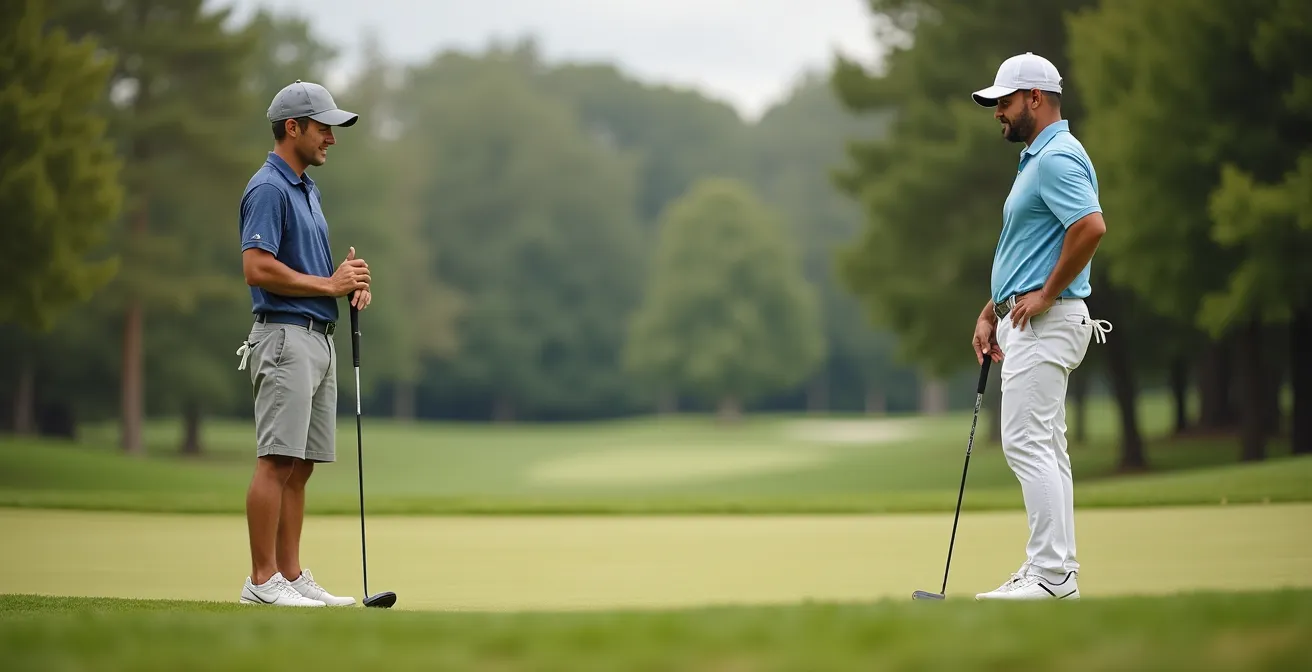
On the tee box, this means that while one player is hitting, the other players should be preparing for their own shots. This includes selecting a club, cleaning the ball, and determining their target line. As soon as the first player has hit and it is safe to do so, the next ready player should step up. This continuous flow prevents the dead time that occurs when players wait for the person with honors to go through their entire routine before they even begin their own. Adopting ready golf is a sign of an experienced, considerate golfer who understands their responsibility to the course community.
When to Tee It High: Optimizing Launch Angle for Max Carry on Par 5s
Par 5s represent the best scoring opportunities for most golfers, but only if the tee shot is executed properly. On these holes, maximizing carry distance is paramount. A long drive that finds the fairway can turn a three-shot hole into a potential birdie or even an eagle chance. The primary tool for maximizing carry is, once again, the strategic use of tee height to optimize your launch angle.
To maximize carry, you need to launch the ball high with low spin. Teeing the ball high is the most effective way to achieve this. It encourages an upward angle of attack, allowing you to strike the ball above the driver’s center of gravity. This impact location naturally reduces backspin and increases the launch angle, creating the ideal trajectory for a long, soaring drive. The data is clear on this point. In fact, ClubTest Live data demonstrates that a mid-to-high tee height increases launch angle and ball speed while reducing backspin, resulting in more carry distance.
A common fear among amateurs is that teeing it higher will lead to a loss of accuracy. However, studies have shown this is often not the case, especially on a hole as forgiving as a par 5. An experiment across three different handicap levels found that the significant increases in carry distance from a high tee did not come at the expense of accuracy in terms of hitting the fairway. For the amateur player, the small risk of a slight miss is far outweighed by the massive reward of an extra 20-30 yards, which could be the difference between having a long iron or a mid-iron into the green for your second shot.
Move Up a Box: How Playing the Wrong Tees Causes Traffic Jams?
One of the biggest contributors to slow play on a golf course has nothing to do with pre-shot routines or looking for lost balls. It’s ego. Specifically, it’s the ego that drives amateur golfers to play from a set of tees that is far too long for their skill level. Playing from the “tips” or championship tees when you don’t have the required driver distance not only ruins your own score but also creates a significant traffic jam for every group behind you. It’s a breach of etiquette that undermines the pace of play integrity of the entire course.
When you play from tees that are too long, nearly every par 4 becomes a three-shot hole, and every par 5 becomes a four or five-shot hole. This adds multiple shots, and precious minutes, to your round. The impact is dramatic and quantifiable. The smart play is to select your tees based on your ability, not your pride. A fantastic and simple rule of thumb is to base your tee selection on your 7-iron distance, not your driver distance. If you hit your 7-iron 150 yards, for example, you should be playing from tees that make the course approximately 6,500 yards long.
Action Plan: Selecting the Correct Tee Box
- Determine Your 7-Iron Carry Distance: Be honest with yourself. What is the realistic distance you carry your 7-iron in the air, not its total roll-out on a perfect day?
- Use the Distance Formula: Multiply your 7-iron carry distance by 36. This number (e.g., 150 yards x 36 = 5,400 yards) gives you a solid baseline for the total course yardage you should be playing.
- Check the Scorecard: Before your round, look at the yardages for the different tee boxes on the scorecard. Select the set of tees that is closest to your calculated ideal yardage.
- Assess On-Course Conditions: On a windy or wet day, consider moving up one set of tees from your calculated baseline to account for the more difficult playing conditions.
- Evaluate Your Performance: If you find you are consistently hitting long irons or hybrids into most par 4s, you are likely playing from tees that are too long. Don’t be afraid to move up mid-round or for your next game.
Playing from the correct tees will not only speed up play but will likely make the game more enjoyable, as you’ll have more scoring opportunities and hit a wider variety of clubs.
Key Takeaways
- The tee box is a strategic tool, not just a starting line. Use its full dimensions to your advantage.
- Your position on the tee box (left, right, back) directly alters the hole’s geometry and can widen the fairway.
- Tee height is a critical factor in “shot engineering.” Use it to control launch angle and spin for distance or accuracy.
- Playing from the correct tees based on your ability (not your ego) improves your score, enjoyment, and the pace of play for everyone.
Why Playing from the Championship Tee Destroys the Score of 90% of Amateurs?
The allure of the championship tees is powerful. It’s the course as the pros play it, the ultimate test. But for the vast majority of amateur golfers, this test is not just difficult; it is fundamentally unfair and destructive to their score. The reason is a simple, brutal reality of distance. Most amateurs drastically overestimate how far they hit the ball, and the gap between their reality and the professionals’ is a chasm. The data is sobering; shocking statistics reveal that the average drive distance for male amateurs is just 217 yards, while the PGA Tour average is over 290 yards.
This 70+ yard gap completely changes the architectural intent of the golf course. A 440-yard par 4 that requires a driver and a mid-iron for a professional becomes an impossible-to-reach-in-two behemoth for the average player. This has a profound effect on scoring, particularly on par 5s. For a scratch golfer, par 5s are the easiest holes on the course. For a 25-handicap player playing from the tips, they often become the hardest. This is because the length prevents them from ever having a realistic chance of reaching the green in regulation, forcing them into long, difficult third and fourth shots where trouble lurks.
Playing from the wrong tees forces a player into a defensive, survival-based style of golf. It removes the strategic element of the game and replaces it with a simple, brutal struggle for distance. You are no longer playing chess against the course architect; you are simply trying to advance the ball as far as possible on every shot. This leads to higher scores, immense frustration, and a significantly slower pace of play.
By embracing this tactical mindset and making conscious, informed decisions before you even place the tee in the ground, you will transform your game. The next time you step onto a tee box, don’t just see a starting line; see an opportunity to engineer a better score.