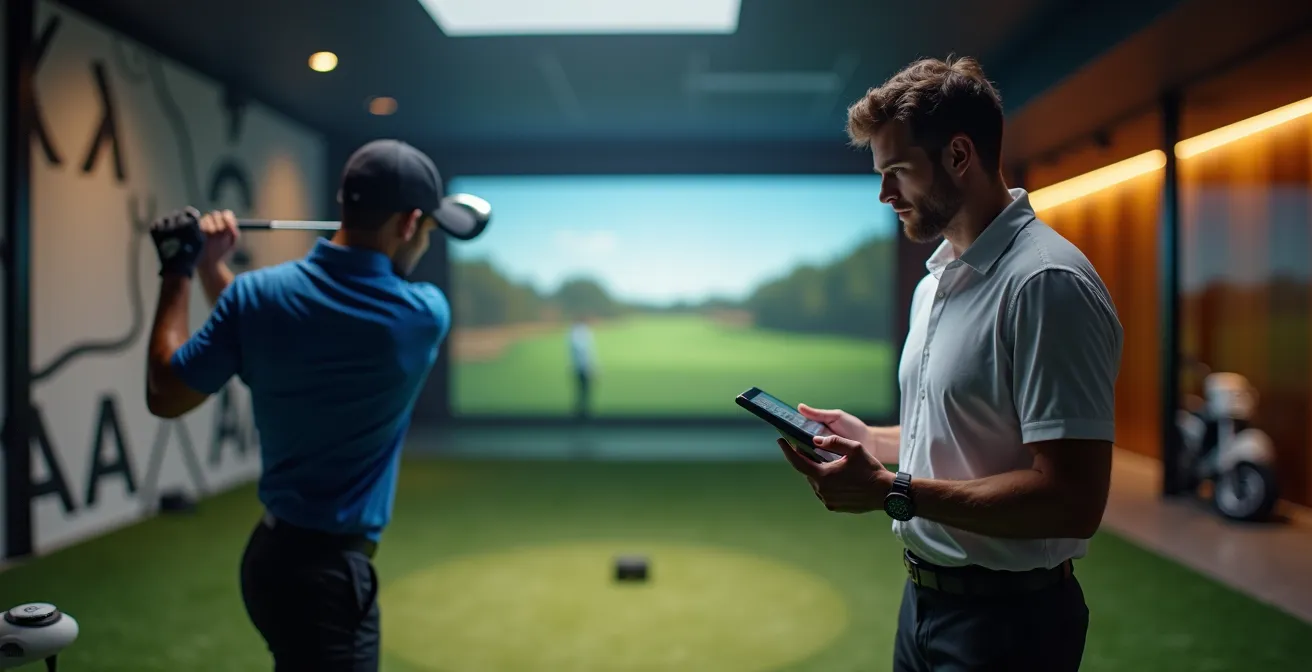
Investing in a new driver is a bet on technology; investing in lessons is a bet on yourself—and it pays far higher dividends for a plateaued golfer.
- A coach diagnoses the root cause of your swing flaws, while new equipment only masks the symptoms.
- Structured practice from a lesson builds permanent skill, whereas a new driver offers, at best, a temporary confidence boost.
Recommendation: Use your $500 to buy a ‘diagnostic dividend’ from an expert, not just a new piece of hardware.
You’re standing on the range, and the frustration is palpable. The same slice, the same inconsistent contact, the same feeling of being stuck on a performance plateau. You look at your driver, then at the ads for the latest carbon-faced wonder promising 10 more yards. The $500 question burns in your mind: is the answer in new technology, or is it somewhere else entirely?
Many golfers fall into the trap of seeking external solutions. They spend hours on YouTube, trying to piece together a functional swing from a firehose of conflicting tips. They believe the marketing hype that a new club can magically fix a deeply ingrained swing fault. This approach is seductive because it promises a quick fix, a shortcut to better scores without the hard work.
But what if the most significant upgrade you can make isn’t to your equipment, but to your swing’s ‘operating system’? The real, lasting improvement in golf comes not from masking flaws, but from systematically dismantling them under expert guidance. Three targeted coaching sessions offer a return on investment a new driver can never match: they provide a professional diagnosis, a personalized roadmap, and the tools to build a swing you can actually own.
This article will break down the precise reasons why investing in coaching is the most pragmatic, results-oriented decision a plateaued golfer can make. We will explore how to find the right coach, understand the learning process, and turn practice time into measurable progress, proving that the best investment you can make in your game is in your own skill.
Summary: Why Coaching Outperforms Equipment for Real Improvement
- Why Self-Diagnosing Your Swing on YouTube Often Makes You Worse?
- Tech-Heavy vs Feel-Based: How to Choose a Coach That Matches Your Learning Style?
- Weekly or Monthly: What Is the Optimal Gap Between Golf Lessons for Retention?
- Why Do You Play Worse Immediately After a Lesson Before Getting Better?
- Online Swing Analysis: Can Remote Coaching Really Fix Your Faults?
- Paralysis by Analysis: When Should You Stop Watching Your Own Swing Videos?
- Player and Caddie: Who Really Makes the Club Decision in Crucial Moments?
- Why Bashing Balls Without Structured Drills Is a Waste of Time and Money?
Why Self-Diagnosing Your Swing on YouTube Often Makes You Worse?
The internet promises a world of free golf instruction, but for the plateaued player, it often becomes a labyrinth of confusion. The core problem is that golfers are notoriously poor at self-diagnosis. You might feel like you’re “coming over the top,” but the root cause could be a poor takeaway or an incorrect weight shift. Treating the symptom—the over-the-top move—without addressing the root cause is like putting a bandage on a broken bone. You might see a temporary change, but you haven’t fixed the underlying issue.
This is a classic example of the Dunning-Kruger effect, where a lack of knowledge in a subject prevents one from accurately assessing their own skill or identifying their own errors. As a coach sees daily, many golfers misinterpret the fundamental goal of the swing. For example, a case study on golf learning highlights that 99% of beginners try to help the ball into the air. This incorrect intention leads to a cascade of technical faults. When a coach provides the correct goal—hitting down on the ball to create compression—many of those faults disappear without directly addressing them.
A new driver won’t fix an incorrect intention. It might be more forgiving on your mishits, effectively masking the problem, but it will never correct it. The first session with a good coach provides a ‘diagnostic dividend’—an expert, objective assessment of what is truly happening in your swing. This diagnosis alone is worth a significant portion of the investment, as it stops you from wasting time and energy chasing the wrong fixes.
Tech-Heavy vs Feel-Based: How to Choose a Coach That Matches Your Learning Style?
Once you’ve decided to invest in coaching, the next crucial step is finding the right coach. Not all instructors are created equal, and their teaching philosophy must align with your learning style. Broadly, coaches fall into two camps: the ‘Tech Guru’ and the ‘Feel Master.’ The Tech Guru lives and breathes data, using launch monitors like TrackMan or Foresight to show you precise numbers on swing path, attack angle, and clubface orientation. This approach is perfect for analytical minds who need to see the “why” in black and white.
On the other side, the Feel Master focuses on kinesthetic learning. They use analogies, feels, and drills to help you internalize a movement. They might say, “feel like you’re skipping a stone” to teach a shallow swing plane, rather than telling you to achieve a -2 degree path. This style works well for intuitive learners who can get bogged down by too much technical information. The best coaches can blend both styles, but they will always have a dominant approach.

The key is self-awareness. Do you get excited by data, or does it cause ‘paralysis by analysis’? Answering this question is vital to building a productive player-coach relationship. There is no right or wrong style, only what is right for you. A great coach understands this and adapts their communication to fit the student, creating an environment where learning can flourish.
Action Plan: Choosing Your Coaching Style
- Assess your learning preference: Are you a ‘Why’ learner who needs to understand mechanics, or a ‘How’ learner who prefers to feel the movement?
- Evaluate your response to feedback: Do you prefer numerical targets (e.g., launch angle degrees) or physical sensations and analogies?
- Gauge your tech comfort: How comfortable are you with tools like launch monitors and constant video analysis during a lesson?
- Consider feedback timing: Do you want immediate, data-driven feedback after every swing, or a summary of feelings and adjustments to work on?
- Define your primary goal: Is it raw distance, pinpoint accuracy, or simply more consistent contact? Your goal may dictate the best coaching approach.
Weekly or Monthly: What Is the Optimal Gap Between Golf Lessons for Retention?
A lesson is not a magic pill; it’s the start of a process. The real improvement happens between sessions, during practice. The optimal frequency of your lessons depends almost entirely on one factor: your commitment to practice. Without dedicated time to ingrain the new feelings and movements, the value of a lesson evaporates quickly. A coach can give you the right information, but only you can turn it into a durable skill.
As a rule of thumb, the amount of time you can dedicate to intentional practice dictates your lesson schedule. If you are a dedicated player, research from university golf programs shows that putting in 4-6 practice hours per week can lead to significant progress. For a player with this level of commitment, a lesson every two weeks is ideal. It provides enough time to work on a specific change, start to automate it, and come back for the next logical step. A weekly lesson might be too much information to absorb, while a monthly lesson allows too much time for old habits to creep back in.
The following table provides a clear framework for aligning your lesson frequency with your available practice time, ensuring you get the maximum return on your coaching investment.
| Practice Hours/Week | Recommended Lesson Gap | Focus Type | Best For |
|---|---|---|---|
| 10+ hours | Weekly | Small adjustments | Competitive players |
| 4-6 hours | Bi-weekly | Skill refinement | Serious amateurs |
| 1-3 hours | Monthly | Major overhauls | Recreational golfers |
Ultimately, the goal is to have enough time to see real change but not so much time that you lose momentum. A new driver requires no practice to use, but it also offers no path for skill development. Lessons, paired with practice, create a powerful feedback loop for continuous improvement.
Why Do You Play Worse Immediately After a Lesson Before Getting Better?
One of the most common and demoralizing experiences for a golfer is playing their worst round of the season right after a great lesson. You felt the change on the range, the ball flight was pure, but on the course, everything falls apart. This is not a sign that the lesson failed; it’s a predictable and necessary part of motor learning known as the J-Curve of Performance. Your brain is trying to overwrite years of ingrained habit—your old ‘operating system’—with new, unfamiliar code.
During this transition, your old swing is no longer automatic, and your new swing isn’t either. You are caught in a state of conscious incompetence, actively thinking about mechanics instead of simply hitting the ball. This cognitive load is immense and almost always leads to a temporary dip in performance. It feels terrible, but it is the single best indicator that you are on the right path to making a significant, lasting change.

Players who buy a new driver never experience this dip. They get an immediate (and often temporary) confidence boost, but their underlying swing flaws remain untouched. The golfer who endures the J-curve, however, is building a new foundation. They are trading short-term comfort for a long-term breakthrough. Understanding and expecting this dip is crucial. It allows you to trust the process, stick with the changes, and not revert to your old, comfortable flaws at the first sign of trouble.
Online Swing Analysis: Can Remote Coaching Really Fix Your Faults?
For many golfers, time and geography are the biggest barriers to traditional lessons. The rise of online coaching has shattered these obstacles, offering access to elite instruction from anywhere in the world. But can a coach truly fix your swing without being there in person? The answer is an emphatic yes, provided the process is structured correctly. Modern remote coaching is far more than just sending a video and hoping for the best.
The effectiveness is backed by data. For example, user data from the Skillest coaching platform shows students gained a full club of distance and dropped an average of five strokes from their handicap in just three months. The power of remote coaching lies in its asynchronous nature. A coach isn’t under pressure to provide an instant diagnosis on the range. They can carefully review your swings, compare them to previous submissions, and provide considered, detailed feedback. This often leads to a more thorough analysis than a time-crunched in-person lesson.
For the student, the benefits are immense. You receive a permanent record of every lesson. You can re-watch your coach’s analysis and drills dozens of times, reinforcing the key messages until they stick. This is impossible with a traditional lesson, where key insights are often forgotten by the time you reach the car park. For remote coaching to be effective, a proper setup is essential. You must film your swing from two specific angles—’face-on’ and ‘down-the-line’—using a high frame rate (240 FPS is standard) to allow for detailed analysis. This simple discipline enables a coach to see everything they need to rebuild your swing’s ‘operating system’ from afar.
Paralysis by Analysis: When Should You Stop Watching Your Own Swing Videos?
Video analysis is a double-edged sword. In the hands of a coach, it’s a precision diagnostic tool. In the hands of an amateur, it can quickly lead to ‘paralysis by analysis.’ After a lesson, your coach might give you one specific move or feeling to work on. Your use of video should be limited exclusively to monitoring that one change. Are you successfully keeping the club outside your hands on the takeaway? Film a few swings, check for that one move, and then put the phone away.
The danger arises when you start ‘fishing’ for other flaws. You check your takeaway, then notice your head moves a little, then you worry about your transition, and suddenly you’re trying to fix five things at once. This is the fastest way to destroy any progress. Your brain can only focus on one conscious swing thought at a time. Trying to manage more is a recipe for disaster, leading to a tense, robotic, and ineffective motion.
At any given time, you should only be looking for one specific thing in your swing video. Stop watching when you start ‘fishing’ for other potential flaws.
– Will Shaw, Sport Science Insider – Motor Learning Perspective
A new driver encourages the opposite mindset; it simplifies the thought process to “just hit it.” While tempting, this ignores the need for focused improvement. A coach gives you a single, high-priority task. Your job is to execute that task, using video as a simple verification tool, not as an open-ended diagnostic machine. Trust your coach’s diagnosis and focus your attention where it matters most.
Player and Caddie: Who Really Makes the Club Decision in Crucial Moments?
Think of a great golf coach as a full-time caddie for your swing. On the course, a Tour player and their caddie engage in a deep dialogue before every crucial shot. The player provides the ‘feel’—how their body is performing that day—while the caddie provides objective data: the exact yardage, the wind’s impact, the historical data of how far the player *actually* hits their 7-iron versus how far they *think* they do. The final decision is a blend of this subjective feel and objective reality.
This is exactly the relationship you should have with your coach. You bring the raw material—your swing, your tendencies, your goals. The coach brings objective, data-driven reality. They see the game from a different perspective, free from the emotional baggage and biases that cloud your judgment. Just as a caddie’s data trumps a player’s ego, a coach’s diagnosis must be trusted over your own ingrained perceptions.
This data-driven approach is proven to lower scores. For instance, modern golf analytics demonstrate that tracking detailed stats like true club distances and common miss patterns leads to better decision-making and improved scoring. A new driver can’t tell you that you miss more greens with a wedge from 80 yards than a 9-iron from 120. A coach can. They can identify these strategic blind spots and prescribe the technical or mental fix. This partnership—this fusion of player intent and expert analysis—is what truly unlocks lower scores, not a shinier clubhead.
Key Takeaways
- Self-diagnosis is inherently flawed; an expert coach is essential for identifying the root causes of swing faults you cannot see yourself.
- True improvement is not linear; expect a temporary performance dip (the J-Curve) after a lesson as your brain rewires new movements before a major breakthrough.
- Structured, intentional practice prescribed by a coach builds lasting skill, while randomly hitting balls often ingrains and reinforces bad habits.
Why Bashing Balls Without Structured Drills Is a Waste of Time and Money?
The single biggest difference between a golfer who improves and one who stays stagnant is how they practice. The golfer who buys a new driver often falls into the “mindless bashing” trap: hitting 100 balls with the new toy, reveling in the few good shots, and ignoring the many bad ones. This is not practice; it’s exercise. You are reinforcing existing habits, both good and bad, without any mechanism for change.
The Neurological Cost of Mindless Practice
Every swing you make reinforces a neural pathway in your brain. When you repeat the same shot with the same club over and over (known as blocked practice), you are strengthening one specific pathway. However, research in motor learning shows that golfers who use varied practice—hitting different clubs to different targets under simulated pressure—achieve significantly better performance outcomes. This is because varied practice forces your brain to retrieve and adapt the motor program for each shot, building a more robust and flexible ‘operating system’ that holds up on the course.
A coach transforms your practice time. Instead of mindless repetition, they provide intentional practice with structured drills designed to target your specific weaknesses. This is far more effective. In fact, 2024 golf season research reveals that implementing just two targeted drills per week (40-90 minutes total) results in steady, sustainable progress. A good practice plan includes performance analysis, a prioritized list of weaknesses, and pressure drills that simulate on-course conditions. It turns the driving range into a laboratory for improvement.
This is where the investment in lessons pays its final, most significant dividend. It doesn’t just fix your swing for an hour; it teaches you how to improve forever. You learn how to diagnose issues, what drills fix them, and how to make your practice time exponentially more valuable. That is a skill a new driver can never give you.
Stop chasing marginal gains with equipment that only masks your flaws. The most pragmatic and effective way to lower your scores is to invest in a professional diagnosis and a clear plan for improvement. Book that first lesson, and start the process of building a swing you can finally own and trust under pressure.