
The root cause of a high-handicapper’s inconsistent swing isn’t the club, but a broken sequence of motion.
- Power originates from a specific ‘kinematic sequence’ starting from the ground up, not from the arms.
- Common faults like a ‘slice’ are just symptoms of this broken sequence, not the core problem to be fixed.
Recommendation: Focus on mastering one biomechanical principle at a time rather than buying new equipment.
If you’re a high-handicap golfer, you know the cycle of frustration well. A string of bad rounds leads to the conviction that your equipment is the problem. You invest in the latest driver, promised to be longer and more forgiving, only to find the same weak slice reappearing after a few range sessions. This expensive loop is built on a fundamental misunderstanding of where performance comes from. While it’s tempting to blame the arrow, the issue almost always lies with the archer.
The golf industry thrives on selling technological solutions, but no amount of carbon fiber or perimeter weighting can fix a flawed movement pattern. The conventional advice to focus on grip, posture, and alignment is a good starting point, but it barely scratches the surface. It tells you *what* to do, but not *why* it works. True, lasting improvement doesn’t come from a box. It comes from understanding the physics of your own body.
But what if the key wasn’t obsessing over isolated positions, but rather understanding your swing as a single, connected system of power transfer? This article will shift your focus away from the club in your hands and toward the engine that swings it: your body. We will explore the core biomechanical principles that separate elite ball-strikers from frustrated amateurs. By understanding how your body is designed to generate force, you can begin to diagnose and fix the root cause of your inconsistency, not just the symptoms.
This guide breaks down the complex physics of the golf swing into understandable and actionable concepts. By grasping these fundamentals, you’ll see why investing in your own biomechanical knowledge offers a far greater return than any piece of new equipment.
Summary: The Biomechanics of a Powerful Golf Swing
- Kinematic Sequence: Why Moving Your Hips Before Your Hands Creates Power?
- Swaying vs Rotating: How to Stay Centered During Your Backswing?
- Creating Lag: How to Store Energy in Your Wrists for Impact?
- Inside-Out vs Outside-In: Which Path Fixes Your Slice Permanently?
- Paralysis by Analysis: When Should You Stop Watching Your Own Swing Videos?
- Over the Top: Why Your Steep Downswing Is Causing That Weak Slice?
- Pushing the Ground: How Using Your Legs Generates Vertical Force?
- Why 3 Private Coaching Sessions Are Worth More Than a New Driver?
Kinematic Sequence: Why Moving Your Hips Before Your Hands Creates Power?
The single most important concept in a powerful golf swing is the kinematic sequence. Imagine cracking a whip. The energy starts at the handle (your body), travels down the leather, and accelerates the tip to supersonic speeds. The golf swing is no different. Power isn’t created by your arms; it’s transferred through a chain of events that starts from the ground up. For a right-handed golfer, the ideal sequence on the downswing is: hips, torso, lead arm, and finally, the club.
When this sequence is correct, each body segment builds on the speed of the previous one, creating a massive multiplication of force. The amateur mistake is to initiate the downswing with the hands and arms. This breaks the chain, forcing the upper body to generate all the power, resulting in a weak, inefficient motion. It’s like trying to crack a whip by only moving the tip. The hips must lead the way, creating separation (or torque) between your lower and upper body. This stretch is a primary source of power.
The science is clear on this. Biomechanical studies confirm that a correct sequence is the hallmark of an elite ball-striker. In fact, research has demonstrated that around 60% of swing power originates from the lower body and core rotation. By learning to fire your hips first, you’re not just making a small tweak; you are fundamentally changing your body’s engine from a small motor in your arms to a powerful V8 in your core and legs.
Swaying vs Rotating: How to Stay Centered During Your Backswing?
A common fault that destroys the kinematic sequence before it even begins is the ‘sway’. This is a lateral shift of the hips and upper body away from the target during the backswing. Many amateurs believe they need to “shift their weight” and do so by sliding. However, this moves their center of gravity, making a consistent return to the ball nearly impossible. The proper motion is a rotation around a stable axis.
Think of your spine as an axle. The goal of the backswing is to wind your torso and shoulders around this axle, loading your trail leg without your entire body drifting sideways. A good mental image is turning your chest and back to the target while keeping your head relatively still. This centered rotation creates the necessary tension and torque in your core muscles—the stretch-shortening cycle—that will be unleashed in the downswing. A sway, by contrast, releases this tension and puts you in a weak, off-balance position at the top.
Case Study: Modern Biomechanical Analysis
Analysis of elite golfers reveals a key difference in how they use their lower body. They maintain the flex in their trail knee during the backswing, which prevents the hips from sliding laterally. This allows for a 65-85% weight transfer to the trail foot through pure rotation, not a sway. From a face-on view, their hips appear to turn levelly. This technique maximizes the stretch-shortening cycle, and can generate up to 60% more force than older methods that involved more lateral movement.
An overhead view provides the clearest picture of this principle in action, contrasting a centered turn with a lateral sway.
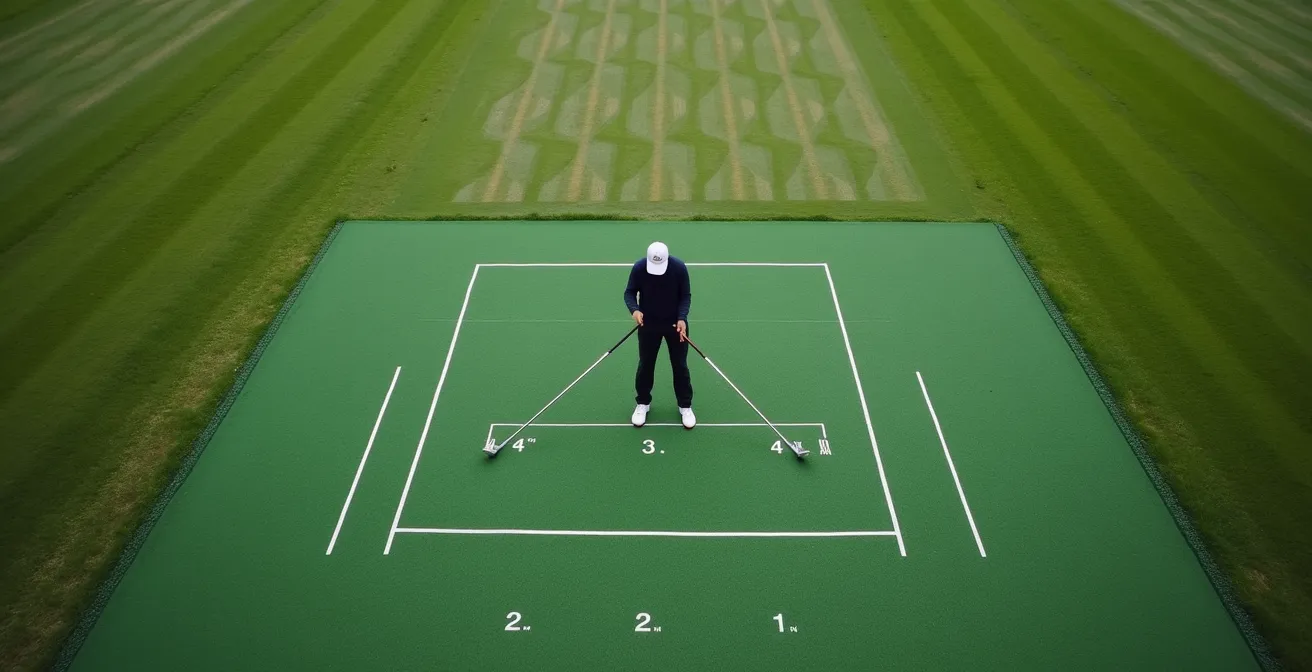
As you can see, maintaining a stable center allows for maximum rotational energy storage. This is the bedrock of a repeatable swing, something no new club can give you. If you fight a sway, you are fighting a battle for consistency on every single shot.
Creating Lag: How to Store Energy in Your Wrists for Impact?
If the kinematic sequence is the engine, then ‘lag’ is its turbocharger. Lag refers to the angle created between your lead arm and the golf club shaft during the downswing. Elite players increase this angle in the initial part of the downswing, ‘storing’ energy, and then release it explosively right before impact. This release is what creates incredible clubhead speed. Most high-handicappers do the opposite: they ‘cast’ the club from the top, losing the angle—and all that stored energy—far too early.
Lag is simply stored energy. It is energy waiting to be released just before impact. When you know this, you are better able to feel great lag in your golf swing.
– USGolfTV Instruction Team, USGolfTV Guide to Lag in Golf Swing
Crucially, lag is not something you actively ‘do’ with your hands. It is a result of a correct kinematic sequence. When your hips fire first and your torso unwinds, your arms and the club are pulled along, naturally maintaining and even increasing the wrist hinge. Trying to ‘hold the angle’ with your hands without a proper body sequence only creates tension and slows you down.
The difference is staggering. After analyzing over 1,000,000 swings with wrist sensors, data shows that elite players often see their wrist angle decrease from around 88 degrees at the top to 55 degrees just before impact. Amateurs, on the other hand, often lose this angle almost immediately. Mastering the body sequence is the only way to achieve this effortless power multiplier. It’s pure physics, not a feeling or a trick.
Inside-Out vs Outside-In: Which Path Fixes Your Slice Permanently?
Your slice is not a mystery. It’s a predictable result of physics. A slice is caused by a simple combination: a club path that moves from outside-to-in across the target line, combined with a clubface that is open to that path at impact. The new driver you bought might have a ‘draw bias’, but it’s a tiny band-aid on a gaping wound. It cannot fix a swing path that cuts across the ball.
The permanent fix is to train your body to deliver the club from the inside-out. This path allows the club to approach the ball from behind, promoting a square or even slightly closed clubface at impact, which produces a straight shot or a draw. This inside-out path is, once again, a natural consequence of a correct kinematic sequence. When your hips clear and your upper body stays back, it creates a ‘slot’ for your arms and the club to drop into, approaching the ball from the inside.
A table helps clarify how these path and face combinations dictate ball flight. As this comparative analysis of swing paths shows, the outcome is governed by predictable geometry.
| Swing Path | Clubface at Impact | Ball Flight Result | Fix Method |
|---|---|---|---|
| Outside-In | Open | Slice (side-spin) | Exaggeration drills with extreme inside-out |
| Inside-Out | Square | Draw | Maintain with gate drill |
| Neutral | Square | Straight | Target achieved |
To change your path, you must change your body’s motion. Drills are essential for this. The ‘gate drill’ is a simple but effective way to provide your brain with immediate feedback. By placing two headcovers to form a ‘gate’, you force yourself to swing through the correct path. It’s a way of retraining your motor program without overthinking it.
Paralysis by Analysis: When Should You Stop Watching Your Own Swing Videos?
With smartphones in every pocket, it’s easier than ever to film your swing. This can be a powerful tool, but for the frustrated golfer, it often leads to ‘paralysis by analysis’. Watching endless slow-motion replays, trying to fix ten different things at once—head movement, wrist angles, swing plane, hip turn—is a recipe for disaster. This hyper-internal focus on body parts actually hinders learning.
Research overwhelmingly shows external focus leads to better performance and faster learning compared to internal focus on body parts
– Sports Science Research, Motor Learning Studies in Golf
An ‘external focus’ means focusing on the effect you want to have on the environment—like “swinging the clubhead through the gate” or “making the ball draw around that tree.” This allows your brain’s sophisticated motor system to self-organize and execute the complex movement required. When you focus internally (“turn my hips more,” “keep my left arm straight”), you interfere with this automatic process.
So when should you stop watching? The key is to use video strategically. Use it once a week to identify ONE major issue. Then, put the camera away. Spend your practice time on a drill with an external focus designed to fix that one issue. A structured practice model like Block-Random-Transfer is far more effective: practice the new move in a block, then mix it with other shots randomly, and finally, take it to the course with zero mechanical thoughts. Analysis has its place, but performance happens when the analytical mind is quiet.
Your 5-Step Swing Self-Audit Plan
- Points of Contact: Identify key moments to check. Film your swing focusing only on the takeaway, the top of the backswing, and the impact position.
- Collect Data: Record ten swings from two angles: directly face-on and down-the-line (from behind, looking towards the target).
- Assess Coherence: Compare your positions to a professional model. Note the single biggest, most consistent deviation—is it a sway, an over-the-top move, or early extension?
- Identify the Root Fault: Don’t get lost in details. Isolate the ONE repeatable fault that likely causes all the others (e.g., an early hip slide causes the over-the-top move). This is your priority.
- Create an Action Plan: Choose ONE specific drill for that ONE fault. Dedicate your next three practice sessions exclusively to that drill with an external focus.
Over the Top: Why Your Steep Downswing Is Causing That Weak Slice?
The ‘over the top’ move is the slice’s evil twin and the most common fault among amateur golfers. It occurs when the downswing is initiated with the shoulders and arms, throwing the club ‘over’ the proper swing plane. This forces the club onto a steep, outside-in path, leading to a weak slice or a sharp pull. It feels powerful because the arms are working hard, but it’s a catastrophic breakdown of the kinematic sequence.
This move is almost always a compensation. It’s what your body does when the lower body fails to lead the downswing. If your hips don’t start the sequence by turning and clearing out of the way, there is no room for the arms and club to drop ‘into the slot’ on the correct inside path. To generate any speed, the brain’s only option is to heave the club over the top with the upper body. It’s a desperate attempt to create power when the proper engine—the lower body—hasn’t started.
Biomechanical Analysis of Compensation
Kinematic sequence analysis using 3D motion capture reveals exactly when the ‘over-the-top’ error occurs. In elite swings, the hips initiate the downswing first (at 0ms). In an amateur’s over-the-top swing, the shoulders and arms often begin moving before the hips. This reversed sequence forces the club outside the correct plane, creating the steep path. The move isn’t a choice; it’s a physical necessity created by the failure of the lower body to lead.
Visualizing the correct swing plane versus the steep, over-the-top motion makes the flaw immediately obvious.
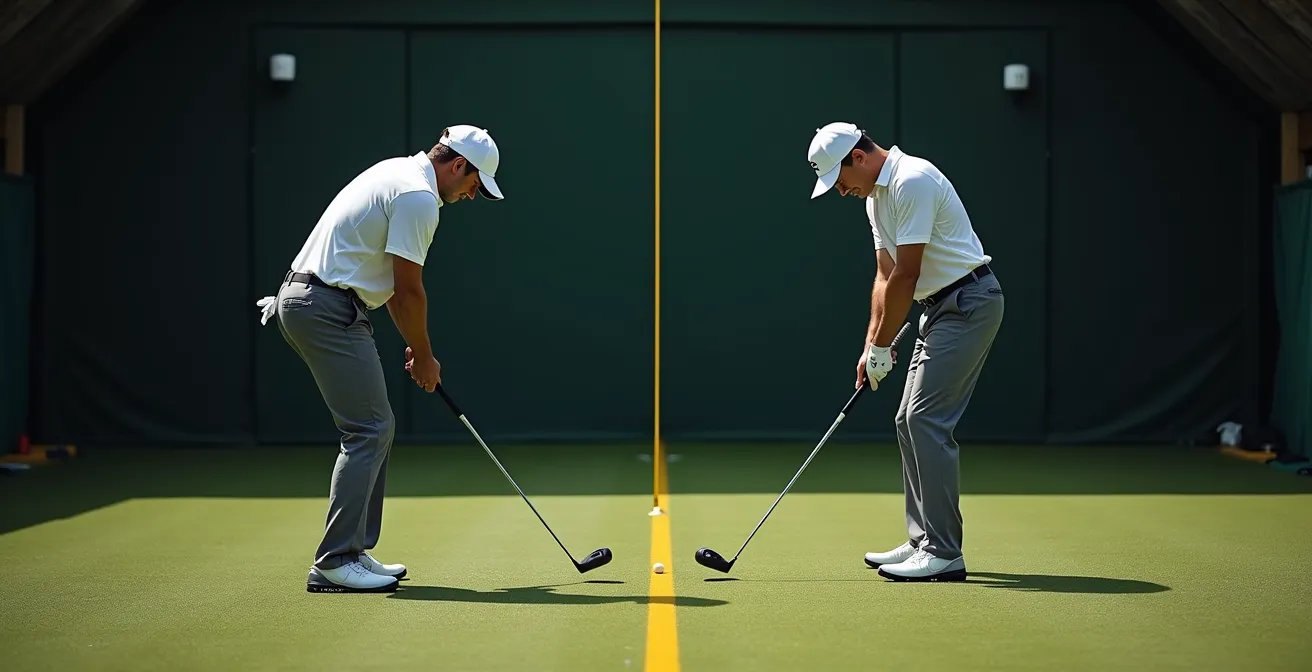
No new driver can correct this. It’s a fundamental sequencing error. The only fix is to retrain your body to start the downswing from the ground up, with the hips leading the charge. This creates the space for the club to fall onto the correct, powerful inside path.
Pushing the Ground: How Using Your Legs Generates Vertical Force?
We’ve established that power comes from the lower body, but how exactly? The secret lies in using the ground. Elite golfers don’t just rotate their hips; they actively use their legs to push into the ground, generating what physicists call Ground Reaction Force (GRF). This is the same force that allows you to jump. By pushing down, the ground pushes back up, sending a wave of energy through your body.
This force has two key components in the golf swing: rotational (torque) and vertical. As the player transitions into the downswing, they create a slight ‘squat’ motion, increasing pressure into their lead foot. Then, as they approach impact, they explosively push upwards, straightening their lead leg. This vertical push sends massive amounts of energy up the kinetic chain, dramatically increasing clubhead speed at the moment of truth. Many long-drive champions appear to be jumping off the ground at impact for this very reason.
High-handicappers often have ‘dead legs’. They swing entirely with their upper body, completely neglecting this primary power source. The numbers are undeniable; professional golfer biomechanical studies confirm that over 60% of swing power originates from these ground reaction forces. Learning to use your legs isn’t just for adding a few yards; it’s about tapping into the main engine of the golf swing. A simple bathroom scale drill can make this tangible, providing real-time feedback on your weight shift and pressure.
Key takeaways
- Your body is a kinetic chain; power is maximized when it moves in the correct sequence (hips, torso, arms, club).
- Most swing faults, like a slice or ‘over the top’ move, are symptoms of a broken sequence, not isolated problems.
- Lasting improvement comes from mastering biomechanical principles like rotation and ground reaction force, not from buying new technology.
Why 3 Private Coaching Sessions Are Worth More Than a New Driver?
By now, it should be clear that the golf swing is a complex biomechanical system. A new driver is a passive tool; it cannot diagnose a faulty sequence, correct an over-the-top move, or teach you to use ground reaction forces. It’s an investment in a symptom, not a cure. The return on investment for equipment depreciates the moment you buy it, as newer technology is always on the horizon.
An investment in coaching, on the other hand, provides compounding returns. A qualified coach acts as a biomechanics expert for your specific swing. In just a few sessions, they can use their trained eye and technology like launch monitors to: 1. Diagnose the root cause of your inconsistency within your kinematic sequence. 2. Provide one or two simple, actionable drills with an external focus. 3. Build a practice plan to turn a new movement into a lasting habit.
This knowledge applies to every club in your bag, from driver to wedge, and lasts a lifetime. You are not just buying an hour of time; you are investing in a new motor program that will pay dividends for years. The cost difference is often negligible, but the impact on performance is worlds apart.
This comparison of investment returns in golf clearly illustrates where the real value lies for long-term improvement.
| Investment Type | Cost Range | Impact Duration | Performance Gain |
|---|---|---|---|
| New Driver | $400-600 | 2-3 years (tech obsolescence) | 5-10 yards with one club |
| 3 Coaching Sessions | $300-450 | Lifetime skill development | Improved mechanics for all 14 clubs |
| Launch Monitor Analysis | $150-200 | Single session data | Information without interpretation |
| Coach + Technology | $400-500 | Ongoing improvement | Data interpretation + actionable drills |
A coach doesn’t just give you a fish; they teach you how to fish. They provide the framework for understanding your own swing so you can self-correct in the future. It’s the ultimate shift from being a frustrated passenger to being the driver of your own improvement.
The next logical step is to stop shopping for a magic bullet and start investing in understanding. Find a qualified coach who understands biomechanics, book a session, and begin the real work of building a swing that is not only powerful but will also last a lifetime.