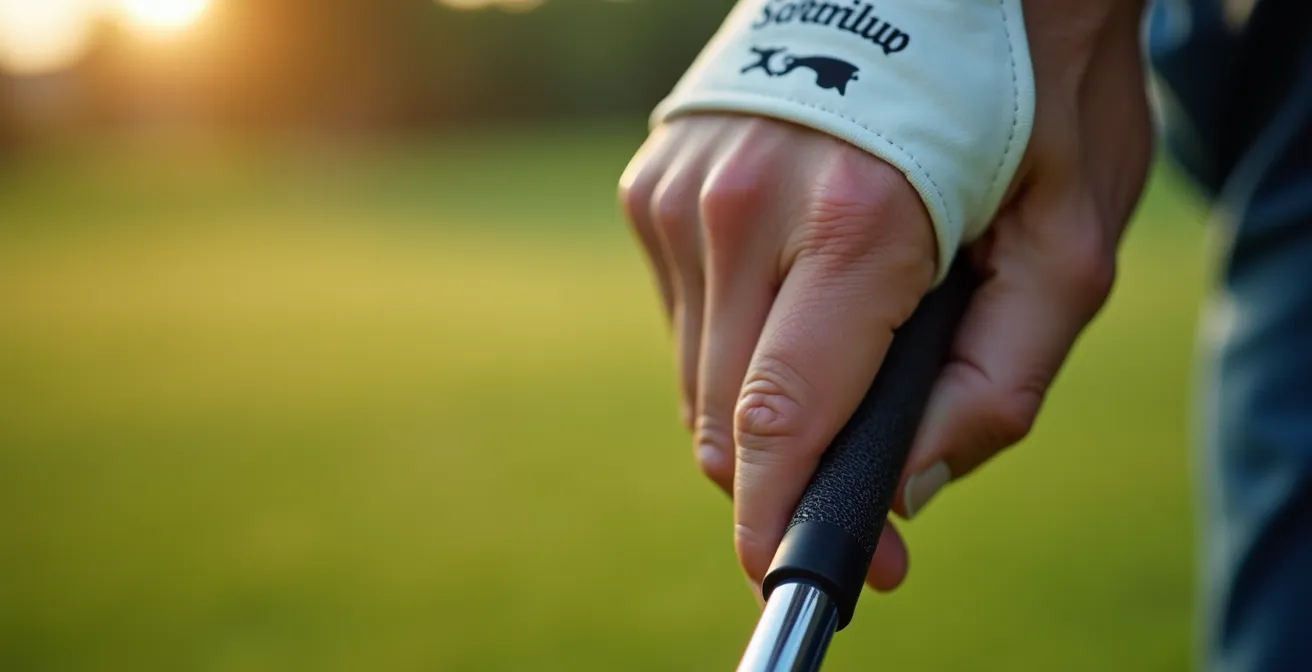
The biggest myth in fixing a slice is that you need to change your swing path; the reality is your swing path is a symptom, and your grip is the cure.
- Your grip is the direct control interface for the clubface; a “weak” grip makes an open face at impact almost unavoidable, causing the slice.
- Proper grip pressure is about consistency throughout the swing, not just a “light” hold at address. Most amateurs ruin their swing by tightening their grip during the downswing.
Recommendation: Before you take another practice swing, stop everything and use the “Hanging Arm Test” described in this guide to find your body’s natural, powerful grip position.
You feel it in your bones. A smooth, athletic turn away from the ball, a powerful rotation through, perfect balance at the finish. You look up, expecting to see a majestic, soaring ball flight, only to witness that same, weak, curving shot peeling off to the right. It’s the most frustrating experience in golf: the chronic slice. For the beginner, it feels like a fundamental disconnect between the effort you put into your swing and the disappointing result.
In the quest for a fix, you’ve likely heard it all. “Swing from the inside,” “keep your head down,” “rotate your forearms.” You may have even been tempted by the siren song of a new, expensive draw-biased driver that promises to magically correct your ball flight. These pieces of advice are not necessarily wrong, but they are all chasing symptoms. They are trying to patch a flawed swing in mid-air. They fail to address the root cause that is set in stone before you even begin your takeaway.
But what if the key wasn’t in changing your complex swing motion, but in correcting the one, simple connection you have to the club? The truth is, your slice is almost certainly a grip problem. It’s a failure of the control interface—your hands. A fundamentally flawed grip pre-programs an open clubface at impact, making a slice the path of least resistance for the club. It makes an effective, inside-out swing path a biomechanical impossibility.
This guide will not give you temporary fixes or swing thoughts. We are going back to the absolute foundation. We will deconstruct every element of your grip—from its rotational position and pressure dynamics to its physical thickness and condition—to rebuild it from the ground up. This is not a shortcut; it is the only permanent solution to fixing your slice.
This article provides a complete framework for understanding and correcting your grip. Below is a table of contents that will guide you through each critical component, from finding your natural hand position to knowing when it’s time to replace your equipment.
Table of Contents: A Golfer’s Guide to Mastering the Grip
- Strong, Neutral, or Weak: Which Grip Style Suits Your Wrist Flexibility?
- Holding the Bird: How Tight Grip Pressure Kills Your Swing Speed?
- Tiger Woods Uses Interlock: Should You Switch from Overlap to Imitate Him?
- Standard vs Midsize: How Grip Thickness Affects Your Hand Action?
- Slippery When Wet: When Is It Time to Regrip Your Clubs for Safety?
- Inside-Out vs Outside-In: Which Path Fixes Your Slice Permanently?
- Second Skin: Why Your Golf Glove Should Feel Tight When You Buy It?
- Why Understanding Basic Swing Mechanics Is More Important Than Buying New Clubs?
Strong, Neutral, or Weak: Which Grip Style Suits Your Wrist Flexibility?
The terms “strong,” “neutral,” and “weak” are the most misunderstood in golf instruction. They do not refer to grip pressure. They refer to the rotational position of your hands on the club. A “weak” grip is one where the hands are rotated too far to the left (for a right-handed golfer), which naturally encourages the clubface to open during the swing. A “strong” grip is rotated to the right, which encourages the face to close. The slice is almost always the result of a grip that is too weak for the player’s biomechanics.
The goal is not to adopt a generic “strong” grip but to find *your* natural, neutral position. This is determined by how your arms hang. Forcing your hands into a textbook position that fights your body’s natural tendencies will only create tension and inconsistency. You must find the position where your hands can return the club to square at impact with minimal manipulation.
The “Hanging Arm Test” is the only way to find this position. Stand up straight and let your arms hang completely relaxed at your sides. Look down at your lead hand (left hand for right-handers). Notice the angle it hangs at; this is your natural orientation. Your grip on the club should replicate this exact angle. When you grasp the club, the “V” formed by your thumb and index finger should point somewhere between your chin and your trail shoulder. For most slicers, moving this “V” more towards the trail shoulder is the first major step toward a square clubface at impact.
Once you find this natural position, you have established the foundation. It sets the clubface on a path to be square, or even slightly closed, at impact—the ultimate antidote to a slice. This single adjustment is more powerful than any swing thought.
Holding the Bird: How Tight Grip Pressure Kills Your Swing Speed?
The old adage is to “hold the club like you’re holding a small bird—tight enough so it can’t fly away, but light enough not to hurt it.” This is a nice image, but it’s useless as practical advice. The real killer of swing speed and control is not static pressure at address, but the change in pressure during the swing. Most amateurs start with a relaxed grip and then squeeze the life out of the club during the downswing. This tenses the forearms, freezes the wrists, and completely prevents the natural release of the clubhead, leaving the face wide open at impact.
A study on professional golfers revealed that they showed the least amount of change in grip pressure from their setup to impact. Their pressure remains incredibly consistent. Amateurs, particularly high-handicappers, show massive variability and almost always tighten their grip in the trail hand during the downswing. This tension is a speed killer. True power comes from relaxed, fast-twitch muscles, not tense, rigid ones. Your grip should be a secure connection, not a death grip.

While a light grip is important, it’s also true that grip strength itself plays a role in potential speed. However, strength and pressure are not the same. A SuperSpeed Golf study found a strong 0.7 correlation between a golfer’s grip strength and their clubhead speed. This doesn’t mean you should squeeze harder; it means that stronger hands and forearms can better stabilize the club with less *perceived effort* and are less likely to tighten defensively during the swing. The goal is to build strength in your hands so you can maintain a consistent, lighter pressure throughout the entire motion.
Tiger Woods Uses Interlock: Should You Switch from Overlap to Imitate Him?
Seeing legends like Tiger Woods and Jack Nicklaus use the interlock grip leads many amateurs to believe it’s inherently superior. This is a classic case of correlation not equaling causation. The choice between the three main grip styles—interlock, overlap (or Vardon), and 10-finger (or baseball)—is not about imitation. It is a deeply personal choice based on hand size, finger length, and comfort.
The primary goal of any grip style is to get your hands to work together as a single, unified unit. For a player with smaller hands or shorter fingers, the interlock (linking the trail pinky and lead index finger) can provide a more secure and connected feeling. However, for a player with larger hands, this same grip can create tension and restrict the fluid motion of the wrists. The overlap, where the trail pinky rests on top of the gap between the lead index and middle fingers, is often more comfortable for those with larger hands.
Blindly copying a pro’s grip without considering your own anatomy is a recipe for failure. The best grip for you is the one that allows you to maintain consistent, light pressure and promotes a unified action of the hands, without creating tension points.
Your Action Plan: The Split-Grip Diagnostic Drill
- Place your hands about two inches apart on the grip of the club.
- Make slow, half-speed practice swings, paying close attention to which hand feels like it’s dominating the motion. Is the trail hand taking over and pushing, or is the lead hand pulling too much?
- Gradually bring your hands closer together on the grip, trying to maintain a feeling of balanced pressure and synchronized movement between both hands.
- Experiment with the overlap and interlock styles during this drill. Choose the one that best helps you feel like your hands are working as a single, cohesive unit, not two separate entities fighting for control.
- The goal is to eliminate the feeling of one hand “winning” and achieve a balanced, unified control system.
This drill removes the guesswork and allows you to feel the correct mechanics, leading you to the grip style that is functionally best for your swing, not just the one that looks like your favorite player’s.
Standard vs Midsize: How Grip Thickness Affects Your Hand Action?
One of the most overlooked equipment factors in fixing a slice is grip thickness. Playing with grips that are too thin for your hand size is a common mistake that actively promotes the errors that cause a slice. When a grip is too small, it encourages excessive hand and wrist action. Golfers tend to get “wristy” and “flippy” at the bottom of the swing, which often involves an overactive trail hand that can hold the face open or create other inconsistencies.
Conversely, a thicker grip, such as a midsize or jumbo, fills the hands more and restricts this excessive wrist motion. It forces the larger muscles of the arms, shoulders, and torso to control the swing, promoting a more connected, body-driven motion. This “quieting of the hands” is a critical component in developing a consistent swing path and clubface control. SuperStroke’s No Taper Technology, for example, is built on this principle, using a parallel design to minimize pressure and enable golfers to quiet their hands for a more consistent stroke.
The effect is so significant that professional tour statistics reveal 71 tournament victories by players using these thicker, specialized grips in 2024 alone. While you shouldn’t switch without testing, if you have larger than average hands (e.g., you wear a large or extra-large glove) and struggle with a slice, experimenting with a midsize grip on your driver could be a revelation. It can immediately reduce your tendency to manipulate the club with your hands and force a more fundamentally sound, big-muscle swing.
The right size grip makes it easier to maintain consistent pressure and harder to introduce the small, destructive hand movements that lead to a slice. It’s an equipment change that directly supports a mechanical improvement.
Slippery When Wet: When Is It Time to Regrip Your Clubs for Safety?
A golf grip is not a permanent part of the club. It is a consumable item with a finite lifespan, much like the tires on a car. Grips are made from materials that degrade over time due to exposure to sweat, dirt, oils from your hands, and UV radiation. As they wear out, they become hard, slick, and lose their tackiness. A worn-out grip is a direct cause of a slice, as it forces you to apply more pressure to prevent the club from twisting in your hands.
This subconscious increase in grip pressure is exactly the tension we are trying to eliminate. You are forced to squeeze the club harder just to maintain control, which tightens your forearms, restricts your wrist hinge, and prevents a natural release. You cannot hold a club with consistent, light pressure if the surface is slippery. It’s a matter of safety and performance. Playing with worn grips is like trying to drive a race car on bald tires; you have no traction and no real control.
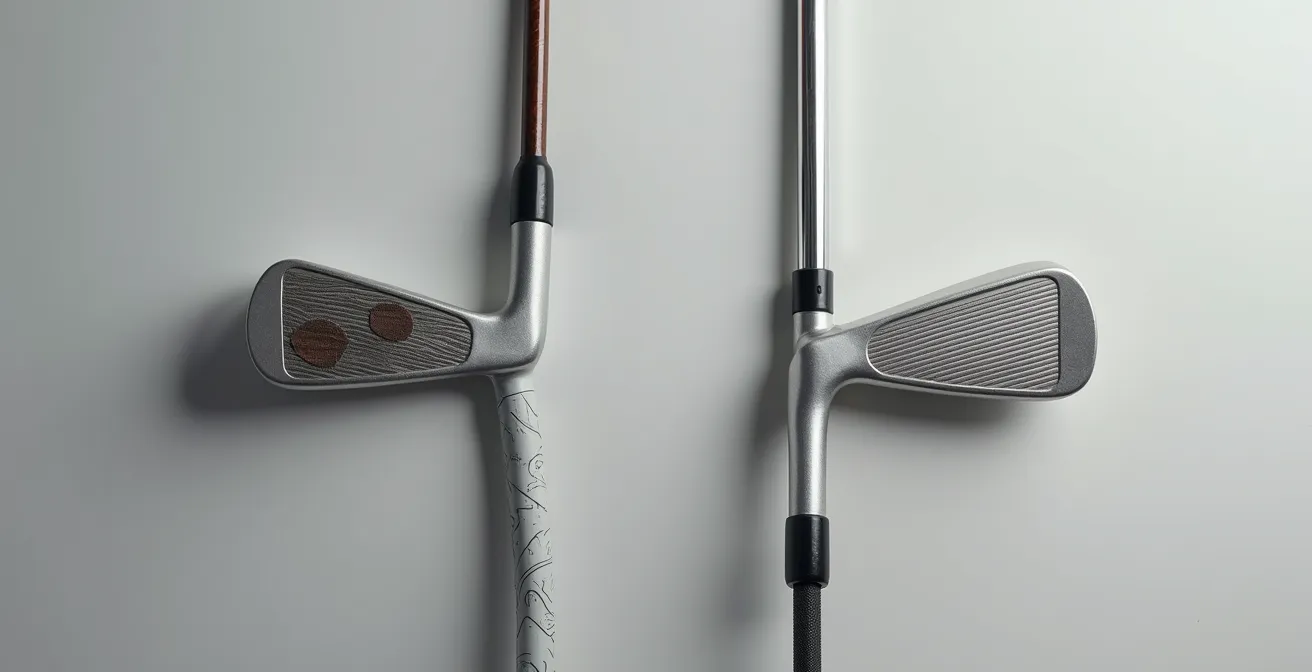
As a rule of thumb, you should regrip your clubs once a year or every 40 rounds, whichever comes first. However, visual and tactile inspection is the best guide. You must regularly assess their condition. Look for shiny, smooth patches, especially where your thumbs rest. Feel for areas that have become hard or brittle. Perform a “twist test”: if you can easily rotate the grip on the shaft with your hands, it’s dangerously worn and needs immediate replacement. A fresh set of grips is one of the cheapest and most effective investments you can make in your game.
Don’t let a $10 component sabotage your entire swing. Maintaining fresh, tacky grips is not a luxury; it is a non-negotiable part of having functional equipment that allows you to execute the fundamentals correctly.
Inside-Out vs Outside-In: Which Path Fixes Your Slice Permanently?
Every slicer has been told they have an “outside-in” swing path. This means the clubhead approaches the ball from outside the target line and cuts across it to the inside, imparting the sidespin that causes the slice. The prescribed fix is to learn to swing “from the inside.” While this is correct, it is also putting the cart before the horse. Trying to force an inside-out path with a weak grip is a futile and frustrating exercise.
As renowned golf instructor Rick Shiels states, “The grip is the prerequisite for the path.” It is the foundational element that makes the correct path possible. With a weak grip, the clubface naturally wants to open on the downswing. To compensate and try to hit the ball straight, a golfer’s brain instinctively reroutes the swing path to come “over the top” in an attempt to pull the ball back on line. This outside-in path is a compensation for a bad grip, not the original sin.
Correct your grip first. By strengthening it to your natural position, you pre-set the club to return to a square or slightly closed position at impact. Once the clubface is no longer destined to be wide open, your brain no longer needs to make that desperate over-the-top move. An inside-out path becomes the more natural and effective way to swing. The path follows the grip.
Case Study: Professional vs. Amateur Grip Pressure
Data from grip pressure analysis highlights this connection perfectly. A study showed that professionals not only maintained consistent pressure but often decreased it slightly in the early downswing, allowing for maximum speed and a free release of the club. High handicappers did the opposite: they significantly increased pressure, especially in their trail hand, during the downswing. This added tension makes it nearly impossible to release the club effectively, holding the face open and reinforcing the slice-causing outside-in path.
Stop chasing the path. Fix the one thing you have direct control over before the swing starts: your hands. A proper grip doesn’t just influence the path; it dictates it.
Second Skin: Why Your Golf Glove Should Feel Tight When You Buy It?
The golf glove is not an accessory; it is an essential piece of performance equipment. It is the final layer of your control interface, and its fit is just as critical as the grip on your club. The most common mistake golfers make is buying a glove that is too large. A loose glove is a performance disaster. Any sliding, wrinkling, or bunching of the material between your hand and the grip creates a disconnect. It introduces a layer of instability that completely undermines a secure hold.
If your glove is loose, your hand can move independently of the club, even if only by a millimeter. This micro-movement is enough to alter the clubface angle and disrupt the entire swing. To compensate for a loose fit, you will subconsciously squeeze the club harder, reintroducing the very tension we have worked so hard to eliminate. A proper golf glove should fit like a second skin. When you first put it on, it should feel slightly tight. High-quality cabretta leather will stretch slightly after a few swings to conform perfectly to your hand.
To check for proper fit, use the “Palm Wrinkle Test.” Put on the glove, make a fist, and then grip a club. Open your hand and look at your palm. If you see any wrinkles or bunching of the material, the glove is too big. There should be no excess material whatsoever. The fit should be snug across the palm and through the fingers, with the Velcro tab only about 75% of the way closed.
Your glove is part of your grip. A perfect fit ensures a seamless, stable connection to the club, allowing you to maintain that ideal, consistent pressure. As a final guideline, research indicates the optimal grip pressure intensity is around a 5 or 6 on a scale of 10. You can only achieve this level of light-but-secure control if your glove fits perfectly.
Key Takeaways
- Your grip is the control interface for the clubface; a slice is fundamentally a grip problem, not a swing path problem.
- Find your natural grip using the Hanging Arm Test; do not force a generic “strong” grip that fights your body’s biomechanics.
- Consistent pressure throughout the swing is more important than light pressure at address. Amateurs tighten their grip in the downswing, which kills speed and opens the face.
Why Understanding Basic Swing Mechanics Is More Important Than Buying New Clubs?
In the face of a persistent slice, the allure of a technological fix is powerful. Marketing promises that the latest $600 driver, with its adjustable weights and draw-bias settings, will be the silver bullet that finally straightens your shots. This is an illusion. While modern technology can help mitigate the effects of a bad swing, it can never fix the root cause. Buying a new driver to fix a slice caused by a bad grip is like taking painkillers for a broken leg; it might mask the symptom for a short time, but the underlying problem remains, and it will eventually show itself again.
The grip is the alignment of the entire golf swing. As GOLFTEC’s Director of Teaching Quality, Brad Skupaka, puts it, “The grip is the alignment of the golf swing; it’s the first and most critical adjustment to make.” It is the single most important fundamental. A small investment of time to correct your grip and a potential $15 for a new grip on your driver will have a more profound and permanent effect on your ball flight than any expensive piece of new equipment.
The following comparison puts the choice into stark perspective:
| Solution | Cost | Effectiveness | Duration |
|---|---|---|---|
| Grip Change | $15-30 | Addresses root cause | Permanent fix |
| New Driver | $400-600 | Masks symptoms | Temporary improvement |
| Grip + Practice | $15 + time | 85% slice reduction | Long-term solution |
True improvement in golf doesn’t come from a credit card. It comes from understanding and mastering the fundamentals. Your hands are the only connection you have to the club, and therefore the only way you can control the clubface. By dedicating yourself to building a fundamentally sound grip, you are not just fixing your slice; you are building the foundation for a consistent, powerful, and enjoyable golf game for years to come.
Stop chasing quick fixes and commit to the real solution. Go to the driving range with the sole intention of rebuilding your grip using the principles in this guide. This focused effort is the most valuable investment you can make in your game.