Contrary to popular belief, your chronic lower back pain isn’t a back problem—it’s a core control crisis that forces your spine into a role it was never designed to play.
- Weak or inactive glutes (“gluteal amnesia”) cause your lower back to dangerously overcompensate for power generation.
- A stable core acts as the swing’s “braking system,” allowing for safe, powerful hip and shoulder separation (the X-Factor).
Recommendation: Shift your focus from stretching a sore back to building 360-degree core stability with targeted exercises that teach your body to generate power from the ground up, not from your spine.
That familiar, nagging ache in your lower back after 18 holes feels like an inevitable part of being a golfer over 50. You’ve likely tried everything: more stretching, Ibuprofen before a round, or even swinging “easier,” sacrificing yards for a few holes of relief. The common advice always points to the site of the pain—the back itself. We’re told to stretch it, rest it, and protect it. But as a TPI Certified trainer who sees this pattern daily, I can tell you this approach is fundamentally flawed. It’s like trying to fix a leaky roof by repeatedly mopping the floor.
The pain you feel is a symptom, not the source. The real issue is a breakdown in the kinetic chain, a “core control crisis” where your body’s central stabilizer has forgotten its primary job. When your core can’t provide a solid foundation, your body, in its desperate search for power and rotation, recruits muscles that were never meant for the task. Chief among these is your vulnerable lower back, which is forced to become a power generator instead of a simple transmitter. This is an unsustainable and painful compensation.
But here is the encouraging news: this is an entirely correctable issue. The secret to a pain-free, powerful swing lies not in endless back stretches, but in re-educating your core to be the unshakeable anchor it was designed to be. This isn’t about building a “six-pack”; it’s about creating 360-degree stiffness that gives your brain the confidence to unleash the power stored in your hips and glutes.
This article will guide you through the TPI-based approach to understanding this dysfunction. We will diagnose the common culprits like gluteal amnesia, explore the true meaning of core stability for golf, provide a clear, actionable plan to rebuild your foundation, and show you how this not only eliminates pain but also unlocks the effortless speed you thought you had lost.
To help you navigate this comprehensive guide, we’ve broken down the key concepts into distinct sections. The following summary outlines the journey from understanding the problem to implementing the solution for a stronger, more resilient golf game.
Summary : The Golfer’s Blueprint to a Pain-Free, Powerful Swing
- Lower Back Pain: How Weak Glutes Force Your Back to Do All the Work?
- Disassociation: How to Separate Hips and Shoulders for Max X-Factor?
- Hold the Finish: Why You Can’t Hold Your Pose Without Core Stability?
- 15 Minutes a Day: The Best Home Core Workout for Golfers?
- Yoga or Pilates: Which Is Better for Golf Mobility and Stability?
- Turn vs Slide: Why Hip Mobility Is the Key to Torque?
- Graphite vs Steel: Which Material Is Better for Golfers with Arthritis?
- Chasing Speed: How to Increase Swing Speed Without Ruining Your Mechanics?
Lower Back Pain: How Weak Glutes Force Your Back to Do All the Work?
The most common instigator of lower back pain in amateur golfers is a phenomenon we call “gluteal amnesia.” It sounds complex, but the concept is simple: your glutes, the most powerful muscle group in your body, have forgotten how to fire correctly in the golf swing sequence. A properly functioning golf swing is a chain reaction that starts from the ground up. Power is generated by pushing into the ground, engaging the legs and glutes, which then rotate the hips. This rotational energy is transferred up through a stable core to the shoulders and finally, to the club.
When your glutes don’t activate, this chain is broken at its most critical link. Your brain, still demanding rotation and power, seeks an alternative source. The next joint up the chain is your lumbar spine. Instead of remaining a stable transmitter of force, your lower back is forced to twist and contort to create the rotation the glutes failed to provide. This puts enormous compressive and shearing forces on your spinal discs and surrounding muscles, leading directly to that post-round pain and inflammation. Your back is doing a job it was never designed for, and it’s screaming for help.
Diagnosing this is the first step toward a cure. You don’t need fancy equipment, just a few minutes on the floor. The following test helps you identify if your lower back is compensating for inactive glutes. When you lift your leg, you should feel your glute muscle tighten first. If you feel your lower back muscles engage before or instead of your glutes, you’re experiencing gluteal amnesia.
Your Action Plan: The Gluteal Amnesia Audit
- Lie on your stomach with your legs straight and forehead resting on your hands to keep your spine neutral.
- Place the fingers of one hand on the glute muscle of the leg you will lift. Place the other hand on the lower back muscles on the same side. This provides sensory feedback.
- Slowly lift one entire leg about six inches off the ground, keeping the knee straight. Feel which muscle group tightens first to initiate the movement.
- Analyze the feedback: If your lower back muscles tightened significantly before your glute, you have a classic case of gluteal amnesia. The back is taking over.
- Establish a re-training plan: Perform simple glute bridges daily for two weeks, focusing on squeezing the glutes to lift the hips. Then, repeat this test to track your improvement in the firing sequence.
By reawakening your glutes with simple exercises like bridges and clamshells, you offload the tremendous strain from your back, allowing it to return to its rightful role as a stable pillar.
Disassociation: How to Separate Hips and Shoulders for Max X-Factor?
The “X-Factor” is the holy grail of swing power. It refers to the maximum rotational difference between your hips and your shoulders at the top of the backswing. The greater this separation, the more potential energy you store, like a coiling spring, ready to be unleashed in the downswing. However, achieving this separation safely and effectively is impossible without a stable core. Think of your core—the entire cylinder of muscle around your midsection—as a “locked box” connecting your upper and lower body.
If that box is weak or unstable, you cannot disassociate. When you try to rotate your shoulders against your hips, an unstable core will buckle, forcing your hips to turn along with your shoulders. This results in a one-piece takeaway with no separation, no stored energy, and a significant loss of power. To compensate, many golfers then sway or slide their hips, putting immense lateral strain on the lower back. A stable core allows you to anchor your lower body while your upper body rotates against it, creating the powerful stretch that is the source of effortless clubhead speed.
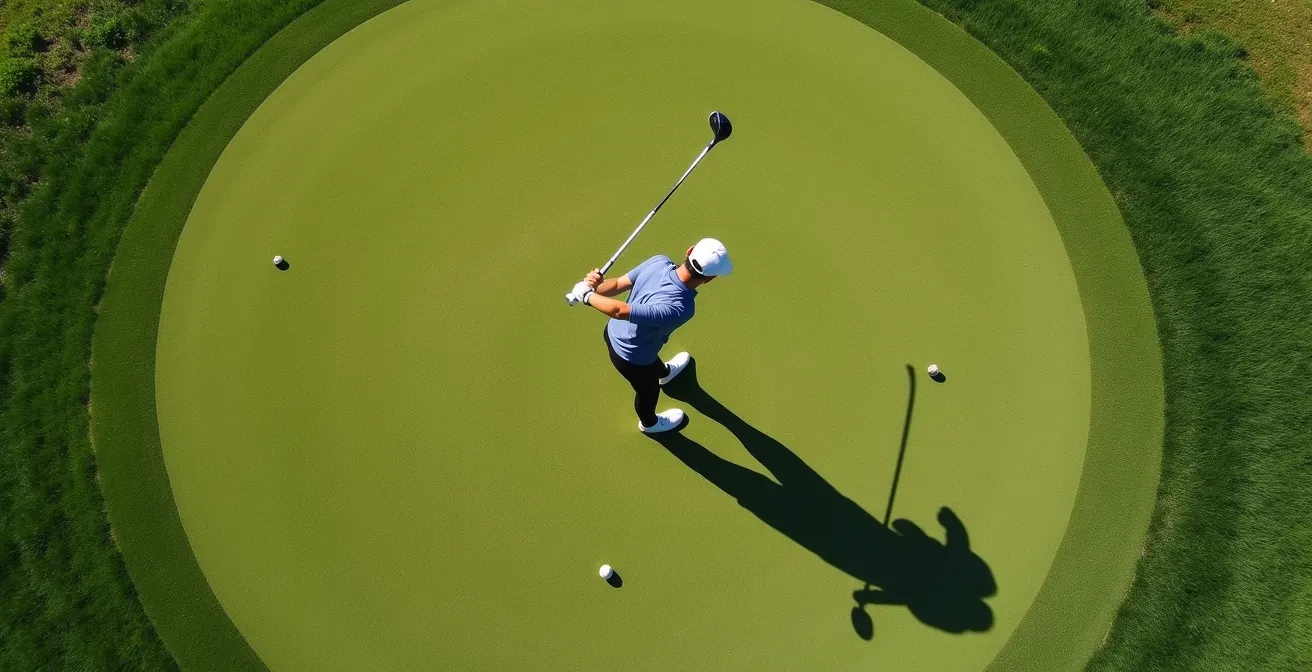
As this overhead view demonstrates, the body forms a distinct “X” at the peak of the swing. This visual representation of disassociation is only possible when the core provides a rock-solid pivot point, preventing the upper and lower body from rotating as a single, inefficient unit. The goal is not just strength, but motor control. You must train your core to brace and resist rotation.
TPI Case Study: The “Locked Box” Principle
The Titleist Performance Institute’s approach to building a golf-ready core doesn’t focus on crunches. Instead, it prioritizes creating “360-degree stiffness” around the spine. This is achieved through motor learning drills like the dead bug or bird-dog, performed in various positions (on your back, on all fours, standing). These exercises teach you to activate all three layers of your abdominal wall simultaneously. This creates the “locked box” stability required to anchor the pelvis, allowing the thoracic spine (upper/mid back) to rotate freely over it. It’s a skill that directly translates to proper hip-shoulder separation in the swing.
Ultimately, a stable core is what allows a mature golfer to generate speed through efficient rotation rather than brute force, protecting the back in the process.
Hold the Finish: Why You Can’t Hold Your Pose Without Core Stability?
The classic, balanced “hold the finish” pose isn’t just for photographers. It is one of the most revealing diagnostic tools for assessing your core’s true function. If you consistently finish your swing off-balance, stumbling forward or unable to hold that poised position for a few seconds, it’s a glaring red flag. This lack of balance isn’t a footwork issue; it’s a direct consequence of your core failing at its second most critical job: deceleration. A golf swing generates incredible rotational velocity. The job of stopping that force safely falls squarely on your core muscles.
If your core lacks the strength and endurance to act as an effective braking system, your body will remain in uncontrolled motion after impact. You’ll stumble, your spine will absorb the residual forces, and you’ll be unable to achieve a stable finish. This inability to decelerate properly not only leaks power but is also a major contributor to injury. As experts in sports rehabilitation note, the forces involved are immense, and the core is the only structure equipped to handle them safely.
The held finish is not just a pose, but the result of the core’s ability to effectively and safely decelerate the immense rotational forces of the downswing – about eight times your body weight in force.
– Jamie Osmak, CSCS, HSS Sports Rehabilitation and Performance
Training your core for stability directly enhances this braking capacity. It improves your proprioception—your body’s awareness of its position in space—allowing for minute adjustments that maintain balance throughout the swing. The link between core stability and injury prevention is not just anecdotal; targeted training has been shown to produce significant results. In fact, specific research indicates that core stability exercises can lead to up to a 50% reduction in injury risk for athletes, a crucial benefit for any golfer looking for longevity in the sport.
By focusing on exercises that challenge your stability, you are directly training your body to control and absorb force, leading to a balanced finish and a healthier back.
15 Minutes a Day: The Best Home Core Workout for Golfers?
Building a golf-specific core doesn’t require hours in the gym. Consistency with the right exercises is far more effective than intensity with the wrong ones. A 15-minute daily routine focused on the three primary functions of the golf core can be transformative. Those functions are: anti-extension (preventing your lower back from arching), anti-rotation (resisting twisting forces), and controlled dynamic rotation. Unfortunately, many golfers unknowingly perform exercises that are counterproductive or even harmful.
Traditional sit-ups, for example, promote excessive spinal flexion and over-activate the hip flexors, which can pull the pelvis forward and increase lower back strain. Heavy, weighted side bends create asymmetrical loading on the spinal discs. And ballistic, weighted “Russian Twists” can be disastrous for a mature spine. The key is to choose exercises that challenge the core to remain stable while the limbs move, which directly mimics the demands of the golf swing.
The following table, based on common coaching recommendations found in sources like leading golf fitness publications, clearly outlines what to avoid and what to embrace for a healthier, more powerful core.
| Avoid These | Why Harmful | Do These Instead |
|---|---|---|
| Traditional Sit-ups | Excessive spinal flexion, hip flexor dominance | Dead Bug or Modified Plank |
| Heavy Side Bends | Asymmetrical loading, potential disc issues | Side Plank or Suitcase Carry |
| Russian Twists with weight | Ballistic rotation under load risks injury | Controlled Pallof Press |
A simple yet highly effective 15-minute workout can be built around these safer, more functional movements. Here is a sample structure:
- Anti-Extension (5 min): The “Dead Bug” is the gold standard. Lie on your back, press your lower back into the floor, and slowly lower your opposite arm and leg without letting your back arch. Perform 3 sets of 10-12 reps.
- Anti-Rotation (5 min): The “Pallof Press” is a must. Using a resistance band anchored at your side, press your hands straight out from your chest and resist the band’s pull to twist you. Hold for 2-3 seconds and return. Do 3 sets of 10-12 reps on each side.
- Dynamic Rotation (5 min): “Medicine Ball Rotational Throws” (using a light ball) teach you to generate rotational power from your hips and core, not your arms. Stand sideways to a solid wall and throw the ball from your back hip. Do 3 sets of 10 reps on each side.
Even a quick 3-minute pre-round activation circuit of a few bird-dogs, Pallof holds, and gentle twists can make a significant difference in preparing your body for the first tee.
Yoga or Pilates: Which Is Better for Golf Mobility and Stability?
As golfers seek to improve their physical condition, yoga and Pilates are often recommended, sometimes interchangeably. While both are immensely beneficial, they serve different primary purposes, and for the golfer struggling with back pain due to a “core control crisis,” one has a distinct advantage. Understanding this difference is key to investing your time wisely. Yoga, in its most common forms, excels at improving global mobility and flexibility. It encourages large-range-of-motion movements and extended holds, which are excellent for lengthening tight muscles like hamstrings, hip flexors, and the thoracic spine—all common problem areas for golfers.
Pilates, on the other hand, was created with a primary focus on core stability and motor control. Its foundational principles revolve around maintaining a neutral spine while moving the limbs, which is the exact skill required in the golf swing. Exercises are precise, controlled, and designed to activate the deep stabilizing muscles of the core, such as the transverse abdominis and multifidus. This directly addresses the issues of gluteal amnesia and the inability to create a “locked box” for rotation.
So, which is better? For the specific problem of back pain caused by instability, Pilates is the more direct and targeted solution. It rebuilds the foundation from the inside out, teaching your body how to brace and control movement before attempting to add power or range of motion. It directly combats the core control crisis. Yoga is an outstanding complement. Once a stable foundation is established through Pilates-like principles, yoga can help you expand your usable range of motion safely. Trying to increase flexibility with yoga on top of an unstable core is like building a bigger house on a crumbling foundation—it only increases the potential for collapse.
The ideal scenario for a mature golfer is a program that incorporates the stability and control of Pilates as its base, supplemented by the mobility and flow of yoga to expand that stable range of motion.
Turn vs Slide: Why Hip Mobility Is the Key to Torque?
Two of the most common power leaks in the amateur golf swing are the “sway” and the “slide.” A sway is when the hips move laterally away from the target during the backswing. A slide is when they move excessively toward the target during the downswing. Both are inefficient movements that reduce power and place significant stress on the lower back. And both are often symptoms of the same root cause: a combination of poor hip mobility and a core that isn’t stable enough to control the movement you do have.
A powerful golf swing requires the hips to rotate, not slide. In the backswing, you should feel your trail hip turn behind you as you load into your trail leg. In the downswing, your lead hip should clear and rotate open towards the target. This pure rotation creates torque. A slide, by contrast, is a linear motion that dissipates rotational energy. The reason many golfers slide is that they lack either the internal hip rotation to make the turn or the core stability to anchor the rotation. As leading sports scientists confirm, the core is the anchor that prevents a turn from becoming a slide.
A slide is often caused by lack of core stability to control the range of motion the hips provide. The core must anchor one side while the other turns.
– Ben Langdown, PhD, PGA National Training Academy Sports Science Executive
A simple diagnostic drill can reveal your tendency. Take your normal 7-iron stance, then lift your trail foot completely off the ground so you are balancing only on your lead leg. Now, make a few slow-motion practice swings. If you immediately fall forward toward the target, it indicates your core is not strong enough to stabilize your body through the swing. If you fall away from the target, it often points to a restriction in your lead hip’s ability to rotate internally. By practicing this drill on both legs, you can diagnose your weakness and simultaneously improve your balance and stability.
By improving both your hip mobility (through stretches like the “90/90”) and your core’s anti-rotation strength (with exercises like the Pallof Press), you teach your body to turn powerfully, leaving the inefficient and painful slide behind.
Graphite vs Steel: Which Material Is Better for Golfers with Arthritis?
For golfers dealing with arthritis or other joint pain, every swing sends vibrations up the club shaft and into the sensitive joints of the hands, wrists, and elbows. Over a full round, this can lead to significant pain, fatigue, and inflammation. While technique and core strength are the primary lines of defense, equipment choices can play a crucial supporting role. The choice between graphite and steel shafts is one of the most impactful decisions a senior golfer can make.
Steel shafts are known for their consistency and lower cost, but they are also heavier and do a poor job of dampening vibration. The uniform metal construction transmits impact shock directly to the player. Graphite shafts, made from layers of carbon fiber composite, are inherently better at absorbing these vibrations. Their composite structure dissipates the harsh frequencies of impact before they reach your hands. This single factor can make a dramatic difference in post-round joint pain.
Furthermore, graphite shafts are significantly lighter. A lighter club requires less muscular effort to swing, reducing the overall strain on your body and your core. For a golfer whose core is already working to maintain stability, a heavier steel-shafted club demands more compensation, which can lead to fatigue and a breakdown in mechanics. As a result, switching to graphite can provide a double benefit: less vibration and less physical strain. While some players worry about a loss of feel, modern graphite technology has advanced to the point where the performance gap is negligible for most amateur swing speeds. In fact, many equipment studies show that switching from steel to graphite can provide a gain of 5-10 yards for golfers with moderate swing speeds, simply because the lighter weight allows them to generate more speed with the same effort.
This comparative data, often highlighted in golf equipment guides, makes a clear case for senior golfers with joint concerns.
| Factor | Graphite | Steel | Winner for Arthritis |
|---|---|---|---|
| Weight | 50-85 grams | 95-130 grams | Graphite |
| Vibration Dampening | Excellent (composite structure) | Poor (uniform metal) | Graphite |
| Cost | Higher ($30-60/shaft) | Lower ($15-30/shaft) | Steel |
| Core Compensation Needed | Less (lighter = less strain) | More (heavier = more effort) | Graphite |
While graphite shafts represent a higher initial investment, the long-term benefits in terms of pain reduction and playing enjoyment make them a wise choice for the mature golfer.
Key Takeaways
- Your lower back pain is a symptom of a weak or inactive core and glutes, not an isolated back problem.
- A stable core functions as a “braking system,” allowing for safe power generation and deceleration, which is essential for balance and injury prevention.
- Targeted, golf-specific exercises (like Dead Bugs and Pallof Presses) are far more effective than generic ab workouts (like sit-ups).
Chasing Speed: How to Increase Swing Speed Without Ruining Your Mechanics?
It’s a frustrating reality for many golfers: as we age, we start to see our clubhead speed and distance decline. This isn’t imagination; it’s a measurable trend. Authoritative TPI data reveals golfers experience an average 10mph loss from ages 30-50. The common reaction is to “swing harder,” which usually involves more effort from the arms and shoulders. This is a recipe for disaster. It throws mechanics out the window, destroys consistency, and puts the body, especially the lower back, at high risk of injury. The chase for speed becomes a destructive cycle.
The intelligent way to regain, and even increase, swing speed after 50 is not by swinging harder, but by swinging smarter. This means rebuilding the kinetic chain from the ground up and restoring the core’s function as the stable center of rotation. When your core is stable, you can generate speed from the correct sources: ground reaction forces and the powerful rotation of the hips. This creates speed that is efficient, repeatable, and safe. There’s a fascinating neurological component to this as well. Your brain has a built-in safety governor.
Your brain will subconsciously limit swing speed if it doesn’t trust your core to safely decelerate the movement. A stronger core gives the brain ‘permission’ to swing faster.
– Michael Carroll, TPI Certified Strength Coach
This is the ultimate payoff for your core training. By building true stability, you are not just eliminating pain; you are sending a powerful signal to your brain that the body is secure and capable of handling higher speeds. The brain then releases its self-imposed limitations, allowing you to access the power that was always there, just locked away for safety. This is how targeted training can lead to gains of 3mph or more, reversing the age-related decline. Speed becomes a byproduct of stability, not a result of reckless effort.
To begin this journey toward a more powerful and pain-free game, the next logical step is to get a professional assessment to identify your specific limitations and build a personalized training program.