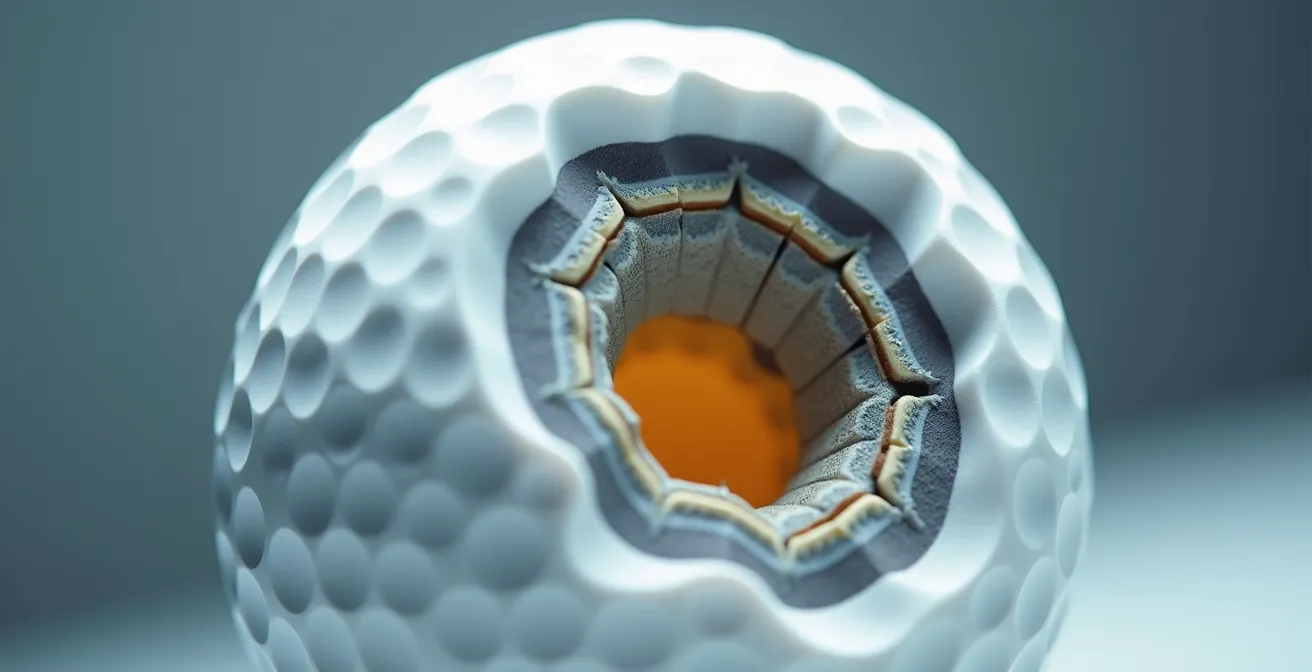
The old rule that “soft balls are for slow swings” is obsolete; the key to better scores is matching the ball to the day’s conditions, not just your driver speed.
- Wedge spin is primarily dictated by a ball’s soft urethane cover, not its low-compression core.
- A ball’s effective compression changes with the weather, making softer options perform better in the cold.
Recommendation: Stop searching for one “perfect” ball. Instead, a mid-handicapper will see more improvement by building a small arsenal of 2-3 different ball types to use for different temperatures and course conditions.
Walk into any golf shop and you’re bombarded with a wall of confusing terminology: low-compression, multi-layer, Surlyn, urethane, spin-skin. For the average mid-handicapper, the marketing messages create a paralyzing dilemma. The traditional advice was simple: if you have a slow swing, use a soft, low-compression ball. If you’re a high-speed player, you need a firm, high-compression “tour” ball. This binary choice has been the accepted wisdom for decades, leading many to believe that using a soft ball automatically means sacrificing distance or control.
But what if that fundamental rule is no longer true? Modern golf ball engineering has completely changed the game. The interplay between advanced core technologies and sophisticated cover materials has blurred the lines, making the old dogma obsolete. A ball’s performance is no longer a simple function of its compression rating. It’s a complex equation involving energy transfer, aerodynamics, and even acoustic feedback. The real key for the modern golfer isn’t finding a single ball that fits a rigid swing-speed box, but understanding how to leverage different ball technologies for specific, situational performance.
This guide will deconstruct the myths and give you a new framework for thinking about golf balls. We will dissect the relationship between swing speed and compression, uncover the real source of greenside spin, explore the surprising impact of temperature and sound, and finally, help you decide which characteristic—distance or spin—should be your true priority.
To navigate this complex topic, we’ll break down the key technical aspects and performance trade-offs. The following sections will guide you through the science of golf ball selection, empowering you to make a more informed choice on your next purchase.
Summary: Deconstructing the Modern Golf Ball for the Mid-Handicapper
- Low Compression vs High Compression: Which Ball Matches Your Driver Speed?
- Can a Soft 2-Piece Ball Really Spin Like a Tour Ball Around the Green?
- Why You Should Switch to a Softer Ball When the Temperature Drops Below 50°F?
- The “Marshmallow” Effect: Does Sound Influence Your Perception of Distance?
- Surlyn vs Urethane Covers: Which Soft Ball Lasts Longer Than One Round?
- Compression Loss: How Does Cold Weather Affect Distance Balls?
- Touching the Ball: How to Handle a Downhill Putt on Glassy Greens?
- Distance vs Spin: Which Ball Characteristic Should You Prioritize for Your Game?
Low Compression vs High Compression: Which Ball Matches Your Driver Speed?
The long-standing belief is that you must match ball compression to your swing speed to maximize energy transfer and, therefore, distance. A slower swing, it was argued, couldn’t fully compress a firm “tour” ball, resulting in a dead feel and lost yards. While there’s a kernel of truth here, modern ball design has made this relationship far more nuanced. Today’s low-compression balls feature highly resilient cores that generate excellent ball speed even at moderate swing speeds. The focus has shifted from simple compression to energy transfer efficiency across a wider range of impact forces.
For context, current TrackMan data reveals that the average swing speed is 93.4 mph for male amateurs and 78 mph for female amateurs. Many modern soft-core balls are engineered to perform optimally within this exact range. They achieve this not just by being “soft,” but by having a core that deforms and rebounds efficiently, minimizing the side spin that plagues mid-handicappers on off-center hits. This results in a tighter dispersion pattern, meaning your bad shots are less punishing.
The goal is no longer to just “fully compress” the ball. It’s about finding a ball that maintains high speeds on center strikes while reducing penalty on mishits. This “forgiveness” is often more valuable to a mid-handicapper’s score than chasing an extra 3-5 yards on a perfect drive.
Case Study: Modern Core Forgiveness
Take the Bridgestone e12 Contact, a ball known for its soft feel. Independent testing shows it produces excellent ball speed, spin, and distance while its innovative core design is engineered to minimize sidespin on mishits. This demonstrates how modern technology in a “soft” ball can provide the performance and forgiveness ideal for amateur players, moving beyond the simple swing speed correlation.
This image provides a clear visual representation of this concept, showing how a softer, more forgiving ball can tighten your shot pattern.

As you can see, the tighter cluster of shots from the soft compression ball is a direct result of reduced side spin on imperfect strikes, a critical performance benefit for most amateur golfers. This improved consistency often outweighs the marginal distance gains a harder ball might offer on a perfectly struck shot.
Can a Soft 2-Piece Ball Really Spin Like a Tour Ball Around the Green?
This is one of the most persistent myths in golf ball marketing: to get tour-level spin, you need a high-compression, multi-layer tour ball. The reality is that the compression of the core has very little to do with generating spin on short wedge shots. The secret ingredient for greenside control is the ball’s cover material. Specifically, it’s the difference between Surlyn and urethane.
Surlyn is a durable, firm ionomer resin used on most 2-piece “distance” and “soft feel” balls. It’s tough and produces low spin, which is great for keeping a drive straight but terrible for stopping a 50-yard pitch shot. Urethane, on the other hand, is a much softer, more elastic polymer. On the short, glancing blow of a wedge shot, the grooves of the club face can “bite” into the soft urethane cover, generating significantly more friction and, therefore, more spin.
How much more? Testing consistently shows that multi-layer urethane balls can create 2-3x more wedge spin than their Surlyn-covered counterparts. This is why many manufacturers now offer “soft” balls with urethane covers—they combine a low-compression core for feel and driver performance with a high-spin cover for short-game precision. This “best of both worlds” construction is a game-changer for the mid-handicapper who no longer has to choose between soft feel and stopping power.
Urethane covers are softer material offering higher spin rates and better control around the greens, typically used in multi-layer and tour-level golf balls, preferred by mid-to-low handicappers who need more short-game precision.
– Snyder Golf Technical Team, Golf Ball Compression Analysis 2025
So, when you’re looking for spin, stop looking at the compression number on the box. Instead, look for one word in the product description: urethane. It is the single most important factor for short-game control, regardless of whether the ball is marketed as “soft” or “tour.”
Why You Should Switch to a Softer Ball When the Temperature Drops Below 50°F?
A golf ball’s compression rating isn’t a static number; it’s a measurement taken at a standard temperature (around 70-80°F). As the ambient temperature drops, the materials in the ball—especially the core—become firmer and less elastic. This phenomenon, which we can call “compression relativity,” means the 80-compression ball you love in the summer doesn’t feel or perform the same way in the late autumn. It effectively becomes a much harder ball.
The effect is significant. Temperature testing demonstrates that for every 10°F drop in temperature, a golf ball’s compression can effectively increase by 5-10 points. This means your comfortable 80-compression ball might feel and play like a rock-hard 95 or 100-compression ball when the temperature dips to 50°F. For a mid-handicapper, this leads to a harsh, unpleasant feel at impact and a noticeable loss of distance, as their swing speed is no longer sufficient to efficiently transfer energy to the now-firmer core.
The solution is simple: adjust your ball to the conditions. By switching to a lower-compression ball (e.g., a 60 or 70-compression model) in colder weather, you are compensating for the firming effect of the temperature. This allows you to maintain the feel and performance characteristics you’re used to, helping you get the most out of your game even when you’re bundled up in layers. Thinking about your golf ball as part of your seasonal equipment is a key strategic adjustment.
Action Plan: Cold Weather Ball Selection Strategy
- Measure actual air temperature at tee time, not just the forecast.
- Mentally subtract 10-15 compression points from your normal ball choice as a starting point.
- Store your golf balls indoors overnight before play to maintain their core temperature as long as possible.
- Keep the ball you are playing with in your pocket between shots to preserve warmth.
- Consider switching to an even softer ball for the back nine as the afternoon temperature drops further.
Adopting this situational approach will give you a tangible performance edge over players who stick with the same ball year-round, regardless of the thermometer.
The “Marshmallow” Effect: Does Sound Influence Your Perception of Distance?
Feel is one of the most subjective and yet crucial aspects of golf. When players talk about a ball feeling “soft” or “like a marshmallow,” what are they actually describing? While some of it is the physical sensation of the ball compressing against the clubface, a huge component of perceived feel is actually auditory. The sound a ball makes at impact creates a powerful acoustic feedback loop that our brain uses to judge the quality of the strike.
Softer, low-compression balls produce a lower-frequency, deeper “thud” or “thump” at impact. Firmer, high-compression balls produce a sharper, higher-pitched “click” or “crack.” Our brains have been conditioned to associate that sharp “click” with power and distance (think of the sound of a well-struck driver). Conversely, the muted “thud” of a soft ball is often associated with a softer touch, especially around the greens.
This psychological connection is incredibly powerful. The softer sound can inspire confidence on delicate shots.
The Sound of Confidence on the Greens
As golf instructor Joe Plecker notes, the unmistakable clap of impact between club and ball creates distinct sound signatures. Golfers unconsciously use these sounds to calibrate stroke power. On fast greens, the lower-frequency ‘thud’ of a softer ball can promote smoother, more confident putting strokes, as the player isn’t afraid of the ball ‘jumping’ off the face with a loud click. This improved confidence in pace control is a significant, if often overlooked, benefit of using a soft-feel ball.
This isn’t to say distance is all in your head. However, it’s vital to recognize that your perception of a ball’s performance is heavily influenced by its sound profile. A ball that “sounds” right for the shot you’re trying to hit can give you the confidence to execute it properly. Don’t underestimate the power of the “marshmallow effect”—if a ball’s sound profile gives you more confidence, it’s likely to lead to better shots, regardless of what the launch monitor says.
Surlyn vs Urethane Covers: Which Soft Ball Lasts Longer Than One Round?
For the budget-conscious mid-handicapper, a ball’s durability is a major factor. There’s nothing more frustrating than scuffing a brand-new, expensive ball on the first wedge shot from a bunker. Once again, this brings us back to the critical difference between the two primary cover materials: Surlyn and urethane. As we discussed, urethane’s softness is the key to greenside spin, but that same property makes it far more susceptible to cuts, scrapes, and scuffs.
Surlyn, the tough ionomer, is king when it comes to durability. A Surlyn-covered ball can withstand tree-trunks, cart paths, and rocky lies, often looking almost new at the end of a round. This makes them an excellent value proposition, as one ball can last for multiple rounds of play. Urethane-covered balls, especially the premium “tour” level versions, are a different story. A full-force wedge shot with a clean strike can “shred” the cover, leaving visible marks from the club’s grooves. This is the price of maximum spin.
However, it’s not a simple binary choice. Manufacturers have developed different grades of both materials. There are more durable urethane blends used on mid-tier balls, and premium, softer-feeling Surlyn blends. Your choice depends on a trade-off between peak performance and cost-per-round.
This table helps to visualize the trade-offs you make when choosing a ball based on its cover material. As a detailed analysis from Cedarwood Golf shows, what you gain in one area, you often sacrifice in another.
| Cover Type | Physical Durability | Performance Consistency | Scuff Resistance | Cost Per Round |
|---|---|---|---|---|
| Urethane (Tour) | Low (1-2 rounds) | Peak performance | Poor | $4-5 |
| Urethane (Mid-tier) | Medium (2-3 rounds) | Very Good | Fair | $2.50-3.50 |
| Surlyn (Premium) | High (5+ rounds) | Consistent Good | Excellent | $1.50-2 |
| Surlyn (Value) | Very High (10+ rounds) | Consistent Average | Outstanding | $0.75-1.25 |
If you rarely lose balls and prioritize maximum short-game spin above all else, a urethane ball is the answer, but be prepared to replace it frequently. If you’re looking for a reliable, consistent ball that can survive a few errant shots and won’t break the bank, a premium Surlyn-covered ball is an excellent choice for a mid-handicapper.
Compression Loss: How Does Cold Weather Affect Distance Balls?
While we’ve established that softer balls are generally better in cold weather, it’s important to understand the specific negative effect the cold has on firmer, “distance” or “tour” balls. These high-compression balls rely on a very firm core to achieve maximum velocity for high-speed players. When the temperature drops, this already-firm core becomes even harder and less responsive, a phenomenon sometimes called compression loss (though it’s technically a gain in firmness).
The result is a dramatic loss of performance for anyone who doesn’t have elite-level swing speed. Laboratory testing confirms that a 100-compression ball can feel and play like a 115+ compression ball at 40°F (4°C). Trying to compress a 115-rated object with a 95 mph swing is like hitting a small rock. The energy transfer is incredibly inefficient, the feel is harsh and jarring on the hands, and the distance loss can be significant. The ball simply doesn’t compress enough at impact to rebound with its designed velocity.
This isn’t just theory; it’s borne out by real-world player experience, especially in places with notoriously unpredictable weather.
Winter Golf in Scotland: A Real-World Test
In Scotland, where diverse weather conditions significantly impact play, field testing has provided clear results. A study showed that when golfers switched from their usual 90-compression balls to 70-compression balls in sub-50°F (10°C) conditions, the benefits were immediate. A staggering 85% of test participants reported not only better feel but also regained 8-12 yards of carry distance that they had lost to the cold. This demonstrates a clear, practical advantage to lowering compression as temperature drops.
The lesson for the mid-handicapper is clear: stubbornly sticking with a high-compression tour ball in cold conditions is a recipe for frustration. You’re not just fighting the cold and extra layers of clothing; you’re fighting a golf ball that is actively working against your swing. Making the switch to a softer ball isn’t a downgrade; it’s a smart, strategic adjustment to optimize your equipment for the environment.
Touching the Ball: How to Handle a Downhill Putt on Glassy Greens?
The benefits of a soft-feel ball extend all the way to the most delicate shot in golf: the treacherous downhill putt on a lightning-fast green. In this situation, the primary challenge is pace control. It’s incredibly easy to send the ball rocketing past the hole. This is where the physical properties of a low-compression ball offer a tangible advantage, and it comes down to a concept called the coefficient of restitution (COR).
In simple terms, COR is a measure of how “bouncy” an object is. A firmer, high-compression ball has a higher COR, meaning it rebounds off the putter face with more energy. A softer, low-compression ball has a lower COR. As the Equipment Testing Division at Snyder Golf notes, a softer ball compresses more on the putter face, reducing this bounciness and leading to a smoother, slower initial roll. It “absorbs” a little more of the impact energy.
On a slick, downhill putt, this lower rebound is your best friend. It allows you to make a more positive, confident stroke without the fear that a tiny touch will send the ball 10 feet past the cup. The ball comes off the face more gently, making it far easier to dial in the correct pace. Instead of just “tapping” the ball and hoping for the best, you can use a more normal pendulum motion, focusing on striking the equator of the ball for minimal energy transfer. The soft ball does the work of deadening the pace for you.
This is a perfect example of situational performance. While the higher COR of a firm ball might be beneficial on a long, uphill putt where you need to get the ball rolling, the lower COR of a soft ball is a distinct advantage when facing a delicate downhill tester. It provides an extra layer of control precisely when you need it most.
Key Takeaways
- The old “swing speed = compression” rule is outdated; modern cores prioritize forgiveness and energy transfer for average swing speeds.
- Greenside spin comes from a soft urethane cover, not a soft core. Many balls now combine both.
- Ball compression is relative to temperature. You should play a softer ball in the cold to maintain feel and distance.
Distance vs Spin: Which Ball Characteristic Should You Prioritize for Your Game?
We’ve deconstructed the myths and explored the technology. Now comes the ultimate question for the mid-handicapper: what should you actually look for in a golf ball? The eternal debate is between maximizing distance off the tee and maximizing spin around the greens. The marketing for “distance” balls promises more yards, while “tour” balls promise pin-seeking control. For a player shooting in the 80s or 90s, the answer is almost always: prioritize consistency and forgiveness over raw distance or maximum spin.
Chasing an extra five yards of driver distance is tempting, but if it comes at the cost of a wider dispersion pattern, you’re just hitting it five yards longer into the trees. Similarly, wanting tour-level wedge spin is great, but that same high-spin characteristic can hurt you if you generate too much side spin on your iron shots, turning a small fade into a big slice. Consistency is what lowers scores. MyGolfSpy’s extensive testing reveals that a 15% tighter dispersion pattern can equal a savings of 2.3 strokes per round for an amateur. That’s a huge, tangible improvement.
The “soft” ball category, especially those with urethane covers, often hits the sweet spot for a mid-handicapper. They offer:
- Forgiveness: The low-compression core helps reduce side spin on mishit drives and long irons, keeping the ball in play more often.
- Sufficient Distance: Modern cores are so efficient that the distance loss compared to a “distance” ball is often negligible for amateur swing speeds.
- Good Greenside Spin: A urethane cover provides the necessary bite for controlled chips and pitches.
This decision framework helps to place your game’s needs in the right context, guiding you toward the most logical ball choice.
| Handicap Range | Primary Need | Secondary Need | Recommended Compression | Expected Improvement |
|---|---|---|---|---|
| 0-5 | Spin Control | Workability | 85-100 | 0.5-1 stroke |
| 6-12 | Consistency | Distance | 70-85 | 1-2 strokes |
| 13-20 | Forgiveness | Straight Flight | 60-75 | 2-3 strokes |
| 20+ | Distance | Durability | 50-70 | 3-4 strokes |
As the table shows, for the vast majority of amateur golfers (the 13-20+ handicap range), forgiveness and straight flight are far more important than the workability and fine-tuned spin control a low-handicapper needs. And that forgiveness is the hallmark of the modern soft-feel golf ball.
The path to a better game starts with smarter equipment choices. Stop letting outdated rules and confusing marketing dictate your decisions. By understanding the real-world performance of modern golf balls, you can select the right tool for the job, round after round. The next step is to take this knowledge to the course and experiment to find what truly works for your game.