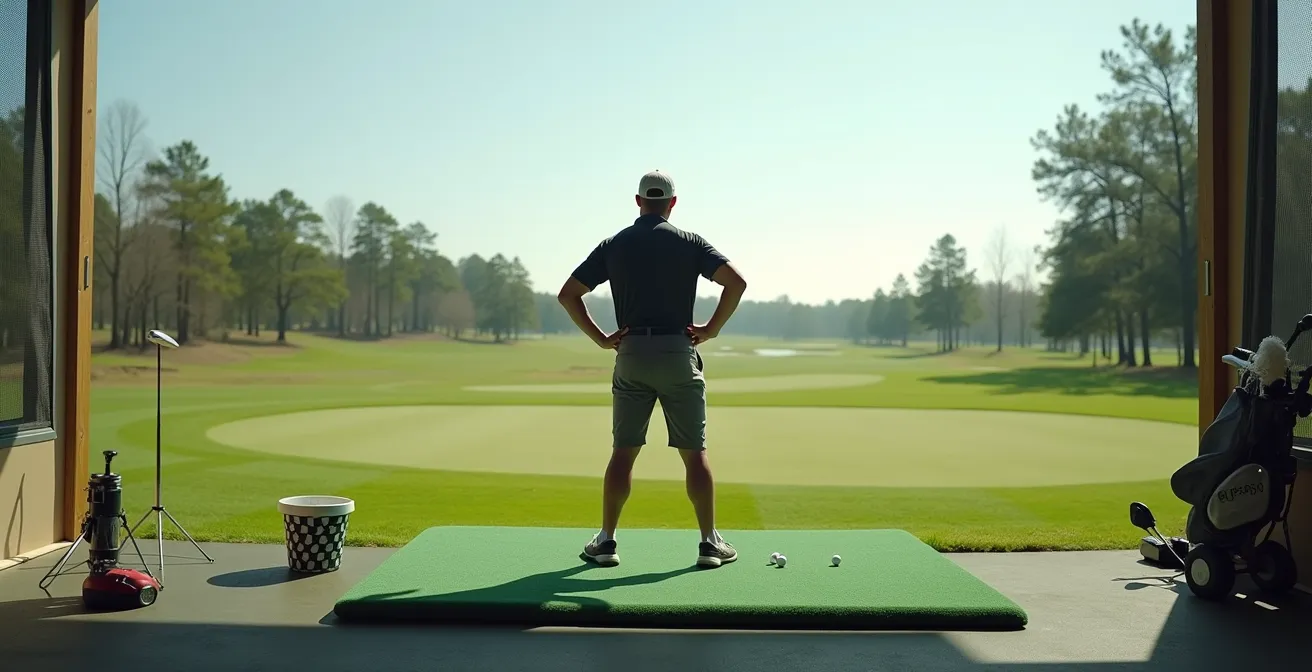
The brutal truth is your range practice is making you a great range player, not a better golfer.
- Hitting off synthetic mats creates false confidence by masking fat shots and altering spin.
- Mindless, repetitive “block” practice fails to simulate the pressure and variability of the actual game.
Recommendation: Stop “practicing” and start “rehearsing.” Ditch block practice for random, consequence-driven drills that directly mimic on-course challenges.
We’ve all been there. On the driving range, you’re a world-beater. The ball explodes off the clubface, soaring on a perfect trajectory toward a distant flag. Every strike feels pure. You’ve grooved the perfect motion. This is it. This is the day it all clicks. Then you step onto the first tee, a real scorecard in your pocket, and that fluid, powerful swing vanishes. The result is a weak slice, a chunked iron, or a topped wood. The frustration is immense. You know the “good” swing is in there, so why can’t you access it when it counts?
The common advice is a litany of quick fixes: check your grip, watch a few more YouTube videos, or maybe just hit another large bucket of balls. But what if the problem isn’t your swing, but your entire practice philosophy? What if the very environment and methodology you’re using to “improve” are the exact things holding you back? The comfortable, sterile world of the driving range is actively teaching you skills that don’t transfer to the chaotic, high-pressure reality of the golf course.
This is not another article about swing tips. This is a wake-up call. We are going to dismantle the flawed logic of traditional range sessions. The issue isn’t a lack of talent; it’s a failure in performance transfer. You’re not training to be a golfer; you’re training to be an expert at hitting balls off a perfect lie with zero consequences. It’s time to stop being a “Range Pro” and start practicing like a “Course Player.”
Throughout this guide, we will deconstruct the cognitive and environmental traps of the modern driving range. We will explore why your mat-based practice is lying to you, why aiminglessly bashing balls is a waste of time, and how to inject real, course-like pressure into every swing you take. Get ready to transform your practice from a mindless workout into a deliberate rehearsal for lower scores.
Summary: Why Your Range Swing Doesn’t Show Up on the Course
- Why Hitting off Mats Hides Your Fat Shots and Creates False Confidence?
- Aim Small, Miss Small: Why You Must Pick a Specific Target on the Range?
- Range Routine: How to Simulate First-Tee Nerves During Practice?
- Warm-Up or Workout: Are You Tiring Yourself Out Before the Round?
- Using Alignment Sticks: The $5 Tool That Corrects Your Aim Instantly?
- Block Practice vs Random Practice: Which One Prepares You for pressure?
- Why Self-Diagnosing Your Swing on YouTube Often Makes You Worse?
- Why Bashing Balls Without Structured Drills Is a Waste of Time and Money?
Why Hitting off Mats Hides Your Fat Shots and Creates False Confidence?
Let’s start with the most fundamental lie of the driving range: the mat. That forgiving patch of synthetic turf is your worst enemy in the quest for real improvement. When you hit a shot slightly “fat” (hitting the ground before the ball) on a grass fairway, the club digs in, loses energy, and the result is a disastrously short shot. The feedback is immediate and painful. On a mat, the club doesn’t dig; it bounces off the hard surface and into the back of the ball. This “bounce” saves the shot, sending it surprisingly straight and with decent distance. You walk away thinking you flushed it, but you just got away with a major swing flaw.
This environmental mismatch creates a dangerous level of false confidence. You’re not learning to hit the ball cleanly; you’re learning to hit it fat without penalty. The data confirms this disconnect. Hitting off mats can significantly alter spin characteristics, with one analysis showing up to a 1,000 rpm difference in spin rates between mat and grass strikes. This means the ball flight you see on the range has little correlation to how the ball will actually behave on the soft greens of a course.
The solution is to force yourself to create clean contact. One of the most effective drills is to place a small towel about two inches behind your golf ball. If you hit the towel, your swing was fat. The goal is to miss the towel completely, striking only the ball. This drill provides the instant, honest feedback that the mat is designed to hide. As research at Pinehurst Resort found, golfers who engage in this type of “transfer practice” see far better on-course results than those mindlessly hitting off mats. Stop letting the mat lie to you and start demanding a pure strike.
Aim Small, Miss Small: Why You Must Pick a Specific Target on the Range?
Walk down any driving range and observe the average golfer. They are typically hitting balls into a vast, undefined expanse. Their “target” is the entire 250-yard-wide field. This is the equivalent of a professional archer aiming at “the barn” instead of the bullseye. On the golf course, you are never aiming at a 250-yard-wide fairway. You are aiming at a specific portion of it, a specific side of the green, or a precise landing spot. Practicing without a specific target is training for a game that doesn’t exist.
The mantra “aim small, miss small” is a cornerstone of performance psychology. By choosing a highly specific target—not just the 150-yard marker, but the right side of it; not just the green, but a particular quadrant—you sharpen your focus and train your brain to execute with precision. When your target is small and your focus is narrow, your misses become tighter and more controlled. A miss that’s 10 yards left of a specific tree is far more manageable than a miss that’s “somewhere left” of the entire range.
Your practice must mirror this on-course reality. Don’t just hit balls; play a game. Pick a target and define a “shot corridor” or a “success window” around it. For an iron shot, this might be a 20-yard-wide channel. For a driver, perhaps 40 yards. The goal is to land a certain number of balls within this window. This simple act transforms a mindless session into a focused, goal-oriented drill. It forces you to engage your alignment, your pre-shot routine, and your mental game on every single ball, just as you would on the course.
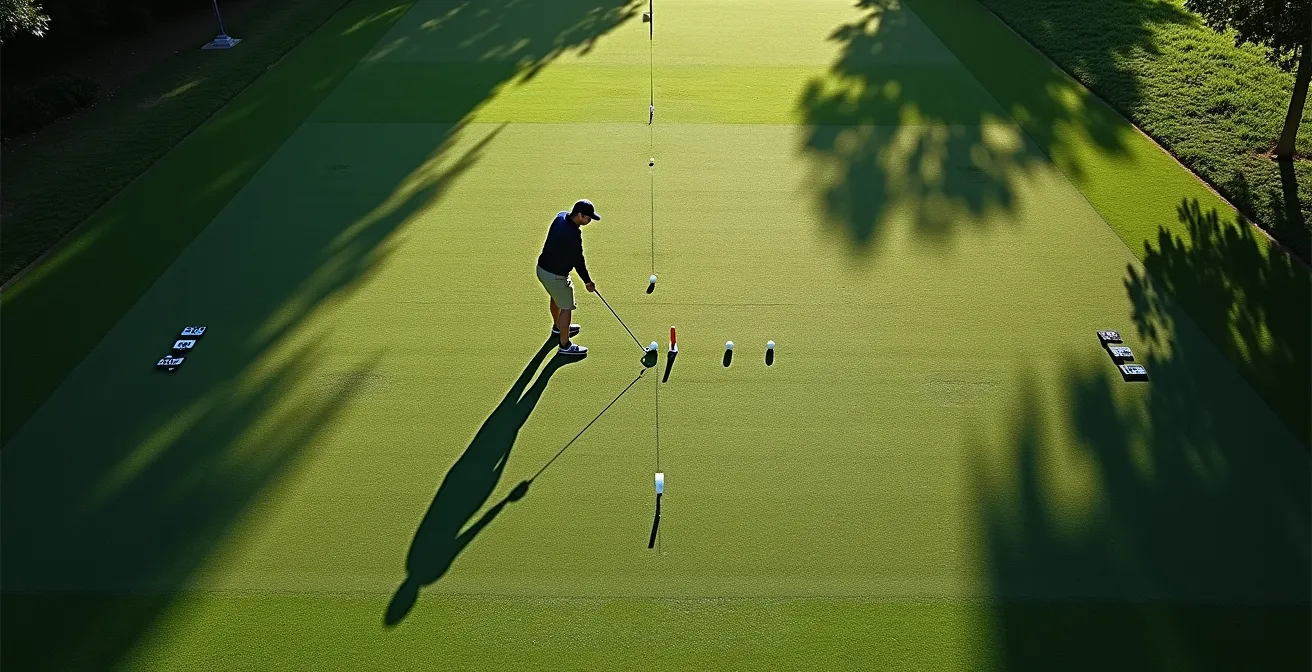
As the visual above demonstrates, the act of aligning to a precise point completely changes the intention behind the shot. You’re no longer just swinging; you are executing a plan. To make this effective, start a practice session by picking targets at various distances and locations across the range. Chart your dispersion pattern over 10 shots to a single target. This data will reveal your natural shot shape and typical miss, providing invaluable strategic information for your next round.
Range Routine: How to Simulate First-Tee Nerves During Practice?
What’s the biggest difference between the range and the course? Consequences. On the range, a bad shot costs you nothing. You simply rake another ball over and try again. On the course, a bad shot costs you strokes, pride, and maybe even a friendly wager. This pressure is what causes the disconnect between your fluid range swing and your tense on-course swing. To bridge this gap, you must find ways to inject consequences and simulate pressure during your practice.
Stop hitting 20 balls in a row with your 7-iron. When does that ever happen on the course? Instead, treat each shot on the range as a unique event. This means going through your entire pre-shot routine for every single ball. Step away from the ball, visualize the shot, take your practice swings, address the ball, and then execute. After the shot, practice your post-shot routine. Analyze the result without emotion, and then move on. This deliberate process slows you down and forces you to treat every ball with the respect you’d give a crucial 5-foot putt.
To truly simulate nerves, create games with consequences. A simple one: dedicate your last 10 balls to playing the first two holes of your home course. One ball for the tee shot, one for the approach, and so on. If you “miss” the fairway (a pre-defined corridor), you have to manufacture a recovery shot. A more extreme version: set a target, and if you miss it, you have to pack up your bag and go home. Immediately. The simple thought of a practice session ending prematurely can add a surprising amount of focus and pressure. As experts in the field note, this approach has a direct impact on your game.
Practicing like you play has high transfer back to the practice area and play on the golf course
– Eric Alpenfels & Dr. Bob Christina, Evidence-Based Golf study
By making practice feel more like play, with real decisions and outcomes, you train your nervous system to handle pressure. You’re not just practicing your swing; you’re practicing your composure.
Warm-Up or Workout: Are You Tiring Yourself Out Before the Round?
The pre-round visit to the driving range is one of the most misunderstood rituals in golf. Many amateurs treat it as a last-minute cram session—a frantic workout to find “the secret” just moments before heading to the first tee. They bash through a large bucket of balls, trying to fix a slice or groove a new feeling, and end up arriving on the first tee physically tired and mentally cluttered. You must understand the crucial distinction: a pre-round session is a warm-up, not a practice session.
The goal of a warm-up is not to build or change your swing. It’s too late for that. The sole purpose is to get your body loose, activate your golf muscles, and diagnose your swing for that specific day. Is your ball flight tending to draw or fade today? Your warm-up tells you what swing you’ve brought to the course, allowing you to strategize accordingly. It is a diagnostic tool, not a construction site.
An effective pre-round warm-up is short and structured. Professional golfers rarely hit more than 30 balls. They start with short wedges to get a feel for contact, progressively move up through the bag, and finish with only a handful of driver swings. The intensity is low, around 60-70% effort. The focus is on tempo, rhythm, and finding the center of the clubface. This is in stark contrast to a practice session, which is longer, involves more balls, and is designed for technical improvement and skill acquisition. Conflating the two is a recipe for disaster.
The following table clarifies the difference between these two critical activities. Treating a warm-up like a workout is a guaranteed way to leave your best shots on the range.
| Aspect | Warm-Up (Pre-Round) | Practice Session |
|---|---|---|
| Duration | 20 minutes | 60+ minutes |
| Ball count | 30 balls maximum | 50-100 balls |
| Goal | Diagnose today’s swing | Improve technique |
| Progression | Wedges to driver | Mixed/random practice |
| Intensity | 60-70% effort | Variable intensity |
Using Alignment Sticks: The $5 Tool That Corrects Your Aim Instantly?
One of the most common faults among amateur golfers is poor alignment. You might have a perfectly good swing, but if you’re not aimed at the target, it’s all for naught. The problem is that it’s incredibly difficult to self-diagnose misalignment. From your perspective at address, the target can look different than it actually is. This is where alignment sticks—arguably the most effective and cheapest training aid in golf—become indispensable.
Their most basic use is to provide an undeniable visual reference for your aim. Place one stick on the ground pointing directly at your target. Then, place a second stick parallel to the first, just outside your golf ball, to represent the line your feet, hips, and shoulders should be on. This simple setup instantly reveals if your body is aimed left, right, or square to your target line. Hitting balls with this feedback forces you to calibrate your “feel” with reality, training your eyes to see what correct alignment actually looks like.
But their utility extends far beyond basic alignment. Alignment sticks are a versatile tool for building a complete practice station. You can create “gates” to ensure your club is on the correct path, stick one in the ground at an angle to monitor your swing plane, or place one outside your trail hip to prevent swaying. They provide instant, physical feedback that is impossible to ignore. They don’t offer opinions or complex theories; they provide simple, geometric truth.

Don’t underestimate the power of this simple tool. Integrating alignment sticks into every practice session is non-negotiable if you are serious about improvement. They remove the guesswork from one of the most critical fundamentals of golf. For a minimal investment, you get an impartial coach that forces you to be honest about your setup and swing path. It’s the first step in moving from “hoping” the ball goes straight to building a repeatable, reliable process.
Block Practice vs Random Practice: Which One Prepares You for pressure?
Here lies the single biggest mistake in how golfers practice. Most golfers engage in “block practice”: hitting the same club to the same target over and over again. It feels productive because you quickly “groove” the swing, and by the 20th ball, you’re hitting it perfectly. The problem? This develops a temporary skill that has very poor retention and almost zero transfer to the course. The golf course is the opposite of block practice; it’s the ultimate test of “random practice,” where every shot presents a different club, a different lie, and a different target.
Random practice, also known as variable or interleaved practice, involves changing the target, club, or shot type on every swing. Hit a driver, then a wedge, then a 7-iron, then a chip shot. This method feels messy and less productive in the short term. You won’t hit as many “perfect” shots, and it can be frustrating. However, this struggle is precisely where the learning happens. This process, called “contextual interference,” forces your brain to forget and then re-learn the motor pattern for each shot. It’s this process of retrieval and re-creation that builds a stable, long-term skill that can be recalled under pressure.
The science is irrefutable. Extensive research on motor learning demonstrates that random practice leads to dramatically better retention and performance transfer. In some studies, the improvement in retention is as high as 40% compared to block practice. While your performance during a random practice session might be worse, your performance on the course—where it actually matters—will be significantly better. You need to abandon the seductive feeling of grooving one club and embrace the chaotic, messy, and ultimately superior method of random practice.
A great way to implement this is to play a virtual round on the range. Take a scorecard from your favorite course and play each hole. Hit a driver for a par 4, then guess the yardage for your next shot and hit the appropriate iron, and so on. This not only forces you to switch clubs but also engages the strategic part of your brain, making your practice a true rehearsal for the game.
Why Self-Diagnosing Your Swing on YouTube Often Makes You Worse?
In the digital age, we have an endless library of golf instruction at our fingertips. With a few clicks on YouTube, you can find a drill for any and every conceivable swing fault. While this seems like a blessing, for most amateurs, it’s a curse. The problem is not the quality of the instruction; it’s the accuracy of the diagnosis. The internet provides a million solutions, but if you don’t correctly identify your problem, you’ll inevitably apply the right fix to the wrong flaw, often making things much worse.
A classic example is the “early extension” fault, where a golfer’s hips thrust toward the ball in the downswing. A player might see a video on this, feel it describes their poor shots, and spend weeks trying to fix it. However, the root cause might not be poor hip movement at all; it could be an “over-the-top” swing path that forces the hips to move in that way to make room for the club. By “fixing” the early extension, they are only treating a symptom, not the disease. The underlying over-the-top move remains, and now they’ve added another compensatory, unnatural move to their swing.
This is the fundamental danger of self-diagnosis. As a player, you can only identify the *outcome* (e.g., “I slice the ball”). You often lack the trained eye to identify the *root cause* within a complex, high-speed motion.
Golfers often lack the expertise to correctly identify the root cause of their problem, leading them to apply the right solution to the wrong problem
– Analysis of amateur golf instruction, Golf instruction methodology review
This doesn’t mean online instruction is useless. It’s an incredibly powerful tool when used correctly. The effective approach is to get a proper diagnosis from a qualified professional first. An instructor can use video analysis to pinpoint the actual root cause of your issue. Once you have that correct diagnosis, you can then use YouTube and other online resources to find specific drills that address that one, specific problem. A study on this very topic found that golfers who get professional diagnosis first improve 3x faster than those who self-diagnose. Stop being your own doctor; get a real diagnosis, then use the internet for the prescription.
Key Takeaways
- Your practice environment is likely lying to you; mats hide flaws and create false confidence.
- Random, variable practice is scientifically proven to be superior to repetitive block practice for on-course performance.
- Injecting pressure and consequences into practice sessions is essential for training your nervous system to perform when it counts.
Why Bashing Balls Without Structured Drills Is a Waste of Time and Money?
If you take away only one thing, let it be this: practice without purpose is not practice; it’s just exercise. Hitting a large bucket of balls with no plan, no structure, and no measurement is one of the least effective ways to improve at golf. You may feel like you’re working hard, but you’re not getting better. You’re just getting tired. To truly improve, you must shift from a “performer” mindset to a “learner” mindset.
A performer goes to the range to hit good shots and feel good. They get frustrated by bad shots and try to forget them. A learner goes to the range to gather information. Every shot, good or bad, is a data point. They analyze their misses to understand their patterns. They embrace struggle as a sign of growth. This shift in mindset is the difference between stagnating and achieving real, lasting improvement.
Structured practice begins with data. Start by tracking simple statistics from your rounds: fairways hit, greens in regulation, and putts per round. This data will tell you, without emotion, where the weakest part of your game is. Is it your driving? Your iron play? Your short game? Your practice sessions should then be designed with the primary goal of improving that specific weakness. This is the essence of deliberate practice. It’s not always fun, but it is always purposeful.
Your Action Plan: Implementing a Structured Practice System
- Collect Data: Track your key stats (fairways, GIR, putts) for at least three rounds to establish a baseline.
- Identify the Weakness: Analyze your stats to objectively pinpoint the single biggest area for improvement.
- Design the Session: Dedicate 60% of your next practice session to drills that specifically target that one weakness.
- Test, Don’t Just Hit: Treat each shot as a mini-experiment. Have a hypothesis (e.g., “If I feel my trail shoulder stays back, the ball will start on line”), and observe the result.
- Measure and Re-evaluate: After a few weeks of targeted practice, review your on-course stats again. Has the needle moved? If so, identify the next weakest link. If not, re-evaluate your drills.
The table below summarizes the critical difference in approach. Which column describes your current practice habits? Being a learner is a choice. It requires discipline and a willingness to trade the short-term satisfaction of a few flushed shots for the long-term reward of a lower handicap.
| Aspect | Learner Mindset | Performer Mindset |
|---|---|---|
| Focus | Process and understanding | Outcomes only |
| Practice approach | Structured with purpose | Random ball hitting |
| Feedback use | Analyzes every shot | Ignores poor shots |
| Improvement rate | Consistent progress | Plateau quickly |
| Investment value | High ROI | Low ROI |
Stop wasting your time, money, and energy on practice methods that are proven to fail. Commit today to transforming your approach. Embrace the discomfort of random practice, introduce consequences, and structure every session with a clear, data-driven purpose. This is the only path to making your range swing your on-course reality.